Showing posts with label Jun Negami. Show all posts

Friday, 30 January 2026

Their Legacy / 家庭の事情 / Katei no jijo (‘Family Circumstances’, 1962)

Obscure Japanese Film #243

So Yamamura

Junko Kano and Ayako Wakao

Utako Shibusawa and Mako Sanjo


Upon retiring, widower Misawa (So Yamamura) decides to give each of his four unmarried daughters 500,000 yen to do with as they wish. The eldest, Kazuyo (Ayako Wakao), is regretting having an affair with a married colleague (Jun Negami) and decides to quit and open a café. Second daughter Fumiko (Junko Kano) gives hers to her boyfriend (Jiro Tamiya) so that he can pay off his debts. Third daughter Miyako (Mako Sanjo) only reluctantly accepts the money and just wants to stay at home with her father. The youngest, Shinako (Utako Shibusawa), works in an accounts department and decides to become a moneylender while fighting off the attentions of a persistent co-worker (Hiroshi Kawaguchi). Meanwhile, Misawa has a relationship with gold-digger Tamako (Murasaki Fujima), although a matchmaker (Haruko Sugimura) is trying to interest him in getting married again to Yasuko (Mayumi Kurata)*…


This Daiei production was based on a magazine serial by Keita Genji (1912-85), whose works were also the source for the previously-reviewed Daiei movies The Most Valuable Wife (1959) and Kirai Kirai Kirai (1960), both of which offered similar fare. Like those, this is a light comedy, a genre not typically associated with director Kozaburo Yoshimura or his screenwriter Kaneto Shindo (although it was by no means the only occasion on which either filmmaker dabbled in comedy). Presumably, then, this was a studio assignment, but it’s well-made and entertaining, and I wasn’t left feeling they had just phoned it in.


Although Ayako Wakao – curiously, the only one who seems to be playing it totally straight – is top-billed, in this case she’s really just part of an impressive ensemble cast which also features Eiji Funakoshi, Keizo Kawasaki and Eitaro Ozawa, most of whom make the most out of the material. If you enjoy Daiei films of this era and like these actors, Katei no jijo is an enjoyable time-passer, with Sei Ikeno’s score helping to heighten the comic effect, although the black-and-white rush hour prologue and epilogue, while fun, seem a bit random to me as I couldn’t really see how they related to the main story. (I could also have done without the close-up of Eitaro Ozawa eating...)


Jiro Tamiya


Incidentally, in one impressive scene, real-life karate black-belt Jiro Tamiya gets properly thrown by another real-life karate black belt, Jun Fujimaki, who also appears here playing a love rival to Tamiya’s character.

Keita Genji’s story was remade by Katsumi Nishikawa for Nikkatsu in 1965 as Yottsu no koi no monogatari (‘Four Love Stories’).


*Although both IMDb and eiga.com state that Tamako is played by Yasuko Nakada and Yasuko is played by Murasaki Fujima, this is incorrect.


Murasaki Fujima as Tamako

Mayumi Kurata as Yasuko


DVD at Amazon Japan (no English subtitles)

Thanks to Coralsundy for the English subtitles, which can be found here.

If you enjoy this blog, feel free to Buy Me a Coffee!


Wednesday, 17 September 2025

Asakusa kurenai dan / 浅草紅団 / (‘The Scarlet Gang of Asakusa’, 1952)


Machiko Kyo


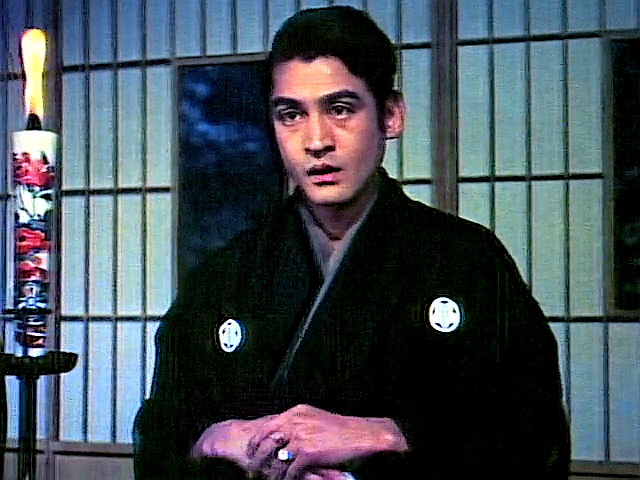
 is a dancer at the Asakusa Follies,  Ryuko (Machiko Kyo) is a kabuki actress and quick-change artist who was adopted by local gang boss Nakane (Joji Oka) when she was a child. Maki is in debt to Nakane, who has designs on her and ordered his men to beat up her boyfriend, Shimakichi (Jun Negami), and scare him away from Asakusa. However, Shimakichi injured one of Nakane’s henchmen and escaped before disappearing for a year. Now he’s back in search of Maki, but Nakane has not forgotten about him and wants revenge, so he tricks Ryuko into luring Shimakichi into a trap…

Jun Negami

Kyo in bumpkin mode

Joji Oka

Nobuko Otowa and dimple

Machiko Kyo


Sunday, 23 March 2025

Golden Demon / 金色夜叉 / Konjiki yasha (1954)

Obscure Japanese Film #175


Jun Negami and Fujiko Yamamoto


1890. Miya (Fujiko Yamamoto) is a young woman in love with her adopted brother, Kan’ichi (Jun Negami). The feeling is mutual and they plan to marry. However, Miya’s parents want her to marry the wealthy Tomiyama (Eiji Funakoshi) and persuade her that it’s in Kan’ichi’s best interests too as then they’ll be able to afford to send him abroad to study, which will greatly improve his prospects.


Eiji Funakoshi


Four years later, Miya is trapped in a miserable marriage to Tomiyama who, knowing that he’s not loved, takes every opportunity to bully and humiliate his wife, while Kan’ichi has taken employment as a debt collector for a much-hated female moneylender, Akagashi (Mitsuko Mito), known as ‘Foxy Shark’. She has only given him a job because she wants to seduce him, and he finds himself in the position of having to demand repayment of loans from his former friends…


Jun Negami and Mitsuko Mito


Based on an unfinished novel by Koyo Ozaki (1868-1903), the plot of this Daiei production must have seemed old hat even in 1954. In fact, there had been numerous silent versions* of the novel as well as previous talkies by Hiroshi Shimizu in 1937 and Masahiro Makino in 1948. The title seems intended to reference the supposed obsession with money which Kan'ichi develops in an attempt to fill his void, but it’s just one aspect of the story that – in this film, anyway – never really convinces and feels like a mere contrivance. Another is his determination to remain so unforgiving towards Miya. What really takes the biscuit though is the fact that these two estranged lovers end up living across the street from each other!


Mitsuko Mito


Otherwise, the film is quite well-made by director Koji Shima and the performances are good, with Mitsuko Mito clearly having the most fun as the lustful loan shark. It won the 1954 Asia Pacific Film Festival award for Best Film and received some distribution abroad, arguably at the expense of other, better films, but this is probably due to the fact that it was one of the earliest Japanese feature films to be made in colour. A lot of trouble was clearly taken to shoot scenes in picturesque settings, such as a field of cherry blossom trees, a moonlit beach and a lonely road at sunset. Unfortunately, the copy I saw looked like a poor VHS transfer and the colours were horrible, but I did have the feeling that it would probably look great in a good quality copy. 


*A 1918 version cast future film director Teinosuke Kinugasa (a male) as Miya, while Kinuyo Tanaka played the role in a 1932 film.


Sunday, 2 March 2025

The Ladder of Success / 夜の素顔 / Yoru no sagao (‘The True Face of the Night’, 1958)

Obscure Japanese Film #170

Machiko Kyo in the moonlight scene


having travelled there in the hope of becoming a disciple to famed dance teacher Shino (Chikako Hosokawa). When her request is denied, she breaks down in tears before leaving, but Shino’s patron, Inokura (Eijiro Yanagi),  who was listening in the room next door, feels sympathetic and urges Shino to change her mind, which she does. The maid is sent to fetch Akemi back and finds her waiting with an expectant smile on her face knowing that her crocodile tears would do the trick…

Chikako Hosokawa


1953. Akemi has helped Shino build up a successful dance school with over 50 students. However, after she encourages her mentor to star in a new show, Shino is mocked by the press for being too old. To add insult to injury, Akemi seduces Inokura and Shino discovers them in flagrante. As a result, Akemi is expelled, but – with the support of Inokura – goes on to start her own dance school, which is soon a great success. However, her most promising pupil, Hisako (Ayako Wakao), turns out to be just as scheming and two-faced as Akemi and it looks like a case of what goes around comes around… 


Ayako Wakao and Machiko Kyo


This Daiei production makes a great star vehicle for Machiko Kyo, although there’s surprisingly little dancing considering that Kyo was herself a trained dancer. In any case, she gives a rich and varied performance as a character who turns out to be less one-dimensional than she first appears. The first indication that there’s more to Akemi than meets the eye is during a memorable scene (perhaps the film’s best) in which she has a moving moonlit encounter with an elderly female shamisen player reduced to busking door-to-door (played by Hisako Takihana, a former star of the silent screen and wife of film director Tomotaka Tasaka). The old lady sings the song which gives the film its Japanese title and, for Akemi, she’s something of a Ghost of Christmas Future. 

Wakao and Kyo


The film is a little less rewarding for Ayako Wakao fans as, while her role is an important one, she has considerably less screen time than Kyo as well as a less multifaceted character to portray. Having said that, she certainly has her moments here and, if you’ve ever wanted to see a catfight between Machiko Kyo and Ayako Wakao (albeit a rather one-sided one), this is the film for you. For their part, the men are pretty forgettable, although Eiji Funakoshi’s role as an avant-garde composer who collaborates with Akemi’s dance troupe provides the film’s composer, Sei Ikeno, with an excuse to conjure up some interesting sounds for the soundtrack, including a musical saw. 


The first part of the film is in monochrome but, instead of black and white, a blue filter is used (the same effect which reappears in the later moonlight scene), which just seems odd. My guess is that this was done because the fact that the film was in colour was an important selling point in Japan in 1958, where colour films were not yet as common as in Hollywood. In fact, the film's posters state 'All natural colour' quite prominently. Perhaps the studio felt that, had they used standard black and white for the sequences set in the 1940s, some patrons might assume that the whole film would be like that, or at least feel cheated that part of it was. Another peculiarity of the film is a long split-screen montage of Akemi and her pupils travelling all over rural Japan to give dance performances outdoors. Otherwise, it’s a fairly typical Daiei production, although a little longer than most at two hours. It’s the sort of story one might have expected to come from the pen of Toyoko Yamasaki, but in fact Kaneto Shindo’s screenplay was an original work. The director is Kozaburo Yoshimura, who frequently collaborated with Shindo, and had a reputation for bringing out the best in female stars such as Machiko Kyo – a reputation which this film certainly supports. Even though it lapses into full-on melodrama at the end, Kyo’s performance alone is enough to make this one worth watching. 


Jun Negami


DVD at Amazon Japan (no English subtitles)

Thursday, 26 December 2024

Asakusa no yoru / 浅草の夜 (‘Asakusa at Night’, 1954)

Obscure Japanese Film #156


Ayako Wakao and Machiko Kyo

Setsuko (Machiko Kyo) is a dancer at a theatre in Asakusa, where she’s been having a relationship with the in-house playwright, Yamaura (Koji Tsuruta), for the past three years. He’s a nice guy whose idealism is beginning to give way to disillusionment as he realises that the bosses will always prioritise putting bums on seats over art. Setsuko has a younger sister, Namie (Ayako Wakao), who has fallen in love with a young painter, Shisui (Jun Negami). 


Koji Tsuruta

Jun Negami


Setsuko is against the relationship and tries to force Namie into breaking it off, citing Shisui’s low social status as an adoptee as the reason. However, this seems to be merely an excuse because Shisui was adopted by Tsuzuki (Osamu Takizawa), a successful painter who is likely to make Shisui his heir. Things are further complicated when Komakichi (Hideo Takamatsu), the son of the yakuza boss who owns the theatre (Takashi Shimura), makes an unexpected offer of marriage to Namie…

Hideo Takamatsu


This Daiei production was based on a novel by Matsutaro Kawaguchi, who – perhaps not entirely coincidentally – was executive director of Daiei Studios. The novel had been published in serial form in Bungei Shunju magazine, but seems never to have made it into book form. Like the protagonists of this film, Kawaguchi grew up in Asakusa. He also went to school with director Kenji Mizoguchi, later writing or co-writing many of Mizoguchi’s films (as well as directing a few films of his own in the early 1930s), and was the father of Daiei star Hiroshi Kawaguchi.  He must have been quite a guy, and was well-respected as a writer, even having a collection published in English (Mistress Oriku – Tales from a Tokyo Teahouse). 

Jun Negami, Osamu Takizawa and Ayako Wakao


I was hoping for something a little grittier from this film, more along the lines of Yuzo Kawashima’s Suzaki Paradise: Red Light District (1956). Instead, what we get is a rather contrived melodrama with a plot hinging on a massively unlikely coincidence. The film was written and directed by Koji Shima, and occupies something of a middle ground among his films, being neither total hack work nor anything especially impressive artistically, although he throws in a few of his trademark symbolic shots (in this case including rolling pachinko balls and a broken sake bottle) and there's also a well-staged fight scene which takes place in heavy rain.

Machiko Kyo


Machiko Kyo fans will probably enjoy this, especially as she had worked as a revue dancer herself earlier in her career and gets to strut her stuff here. Ayako Wakao fans, however, are likely to find the film considerably less rewarding as she doesn’t have much of a role, although that shouldn't be too surprising as this was still early in her career and she wasn't yet a major star. 


The remainder of the cast are fine but unremarkable, with the exception of Takashi Shimura, who seems determined to steal each of his few scenes by any means necessary, and is variously seen limping, massaging his foot, smoking with a cigarette holder, using a lucky cat as an ashtray, and pruning his bonsai. It’s a masterclass in the actor’s guiding principle of there being ‘no small parts.’


Takashi Shimura

Thanks to A.K.

DVD at Amazon Japan (no English subtitles)