Showing posts with label Fujiko Yamamoto. Show all posts

Friday, 25 September 2026

Kagero ezu / かげろう絵図 (‘The Dragonfly Motif’, aka ‘Stop the Old Fox’, 1959)

Obscure Japanese Film #281

Osamu Takizawa

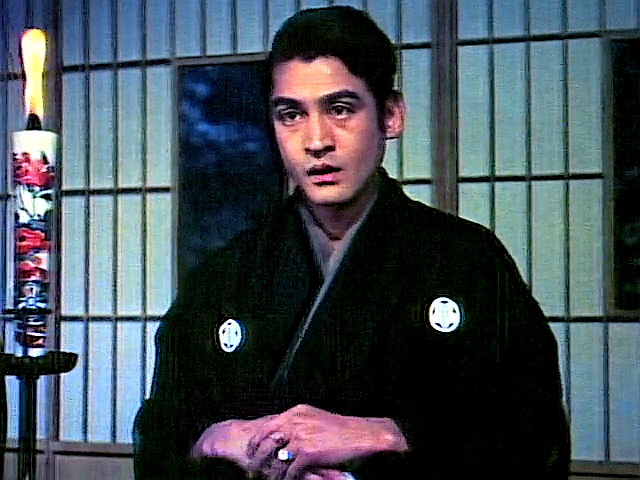
The 11th year of the Tenpo era (1840). Sekio Nakano (Osamu Takizawa) is a senior retainer and trusted advisor to Ienari Tokugawa (Eijro Yanagi), the retired shogun, who remains the most powerful of the Tokugawas despite having been succeeded by his son, Ieyoshi (Ichiro Izawa). Nakano is also the adoptive father of Ienari’s senior concubine, Omiyo-no-kata (Michiyo Kogure). When Ienari impregnates the younger lady-in-waiting, Otaki-no-kata (Hiroko Yajima), Nakano arranges for her to have an accident leading to a miscarriage so as not to threaten Omiyo’s position, but when Otaki also dies as a result, the young maid Tomi (Fujiko Yamamoto), who had helped set up the accident, is promoted to take her place.


Michiyo Kogure


Tomi has an identical sister, Toyoharu (also played by Fujiko Yamamoto), who lives with young samurai Shinnosuke (Raizo Ichikawa), who is rather lazy but an expert swordsman. Living next door to him is Ryoan, a friendly, saké-loving doctor (Takashi Shimura), who is called to the castle to examine lady-in-waiting Kikukawa (Michiko Ai) and discovers she’s pregnant. As no men are permitted to enter the Ooku (inner chambers of the palace), this could cause a scandal, so Nakano orders a cover up. Ryoan’s life is now in danger, and Shinnosuke comes to his defence...


Raizo Ichikawa


Most Japanese online reviewers seem to regard this Daiei production as a disappointment, and in general it’s not hard to see why – with a talky and confusing first half, it feels like it takes ages to get anywhere, while eventually ending abruptly with nothing resolved. It was based on a novel by Seicho Matsumoto – better known for his contemporary crime dramas – which was not yet finished and was still in the process of being serialised in the Tokyo Shinbun when the film went into production. Half an hour longer than most Daiei films and helmed by a prestigious director (Teinosuke Kinugasa, whose 1953 film Gate of Hell had been a prize-winning international success), it was planned as the first part of a grand trilogy, but the sequels were never made. According to one online commentator, this was due to objections from Matsumoto, who was displeased with the first film, though on its release Kinema Junpo stated that the opening weekend had been ‘somewhat disappointing’, so this may well have been another factor.


Takashi Shimura


The film was heavily promoted as a vehicle for Daiei’s popular stars Raizo Ichikawa and Fujiko Yamamoto, whose 16th film this was together, yet Ichikawa is entirely absent for the first 35 minutes and the main protagonist actually seems to be the bald villain Nakano, who was presumably the ‘old fox’ of the film’s silly English title. Unfortunately, as played by the stage-trained Osamu Takizawa – once acclaimed for playing Willy Loman in a theatre production of Death of a Salesman – Nakano is too one-dimensional to be terribly interesting. And although Yamamoto plays two roles, she was hardly an actor known for her versatility, so there’s little discernible difference between the two Yamamotos.


Fujiko Yamamoto x2


Having said all that, there’s actually quite a bit to enjoy here, and things do pick up a bit halfway, with more exterior scenes and more action. Kinugasa’s direction is elegant and makes the most of the excellent art direction and colour cinematography (although everything looked oddly pale and beige in the copy I watched, so I had to tweak the colour settings to make it look its best). The music score by Mizoguchi / Naruse favourite Ichiro Saito veers from bombastic to so subtle it’s almost subliminal, but always helps to heighten the sometimes underpowered drama. On a purely aesthetic level, then, I’d call this one a success and say that the flaws are mostly with the story.


DVD at Amazon Japan (no English subtitles)

If you’d like to support this blog, you can Buy Me a Coffee.


Sunday, 23 March 2025

Golden Demon / 金色夜叉 / Konjiki yasha (1954)

Obscure Japanese Film #175


Jun Negami and Fujiko Yamamoto


1890. Miya (Fujiko Yamamoto) is a young woman in love with her adopted brother, Kan’ichi (Jun Negami). The feeling is mutual and they plan to marry. However, Miya’s parents want her to marry the wealthy Tomiyama (Eiji Funakoshi) and persuade her that it’s in Kan’ichi’s best interests too as then they’ll be able to afford to send him abroad to study, which will greatly improve his prospects.


Eiji Funakoshi


Four years later, Miya is trapped in a miserable marriage to Tomiyama who, knowing that he’s not loved, takes every opportunity to bully and humiliate his wife, while Kan’ichi has taken employment as a debt collector for a much-hated female moneylender, Akagashi (Mitsuko Mito), known as ‘Foxy Shark’. She has only given him a job because she wants to seduce him, and he finds himself in the position of having to demand repayment of loans from his former friends…


Jun Negami and Mitsuko Mito


Based on an unfinished novel by Koyo Ozaki (1868-1903), the plot of this Daiei production must have seemed old hat even in 1954. In fact, there had been numerous silent versions* of the novel as well as previous talkies by Hiroshi Shimizu in 1937 and Masahiro Makino in 1948. The title seems intended to reference the supposed obsession with money which Kan'ichi develops in an attempt to fill his void, but it’s just one aspect of the story that – in this film, anyway – never really convinces and feels like a mere contrivance. Another is his determination to remain so unforgiving towards Miya. What really takes the biscuit though is the fact that these two estranged lovers end up living across the street from each other!


Mitsuko Mito


Otherwise, the film is quite well-made by director Koji Shima and the performances are good, with Mitsuko Mito clearly having the most fun as the lustful loan shark. It won the 1954 Asia Pacific Film Festival award for Best Film and received some distribution abroad, arguably at the expense of other, better films, but this is probably due to the fact that it was one of the earliest Japanese feature films to be made in colour. A lot of trouble was clearly taken to shoot scenes in picturesque settings, such as a field of cherry blossom trees, a moonlit beach and a lonely road at sunset. Unfortunately, the copy I saw looked like a poor VHS transfer and the colours were horrible, but I did have the feeling that it would probably look great in a good quality copy. 


*A 1918 version cast future film director Teinosuke Kinugasa (a male) as Miya, while Kinuyo Tanaka played the role in a 1932 film.


Friday, 15 November 2024

The Makioka Sisters / 細雪 / Sasameyuki (‘Light Snowfall’, 1959)

Obscure Japanese Film #148

Junko Kano and Fujiko Yamamoto

Junichiro Tanizaki’s novel Sasameyuki is widely recognised as a classic of Japanese literature. Translated into English as The Makioka Sisters in 1957 by Edward G Seidensticker, it has remained constantly in print ever since. The book was originally published in serial form beginning in 1943, but this was soon halted by the Japanese War Ministry – not because it criticised the government, but because, according to them at the time, ‘The novel goes on and on detailing the very thing we are most supposed to be on our guard against during this period of wartime emergency: the soft, effeminate, and grossly individualistic lives of women.’* I would have thought they should have been more worried about the enemy, but in any case, Tanizaki was forced to wait until the war had ended to resume publication, with the final instalment appearing in 1948.


Yukiko Todoroki


The story itself takes place between 1936 and 1941, ending around eight months before the attack on Pearl Harbour, and it seems that Tanizaki’s intention was partly to provide a record of a way of life he had seen rapidly vanishing before his eyes. The Makioka sisters are four adult siblings whose parents are no longer alive. Once a grand family, their fortunes are on the wane but they remain very well-to-do in comparison with most Japanese and keep a number of servants. The eldest, Tsuruko (played here by Yukiko Todoroki), lives apart from the others with her husband and children in what is referred to as the ‘main house.’ She is a peripheral character, but, as the senior surviving member of the family, the other sisters must defer to her and her husband before making any important decisions. Tsuruko later goes to live in Tokyo when her husband has to relocate for his job, but her sisters remain in their hometown of Osaka.


Machiko Kyo and Fujiko Yamamoto

The other three sisters live together. In order of age, they are Sachiko (Machiko Kyo), Yukiko (Fujiko Yamamoto) and Taeko, familiarly called ‘Koi-san’ (Junko Kano). Sachiko is married to Teinosuke (Kyu Sazanka), with whom she has one child, Etsuko (Takako Shima). Although Sachiko is held responsible for her two younger sisters by the main house, little of the drama revolves around her. Instead, much of it concerns the attempts to find a husband for Yukiko, whose shy and sometimes stubborn nature makes this difficult. Ever since her original fiancée was killed in an accident, each marriage proposal has come to naught for one reason or another, and Yukiko is already approaching 30 when the story begins. Complicating matters further is the fact that Taeko must wait until Yukiko is married before getting married herself in order not to humiliate Yukiko and leave her looking like an old maid that nobody wants. Taeko is the closest thing to a rebel in the family, generally doing as she likes and indulged by her older sisters, who make allowances for her due to the fact that their parents died when she was so young. Even so, her disregard of the rules only goes so far and she avoids direct confrontation. 


Junko Kano


The sisters are likeable characters who live their lives trapped in a web of etiquette. Overly-concerned with what others think, they are unable to make a move without first ensuring that what they do will not offend anyone else or damage their own social status, but there’s little in the way of arrogance about them. Rather, they are simply behaving according to the rules by which they were brought up and it doesn’t even occur to them to do otherwise. In the book, Tanizaki paints a minutely-detailed picture of their lives, but never tells us what to think about it. The future of the family is left open at the end, but it’s impossible to be unaware of the dark cloud of war that awaits them just over the horizon, and no doubt Tanizaki planned it that way. 


The first film version appeared in 1950, directed by the forgotten Yutaka Abe, but notably starring Hideko Takamine as Taeko. When Koji Shima came to direct this remake for Daiei, Tanizaki was still alive (aged 74), and permission was sought from him to update the story to the present day, which he granted. I doubt whether this was to save money as the Japanese film industry seemed to have plenty to throw around in 1959, so I suspect the idea was to broaden the appeal to the modern audience. The story transfers with surprising ease to the Japan of the late ‘50s, but of course the feeling of watching a vanishing way of life is mostly lost. 


The wisdom of attempting to condense a novel which comes in at 530 pages (in its English translation) into a film running an hour and 45 minutes is also open to question. This episodic kind of material is probably better-suited to television and, in fact, there have been six different versions made for Japanese TV over the years. These misgivings aside, screenwriter Toshio Yasumi does a creditable job under the circumstances, choosing to concentrate less on the attempts to arrange a marriage for Yukiko and instead focus on the events revolving around Taeko, which are somewhat more dramatic. 


One of the best things about this film is the casting – all of the main actors are well-suited to their roles and are talented enough to make them feel like real people. It also looks a treat, with some interesting lighting choices including director Koji Shima’s trademark orange glow of sunset in several scenes, while the music – at least once the main credits are over – is restrained and tasteful. Cinematographer Joji Ohara and composer Seitaro Omori were both regular collaborators of the director. Shima had a fondness for storms as well as sunsets, which is just as well as the book contains a dramatic storm sequence which he pulls off nicely here. He also shows great skill at co-ordinating his actors, who perform all sorts of little bits of business during their dialogue scenes with great naturalism. Along with films such as The Beloved Image and A Rainbow at Every Turn, The Makioka Sisters provides further proof that Koji Shima was not simply a hack who made Warning from Space and The Phantom Horse, but was also a true artist when he wanted to be.  


Bonus trivia: After 20 years of being blacklisted, Fujiko Yamamoto (who plays Yukiko here) was invited back to the big screen by Kon Ichikawa to play Tsuruko in his 1983 remake. After thinking about it for six months, she said no and decided to stick with her stage work.


 *Rubin, Jay. Injurious to Public Morals: Writers and the Meiji State. Seattle: University of Washington Press, 1984. P.264.

Blu-ray at Amazon Japan (no English subtitles). This comes with a bonus DVD of a rare early Machiko Kyo film apparently, but I haven't been able to determine the title.

DVD at Amazon Japan (no English subtitles).

Thanks to A.K.

Monday, 24 June 2024

The Precipice / 氷壁 / Hyoheki (1958)

Obscure Japanese Film #119

Kenji Sugawara

When salaryman Uoza (Kenji Sugawara) returns from a mountaineering trip and encounters his friend and former climbing partner Kosaka (Keizo Kawasaki) in a restaurant, he’s astonished to find that Kosaka is there to meet a married woman, Minako (Fujiko Yamamoto). 


Keizo Kawasaki and Fujiko Yamamoto

Feeling awkward, Uoza makes his excuses and leaves, but Minako catches up with him outside and asks if she can speak to him. Uoza learns that the relationship between Kosaka and Minako has been going on for a while although they’ve only slept together once. She regards the event as a moment of madness on her part and has been trying to break if off, but Kosaka has fallen head over heels for her and won’t accept this, so Minako wants to enlist Uoza’s help in order to make Kosaka see sense. Minako’s anxiety may also be partly due to the fact that her older husband, Yashiro (Ken Uehara with white hair), is a man not easily deceived.

Ken Uehara


Uoza decides to take Kosaka with him on his next trip to the mountains, where they attempt a difficult climb which Uoza hopes will take his friend’s mind off his emotional troubles. He also takes the opportunity to try and talk some sense into Kosaka, who finally seems to be resigning himself to a life without Minako. However, when they continue the last stage of their climb, Kosaka’s supposedly unbreakable nylon rope breaks and Uoza can only watch in horror as his friend falls down the mountainside…


Yasuzo Masumura’s fourth film as director covers similar territory to his better-known picture A Wife Confesses (1961). Kaneto Shindo’s screenplay was based on a novel published the previous year by the prolific Yasushi Inoue, who would go on to become one of Japan’s most respected authors but had yet to acquire that status. At the time, Inoue’s story was a topical one as he had based it on a couple of recent mountain accidents involving a new type of nylon rope. 


In the lead, actor Kenji Sugawara is a little on the stolid side, but was probably selected as much for his physical toughness – he was a 3rd dan in judo – as his acting ability. The film’s location photography is impressive and it certainly appears as if at least some of the climbing sequences were shot on location at Mount Hotaka in challenging conditions. 

Hitomi Nozoe
 

In the latter half of the film, Hitomi Nozoe has an important part as Kosaka’s sister. Any appearance by Nozoe is welcome in my view as she was an underrated actor, and her brilliant comic performance in Masumura’s Giants and Toys made that movie (and as we can see here, there was nothing wrong with her teeth!). Another actor who makes an impression is Kyu Sazanka, who uses every trick in the book to steal all of his scenes as Uoza’s boss. 

Kyu Sazanka


The Precipice was shot in Daiei’s briefly-adopted VistaVision process, with an aspect ratio of 1.85:1, so it’s a little unusual in that respect as it was the 2.35:1 format that rapidly became standard in Japan around this time, replacing the old academy ratio of 1.33:1. Masumura and his cameraman Hiroshi Murai (who later shot Sword of Doom) use the VistaVision format to good effect here, pinning the characters down with clever blocking of scenes, with the camera closely following their every movement, and managing to squeeze in two or even three of the main characters at once when appropriate. 


The plot has its flaws, with one unlikely coincidence feeling especially unnecessary, but it’s such a well-made film that it remains worth watching, and the moving music by Akira Ifukube is a major asset. Inoue's story has proved a popular one in Japan and been remade for TV on a number of occasions.

Note on the title: The Japanese title translates as ‘Ice Wall’.


Thanks to Coralsundy for the English subtitles, which can be found here.