Showing posts with label Eijiro Yanagi. Show all posts

Monday, 18 August 2025

Yume miru hitobito / 夢見る人々 (‘People Who Dream’, 1953)


Yoko Katsuragi


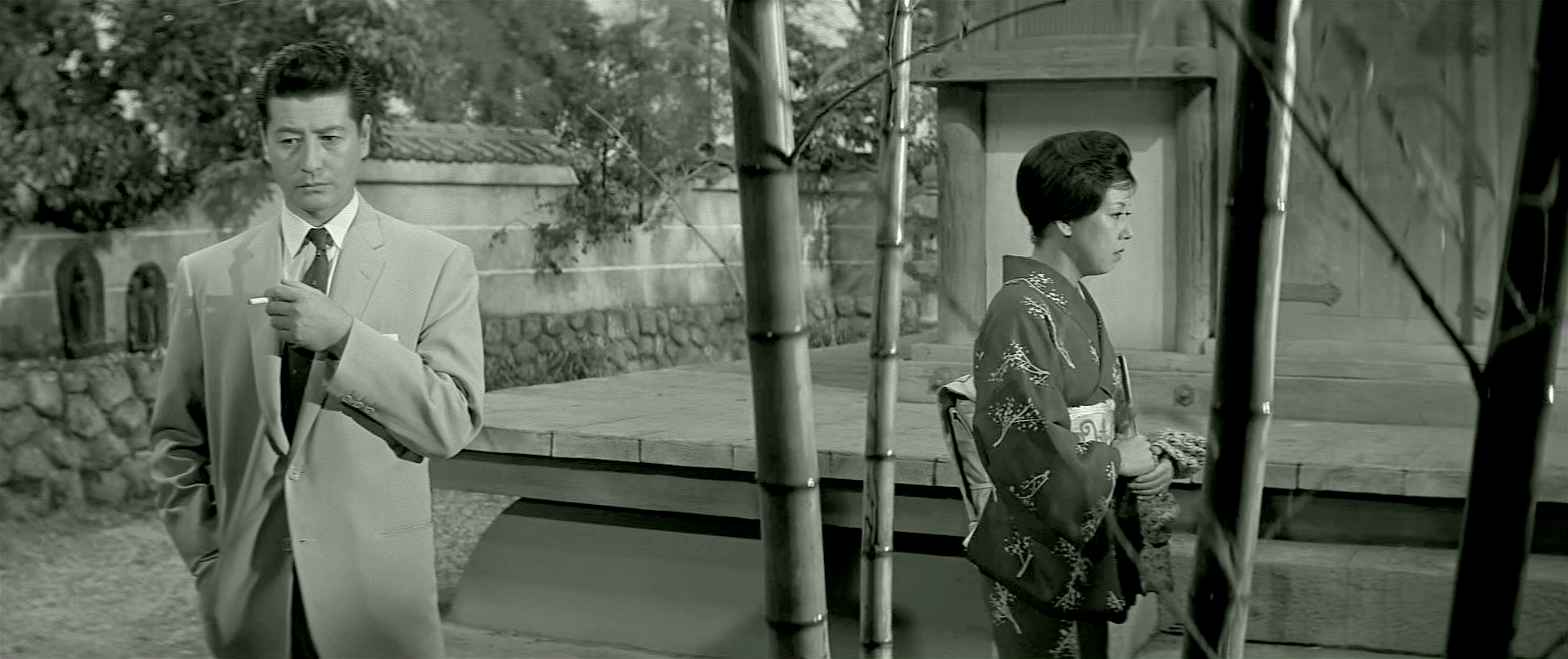
Shinya (Masao Wakahara) is an architect who returns home from ‘the South’ for the first time since the war to find that his fiancée, writer Yuriko (Mieko Takamine) has married someone else, his family home has been destroyed in an air raid and his parents killed, and his half-sister and her husband have spent his inheritance. Needless to say, he’s not a happy bunny. However, his father’s friend’s granddaughter, Sumiko (Yoko Katsuragi), still loves him even though he only thinks of her as a younger sister…


Masao Wakahara


This Shochiku production was based on a 1952 newspaper-serial novel by Nobuko Yoshiya, the Christian-lesbian writer who also supplied the source material for Flower-Picking Diary (1939). In this case there’s no sign of Christianity nor lesbian love, and the two more unconventional female characters – company president Fujie (Sadako Sawamura) and her tomboyish daughter Ioko (Kyoko Kami) – seem to be present mainly to serve as comedy relief. Speaking of comedy, one amusing moment which feels unintentional comes at the beginning when a blind war veteran solicits donations on a train and seems able to tell when people are holding out money to him even when they say nothing. 


Kyoko Kami, Wakahara and Sadako Sawamura


The awkward subject of the war is always present in the background of the story, but only occasionally comes to the fore, and it’s entirely unclear what Shinya has been doing for the seven or eight years since the conflict ended. We know only that he has testified on behalf of a former sergeant, Arakawa (Jun Tatara), to save him from being sentenced as a war criminal. Many of the characters are portrayed as victims of the war in various ways, and there’s never really an acknowledgement of any guilt – the closest we get is a scene in which Shinya’s father’s friend, Shibata (Eijiro Yanagi), finally forgives his son, who had incurred his wrath during the war by daring to express the opinion that Japan would lose. 


Mieko Takamine


In terms of the cast, the forgotten Masao Wakahara as Shinya – described at one point as looking ‘like (Charles) Boyer’ – seems to have been quite a big star at the time, but his performance here is on the wooden side, which is perhaps why his career petered out early once his Boyer-esque looks began to fade. Mieko Takamine does her best with an underwritten role, but it’s Yoko Katsuragi as Sumiko who really becomes the heart of the film. She was an underrated actor whose girlish looks often prevented her from getting the more interesting dramatic parts, but it’s not for nothing that she was a favourite of Keisuke Kinoshita as well as this film’s director, Noboru Nakamura, for whom she made six pictures. One of these was Nakamura’s previous film, Natsuko’s Adventure in Hokkaido, in which she had also co-starred with Masao Wakahara. Regarding Nakamura, his direction is certainly highly competent, but his best work was yet to come in films such as Koto (1963), The Shape of Night (1964) and The Kii River (1966)


Thanks to A.K. 

Watch with English subtitles on my YouTube channel here.

Wednesday, 11 June 2025

The Last Trump Card / 最後の切札 / Saigo no kirifuda (1960)

Obscure Japanese Film #193

Keiji Sada


Tatsuno (Keiji Sada) is a clothing store owner who has an unusual side hustle – he pretends to be part of a ‘New Religion research group’ with his sidekick Yoshimura (Seiji Miyaguchi), and together they extort money from religious organisations by offering to save them from potential scandals (mostly created by Tatsuno) for a price. In other words, they are blackmailers, and their only motivation seems to be greed. As if this weren’t sleazy enough, Tatsuno also dabbles in a little pimping and procuring on the side, and is having affairs with multiple women including nightclub singer Sonoko (Miyuki Kuwano from The Shape of Night) and TV actress Tsuruko (Keiko Hibino), both of whom he treats with contempt… 


Miyuki Kuwano


Based on a 1957 novel entitled Niku no boku (‘Servant of the Flesh’ or ‘I am Flesh’) by Hideo Shirasaki (1920-92) and with a screenplay by Kurosawa regular Shinobu Hashimoto, this Shochiku production was directed by Yoshitaro Nomura, who had been an assistant to Kurosawa on Scandal (1950) and The Idiot (1951), and it features a whole host of character actors familiar from Kurosawa pictures, including Miki Odagiri (the girl from Ikiru), Jerry Fujio, Seiji Miyaguchi, Eijiro Yanagi, Taiji Tonoyama and Koji Mitsui. And just when you think Ko Nishimura’s not going to be in it, his macabre little face finally pops up to deliver the rather gruesome ending - it's the sort of role usually played by Michael Ripper in Hammer horror films. However, in my view screenwriter Hashimoto sometimes produced sub-par work when not undert the guidance of a really great director like Kurosawa or Masaki Kobayashi, and here he allows the story to become too talky and complicated (even when watched with pretty good subtitles) while forgetting to give us anyone to root for, resulting in a mostly unengaging movie. 


Ko Nishimura


Usually cast in nice guy roles, leading man Keiji Sada probably relished the opportunity to play a complete scumbag for a change, something he would go on to do again in his final film, Sweet Sweat (1964). Talking of sweat, there’s also a lot of that in this movie, which is set in Tokyo during a heatwave and has everyone dripping throughout. Director Yoshitaro Nomura – best known for his Seicho Matsumoto adaptations (often adapted by Hashimoto) such as Castle of Sand (1974) – was a very good director, but this is not one of his best and I couldn’t help feeling it’s the sort of material that would have been better in black and white. For all its cynicism, at heart this is a superficial film – if watching a nasty guy do nasty things for 90 minutes before getting his comeuppance is enough for you, you might enjoy it, but it’s really got nothing to say. I doubt that it was a box office success, especially as it appears to be the only film adaptation of a Hideo Shirasaki novel and Japanese film companies tended to raid an author’s work repeatedly if they had made any money from it.


Sada with Seiji Miyaguchi


Alternative titles: The Grave Tells All / The Cards Will Tell

Thanks to A.K.

Sunday, 2 March 2025

The Ladder of Success / 夜の素顔 / Yoru no sagao (‘The True Face of the Night’, 1958)

Obscure Japanese Film #170

Machiko Kyo in the moonlight scene


having travelled there in the hope of becoming a disciple to famed dance teacher Shino (Chikako Hosokawa). When her request is denied, she breaks down in tears before leaving, but Shino’s patron, Inokura (Eijiro Yanagi),  who was listening in the room next door, feels sympathetic and urges Shino to change her mind, which she does. The maid is sent to fetch Akemi back and finds her waiting with an expectant smile on her face knowing that her crocodile tears would do the trick…

Chikako Hosokawa


1953. Akemi has helped Shino build up a successful dance school with over 50 students. However, after she encourages her mentor to star in a new show, Shino is mocked by the press for being too old. To add insult to injury, Akemi seduces Inokura and Shino discovers them in flagrante. As a result, Akemi is expelled, but – with the support of Inokura – goes on to start her own dance school, which is soon a great success. However, her most promising pupil, Hisako (Ayako Wakao), turns out to be just as scheming and two-faced as Akemi and it looks like a case of what goes around comes around… 


Ayako Wakao and Machiko Kyo


This Daiei production makes a great star vehicle for Machiko Kyo, although there’s surprisingly little dancing considering that Kyo was herself a trained dancer. In any case, she gives a rich and varied performance as a character who turns out to be less one-dimensional than she first appears. The first indication that there’s more to Akemi than meets the eye is during a memorable scene (perhaps the film’s best) in which she has a moving moonlit encounter with an elderly female shamisen player reduced to busking door-to-door (played by Hisako Takihana, a former star of the silent screen and wife of film director Tomotaka Tasaka). The old lady sings the song which gives the film its Japanese title and, for Akemi, she’s something of a Ghost of Christmas Future. 

Wakao and Kyo


The film is a little less rewarding for Ayako Wakao fans as, while her role is an important one, she has considerably less screen time than Kyo as well as a less multifaceted character to portray. Having said that, she certainly has her moments here and, if you’ve ever wanted to see a catfight between Machiko Kyo and Ayako Wakao (albeit a rather one-sided one), this is the film for you. For their part, the men are pretty forgettable, although Eiji Funakoshi’s role as an avant-garde composer who collaborates with Akemi’s dance troupe provides the film’s composer, Sei Ikeno, with an excuse to conjure up some interesting sounds for the soundtrack, including a musical saw. 


The first part of the film is in monochrome but, instead of black and white, a blue filter is used (the same effect which reappears in the later moonlight scene), which just seems odd. My guess is that this was done because the fact that the film was in colour was an important selling point in Japan in 1958, where colour films were not yet as common as in Hollywood. In fact, the film's posters state 'All natural colour' quite prominently. Perhaps the studio felt that, had they used standard black and white for the sequences set in the 1940s, some patrons might assume that the whole film would be like that, or at least feel cheated that part of it was. Another peculiarity of the film is a long split-screen montage of Akemi and her pupils travelling all over rural Japan to give dance performances outdoors. Otherwise, it’s a fairly typical Daiei production, although a little longer than most at two hours. It’s the sort of story one might have expected to come from the pen of Toyoko Yamasaki, but in fact Kaneto Shindo’s screenplay was an original work. The director is Kozaburo Yoshimura, who frequently collaborated with Shindo, and had a reputation for bringing out the best in female stars such as Machiko Kyo – a reputation which this film certainly supports. Even though it lapses into full-on melodrama at the end, Kyo’s performance alone is enough to make this one worth watching. 


Jun Negami


DVD at Amazon Japan (no English subtitles)

Tuesday, 3 September 2024

The Beloved Image/ 顔 / Kao (‘Face’, 1960)

Obscure Japanese Film #129

Machiko Kyo and Ryo Ikebe

Eijiro Yanagi


Yasuko Nakada


Kyoko Enami