Showing posts with label Koji Shima. Show all posts

Monday, 4 May 2026

Anchin to Kiyohime / 安珍と清姫 / (‘Anchin and Kiyohime’, 1960)

Obscure Japanese Film #261

Ayako Wakao


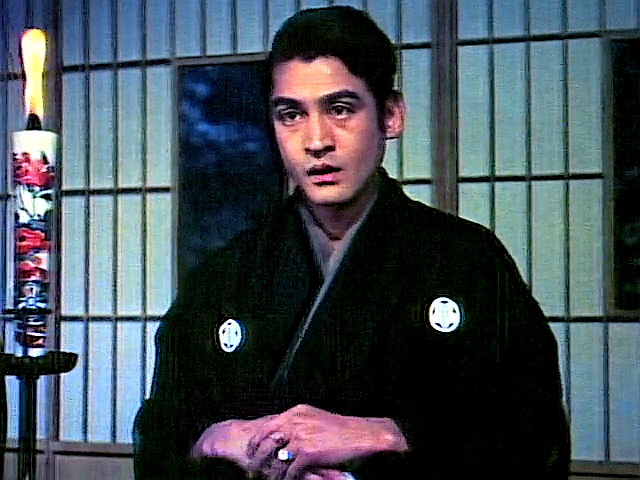
The Heian era. Kiyohime (Ayako Wakao) is the feisty daughter of a village headman. Out hunting a fox one day, she fires an arrow at it, but hits a handsome young monk, Anchin (Raizo Ichikawa), in the arm (presumably there was no cappuccino around in those days for her to spill on him). Apparently confusing the first aid procedure for arrow wounds with the one for snake bites, she sucks his wound and spits out the blood, then bandages it and invites him back to her place to recuperate. As a monk who takes his religion seriously, he spurns her company because he wants to avoid temptation; she takes this as an insult. To get revenge – in a literally ‘steamy’ scene made much of at the time – she follows him to a hot spring in which he’s taking a moonlit bath, strips off and makes as if to seduce him, then laughs in his face when he begins to give in to temptation. He runs off and confesses to a priest who advises him to go and stand under a waterfall until he stops thinking about her (is this the origin of the cold shower treatment?). Meanwhile, she decides that she really loves him after all, but of course everyone else in the movie is determined to keep them apart…


Raizo Ichikawa


This Daiei production was based on a legend about the ancient Buddhist temple of Dojoji in Wakayama Prefecture. The legend had been the basis for numerous Noh, kabuki and bunraku (puppet) plays, but the sole writing credit here goes to screenwriter Hideo Oguni, a frequent Kurosawa collaborator. Unfortunately, in this case he came up with such a corny load of old tosh that the only reasonable way to atone for it would have been to commit hara kiri. Even at a mere 85-minutes, it feels incredibly drawn-out and plods on predictably at a glacial pace before finally reaching its climax, in which either Ayako Wakao turned into a giant snake, or I had begun to hallucinate as a result of brain-rot brought on by the previous 75 minutes, I’m really not sure which.


This was the tenth of 19 films in which Ayako Wakao and Raizo Ichikawa – two of Daiei’s biggest stars – appeared together, and they were rumoured to have been lovers at the time. I don’t know about that, but they were certainly very flirty in a joint magazine interview quoted at this Japanese Raizo Ichikawa fan blog. In any case, one can only pity them here for being lumbered with such unconvincing characters and risible dialogue. Director Koji Shima throws in a couple of his trademark storms and makes it all look quite pretty in an artificial sort of way, but this one’s a lost cause, although – not too surprisingly, perhaps – it was a box office success at the time. All in all, it’s the sort of story that works much better in Kihachiro Kawamoto’s 20-minute puppet film version of 1976 entitled Dojoji, which you can watch on YouTube.


Incidentally, anyone visiting Wakayama Prefecture can visit Dojoji, where there is a picture scroll depicting the story of Anchin and Kiyohime, and request a monk to tell the story (with the option of English, I think). For more info, visit Dojoji’s English web page.

At the time of writing, masochists can watch the film with English subs on YouTube

If you enjoy this blog, feel free to Buy Me a Coffee. 


Sunday, 28 December 2025

That Complicated Guy / 複雑な彼 / Fukuzatsu no kare (aka ‘A Complicated Man’,1966)

Obscure Japanese Film #238

Jiro Tamiya

This Daiei production stars Jiro Tamiya as Joji Miyagi, who works as a flight attendant for a Japanese airline. One day, en route to San Francisco, he attracts the attention of a passenger, Saeko (Mariko Taka), the daughter of a banker. Saeko asks around about him and discovers that he has an unusual history, having apparently flitted from one random job to another. Although he also has a reputation as a ladies’ man, she is not put off and manages to engineer another meeting. A passionate love affair begins, but is there a darker side to his strange past?


SPOILER BELOW


Mariko Taka


Based on one of those novels by Yukio Mishima which he knocked out for women’s magazines between more serious efforts, it was faithfully adapted for the screen by the not-especially-distinguished Kimiyuki Hasegawa. Mishima had actually based his protagonist very closely on a friend of his, Joji Abe (1937-2019), a yakuza who had worked for Japan Air Lines in the early 1960s before his background came to light and he was forced to leave. Abe later served time in prison before finally quitting the yakuza in 1981, subsequently becoming a writer himself and even acting in a few films. According to Persona: A Biography of Yukio Mishima by Naoki Inose and Hiroaki Sato,


Mishima had become acquainted with Abe around 1953 when Abe, a member of the yakuza group Ando Gumi [yakuza-turned -actor Noboru Ando’s gang], was working as a bouncer at a gay bar. It was largely because he was impressed by Abe’s handling of a drunken gaijin that Mishima took up boxing when he thought he was ready. He decided he was unfit for the sport and gave it up after about a year, but he kept in touch with Abe.


Mishima admired Abe for what he perceived as his manliness and his readiness to disregard the rules of convention and go his own way. Mishima also knew Jiro Tamiya, who read the book in proof form and pushed to play the part. (Tamiya’s little-known co-star Mariko Taka appeared in half a dozen films for Daiei between 1966-68 before moving to Toei, for whom she mainly did television before getting married in 1974, after which she promptly retired.) Although the film is a fairly lightweight entertainment whose appeal relies partly on the location shooting in San Francisco and Rio de Janeiro, it’s permeated by the author’s far-right ideology and its portrayal of foreigners feels xenophobic.


Mariko Taka


However, director Koji Shima and his DP Akira Uehara – who went on to shoot Man without a Map for Teshigahara and the recently-rediscovered The Snake Girl and the Silver-Haired Witch (both 1968) – bring some real visual style to the material with subtle lighting and a strong sense of composition and colour. All in all, a more interesting film than I had expected and certainly an effective vehicle for its star, whose athleticism is also put to good use in a few action scenes. 


Tamiya with Eiko Taki


Bonus trivia: According to Japanese Wikipedia, ‘At the age of 16, Joji Abe went to the Netherlands as a cameraman’s assistant, where he once got into a fistfight with Robert Mitchum over a prostitute.’


DVD at Amazon Japan


Thanks to Coralsundy for the English subtitles


If you enjoy this blog, feel free to buy me a coffee!


Sunday, 27 April 2025

The Woman Who Touched Legs / 足にさわった女 / Ashi ni sawatta onna (1952 and 1960)

Obscure Japanese Film #183 and #184

Fubiki Koshiji


Machiko Kyo


The romantic comedy Ashi ni sawatta onna began life as a magazine serial by the now-forgotten Nadematsu (or Nadeshiko? or Bumatsu?) Sawada (male, 1871-1927) and was first filmed in 1926 (the year of publication) by director Yutaka Abe. The story (in the two existing film versions anyway) tells of Saya, a pickpocket in Osaka who uses her good looks to get close to men in order to steal their wallets. She’s just served three months in prison and is on her way by train back to her home village for the first time in many years. However, she’s not the usual criminal type, and it emerges that her father was suspected of being a spy and committed suicide, so she has been stealing in order to hold an expensive memorial service for him and thereby get revenge on the villagers who ostracised him. Also on the train are Saya’s grown-up but childlike younger brother, a bumbling detective (who has arrested Saya in the past but is now on vacation), and a pretentious, slightly-effeminate best-selling crime writer who learns about Saya and wants to use her as the basis for his next novel.  

Tokihiko Okada, Yoko Umemura and Koji Shima


In the 1926 film – which won the first ever Kinema Junpo Award for Best Japanese Film – the leading roles of the female pickpocket, the crime writer and the detective were played, respectively, by Yoko Umemura, Tokihiko Okada and future director Koji Shima. The former two died tragically young – Yoko Umemura (a favourite of director Kenji Mizoguchi) died at 40 following complications from appendicitis while working on Mizoguchi’s Danjuro Sandai (1944); Tokihiko Okada (the father of Mariko Okada) died at 30 from tuberculosis in 1934. Like the vast majority of Japanese silent films, that version is long lost and it’s unlikely that it still existed when Kon Ichikawa made the first remake for Toho in 1952, although he may well have seen it in his youth. Incidentally, according to Donald Richie in A Hundred Years of Japanese Film, rather than featuring a motley bunch of characters and having the bulk of the story set on a train, ‘The original Abe movie was about the upper-middle class in a hot spring resort.’ When he made the film, Abe had actually not long returned from a decade in America, during which time he had acted in a number of Hollywood films, so there’s little doubt that his work was heavily influenced by this experience.

Ryo Ikebe


Ichikawa modelled his version on Hollywood’s screwball comedies of the 1930s, and top-billed Ryo Ikebe as the detective appears to be attempting to emulate Cary Grant. It’s certainly the most animated I’ve ever seen Ikebe on screen, but not his most successful performance in my view. On the other hand, Fubuki Koshiji, who plays Saya, is a natural comedienne and is in her element here. It’s a little surprising to see So Yamamura mincing his way through his performance as the presumably gay writer, but he stops short of full-on caricature, thankfully. One nice touch is that his character’s niece is played by Mariko Okada, whose father had played Yamamura’s role in the 1926 original. 


So Yamamura and Mariko Okada

Sadako Sawamura and Yunosuke Ito

Eiko Miyoshi


A terrific supporting cast also features Yunosuke ‘why the long face?’ Ito, Sadako Sawamura, Sawamura’s brother Daisuke Kato and ex-husband Kamatari Fujiwara, and decrepit old lady specialist Eiko Miyoshi. It’s a jolly ride which zips by in a fast-paced and entertaining fashion, although some of the one-liners were no doubt lost in the subtitles I auto-translated from Japanese. 


Kyo with Hajime Hana


Daiei produced a colour remake a mere eight years later, directed by Yasuzo Masumura. Although Kon Ichikawa and his wife Natto Wada are again credited with the screenplay, it appears to have been revised – whether by Ichikawa and Wada or by Masumura I have no idea, but in neither version does the story make a great deal of sense. In any case, the 1960 version seems more calculated as a vehicle for a particular star – in this case, Machiko Kyo, who plays Saya in a more blatantly sexy manner than Fubuki Koshiji, although she’s arguably less of a natural for comedy. The detective is played as a much more slow-witted character by the far less well-known Hajime Hana, but I found him more amusing than Ryo Ikebe, while Eiji Funakoshi is slightly less effeminate as the writer than So Yamamura had been. 


Jiro Tamiya and Eiji Funakoshi

Shiro Otsuji, Kyo and Haruko Sugimura


Other notables in the cast include Haruko Sugimura in the role formerly played by Sadako Sawamura, and Jiro Tamiya and Kyoko Enami making early appearances in minor roles. Perhaps the most notable difference is that Masumura puts far less emphasis on Saya’s motivation for being a thief and, in fact, drops the memorial ceremony scene entirely – the cynical Masumura would probably have considered this mere sentimentality. Personally, I wouldn’t consider either version a must-see, but I slightly preferred Ichikawa’s on the whole. He was obviously into it anyway, as he also directed a 45-minute TV version in 1960 with Keiko Kishi as Saya, Frankie Sakai as the detective and Tomo’o Nagai as the writer.


Note on the title:

The original novel and 1926 film have a slightly different title from the remakes: Ashi ni sa hatta onna (足にさはった女), which could be translated as The Woman with a Scar on Her Leg. Although the remakes are usually referred to in English as The Woman Who Touched Legs (or similar), the 1952 version at some point had the English title of Doubledyed Detective, while the 1960 version has also been known as A Lady Pickpocket in English. Furthermore, it’s not entirely clear what is meant by the Japanese title. Ashi can mean leg, legs, foot or feet and, as there are no articles or possessive pronouns in Japanese, it’s anyone’s guess whether it should be ‘her leg/foot’, ‘the leg/foot’, ‘a leg/foot’, ‘his leg/foot’, ‘their legs/feet’, etc. While it might be necessary to touch somebody else’s leg when stealing a wallet from their trouser pocket, I think the title is intended to refer to Saya’s legs – which she uses to attract men in order to get close enough to pick their pockets – rather than those of her victims, so The Woman Who Used Her Legs would seem a better title. 


Thanks to A.K. 

1952 version DVD at Amazon Japan (no English subtitles)

1960 version DVD at Amazon Japan (no English subtitles)

English subtitles for 1960 version courtesy of Coralsundy

Sunday, 23 March 2025

Golden Demon / 金色夜叉 / Konjiki yasha (1954)

Obscure Japanese Film #175


Jun Negami and Fujiko Yamamoto


1890. Miya (Fujiko Yamamoto) is a young woman in love with her adopted brother, Kan’ichi (Jun Negami). The feeling is mutual and they plan to marry. However, Miya’s parents want her to marry the wealthy Tomiyama (Eiji Funakoshi) and persuade her that it’s in Kan’ichi’s best interests too as then they’ll be able to afford to send him abroad to study, which will greatly improve his prospects.


Eiji Funakoshi


Four years later, Miya is trapped in a miserable marriage to Tomiyama who, knowing that he’s not loved, takes every opportunity to bully and humiliate his wife, while Kan’ichi has taken employment as a debt collector for a much-hated female moneylender, Akagashi (Mitsuko Mito), known as ‘Foxy Shark’. She has only given him a job because she wants to seduce him, and he finds himself in the position of having to demand repayment of loans from his former friends…


Jun Negami and Mitsuko Mito


Based on an unfinished novel by Koyo Ozaki (1868-1903), the plot of this Daiei production must have seemed old hat even in 1954. In fact, there had been numerous silent versions* of the novel as well as previous talkies by Hiroshi Shimizu in 1937 and Masahiro Makino in 1948. The title seems intended to reference the supposed obsession with money which Kan'ichi develops in an attempt to fill his void, but it’s just one aspect of the story that – in this film, anyway – never really convinces and feels like a mere contrivance. Another is his determination to remain so unforgiving towards Miya. What really takes the biscuit though is the fact that these two estranged lovers end up living across the street from each other!


Mitsuko Mito


Otherwise, the film is quite well-made by director Koji Shima and the performances are good, with Mitsuko Mito clearly having the most fun as the lustful loan shark. It won the 1954 Asia Pacific Film Festival award for Best Film and received some distribution abroad, arguably at the expense of other, better films, but this is probably due to the fact that it was one of the earliest Japanese feature films to be made in colour. A lot of trouble was clearly taken to shoot scenes in picturesque settings, such as a field of cherry blossom trees, a moonlit beach and a lonely road at sunset. Unfortunately, the copy I saw looked like a poor VHS transfer and the colours were horrible, but I did have the feeling that it would probably look great in a good quality copy. 


*A 1918 version cast future film director Teinosuke Kinugasa (a male) as Miya, while Kinuyo Tanaka played the role in a 1932 film.