Showing posts with label Koji Tsuruta. Show all posts

Saturday, 29 March 2025

Deep River Melody / 風流深川唄 / Furyu Fukagawa uta (‘Elegant Fukagawa Song’, 1960)

Obscure Japanese Film #176

Hibari Misora


Fukagawa, Tokyo, c.1925. Daughter (Hibari Misora) wants to marry childhood sweetheart (Koji Tsuruta), but he’s got no dosh. Family business runs into financial difficulties. Only way to save it is for daughter to marry repulsive rich dude (Masahiko Naruse).

(For a proper synopsis, see Hayley Scanlon’s review at Windows on Worlds here.)

When boiled down to its bare bones, the plot of this Toei production is not only the same as that of the previous film I reviewed, Golden Demon, but is basically a formula that has been used ad infinitum in Japanese literature and film. However, while in a Hollywood movie you could be almost certain that the childhood sweetheart character would win the girl in the end, in Japanese films it could go either way as audiences there have generally been much more willing to accept an unhappy ending. I’ll leave it to you to guess the outcome in this one.
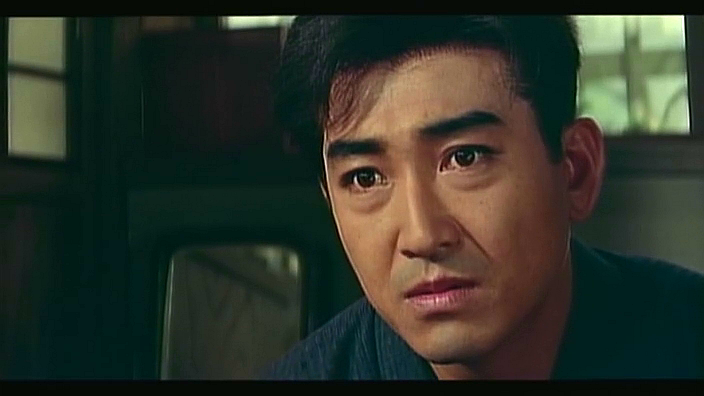
 

Koji Tsuruta


The film was based on a 1935 novel of the same name by Matsutaro Kawaguchi, who was the senior managing director at Daiei when it was made, so it’s a little surprising that a rival studio chose to adapt it. Kawaguchi actually won the first Naoki Prize for the book and went on to write many others, but as far as I’m aware, the only work of his to have been translated into English is Mistress Oriku – Tales from a Tokyo Teahouse. I’ve read a little of that and found it to be literature of a very lightweight and middlebrow variety, so was a little surprised that it had been selected for translation. 


So Yamamura


Deep River Melody the film is well-made by actor-turned-director So Yamamura, but it’s not as interesting as his earlier picture, The Crab Cannery Ship, which was based on a book by a communist author who fell foul of the authorities and was killed as a result. Perhaps in tribute, Yamamura gives himself a minor role here as a communist who also gets into trouble with the police. Incidentally, Japan’s relationship with communism is an interesting one – the Japanese Communist Party was founded in 1922, outlawed in 1925, then legalised by the occupation forces in 1945. In fact, it was almost encouraged by the Americans for a year or two as an antidote to feudalism before they did a U-turn and began discouraging it but ultimately decided not to ban it… 


Anyway, back to the film. Despite its rather hackneyed plot, it might have worked well with Ayako Wakao and Toshiro Mifune in the leads, but here we get Hibari Misora and Koji Tsuruta. Hibari was, of course, a huge singing star who mainly appeared in musicals, but even though the Japanese title contains the word for ‘song’, she doesn’t get one in this film and the material tends to expose her limitations as an actress. She had some ability in that department, but unfortunately she just did not have a very expressive face and that’s something that would have been very handy in this type of role. As for Tsuruta, well, he’s just not terribly interesting or charismatic here. 


Hibari with Isuzu Yamada


Weirdly, it turns out to be Isuzu Yamada who gets to sing a song here, which she does while accompanying herself on the shamisen. She also gives what’s easily the best performance in the film as Hibari’s widowed father’s forthright and not-to-be-messed-with mistress, who at one point actually attacks Hibari's dad for discouraging his daughter from marrying the one she loves. In my view, Yamada was the most versatile character actress in Japanese cinema and the shortcomings of the leads are even more obvious in contrast with her remarkable talents. If she’d had a larger role, I’d recommend watching the film for Yamada alone, but her screen time’s quite limited, so it’s probably not worth suffering through the misguided star pairing of Hibari and Tsuruta, which is to this film what that big lump of ice was to the Titanic. In terms of So Yamamura films, this one’s just… so-so (sorry!).

Thursday, 26 December 2024

Asakusa no yoru / 浅草の夜 (‘Asakusa at Night’, 1954)

Obscure Japanese Film #156


Ayako Wakao and Machiko Kyo

Setsuko (Machiko Kyo) is a dancer at a theatre in Asakusa, where she’s been having a relationship with the in-house playwright, Yamaura (Koji Tsuruta), for the past three years. He’s a nice guy whose idealism is beginning to give way to disillusionment as he realises that the bosses will always prioritise putting bums on seats over art. Setsuko has a younger sister, Namie (Ayako Wakao), who has fallen in love with a young painter, Shisui (Jun Negami). 


Koji Tsuruta

Jun Negami


Setsuko is against the relationship and tries to force Namie into breaking it off, citing Shisui’s low social status as an adoptee as the reason. However, this seems to be merely an excuse because Shisui was adopted by Tsuzuki (Osamu Takizawa), a successful painter who is likely to make Shisui his heir. Things are further complicated when Komakichi (Hideo Takamatsu), the son of the yakuza boss who owns the theatre (Takashi Shimura), makes an unexpected offer of marriage to Namie…

Hideo Takamatsu


This Daiei production was based on a novel by Matsutaro Kawaguchi, who – perhaps not entirely coincidentally – was executive director of Daiei Studios. The novel had been published in serial form in Bungei Shunju magazine, but seems never to have made it into book form. Like the protagonists of this film, Kawaguchi grew up in Asakusa. He also went to school with director Kenji Mizoguchi, later writing or co-writing many of Mizoguchi’s films (as well as directing a few films of his own in the early 1930s), and was the father of Daiei star Hiroshi Kawaguchi.  He must have been quite a guy, and was well-respected as a writer, even having a collection published in English (Mistress Oriku – Tales from a Tokyo Teahouse). 

Jun Negami, Osamu Takizawa and Ayako Wakao


I was hoping for something a little grittier from this film, more along the lines of Yuzo Kawashima’s Suzaki Paradise: Red Light District (1956). Instead, what we get is a rather contrived melodrama with a plot hinging on a massively unlikely coincidence. The film was written and directed by Koji Shima, and occupies something of a middle ground among his films, being neither total hack work nor anything especially impressive artistically, although he throws in a few of his trademark symbolic shots (in this case including rolling pachinko balls and a broken sake bottle) and there's also a well-staged fight scene which takes place in heavy rain.

Machiko Kyo


Machiko Kyo fans will probably enjoy this, especially as she had worked as a revue dancer herself earlier in her career and gets to strut her stuff here. Ayako Wakao fans, however, are likely to find the film considerably less rewarding as she doesn’t have much of a role, although that shouldn't be too surprising as this was still early in her career and she wasn't yet a major star. 


The remainder of the cast are fine but unremarkable, with the exception of Takashi Shimura, who seems determined to steal each of his few scenes by any means necessary, and is variously seen limping, massaging his foot, smoking with a cigarette holder, using a lucky cat as an ashtray, and pruning his bonsai. It’s a masterclass in the actor’s guiding principle of there being ‘no small parts.’


Takashi Shimura

Thanks to A.K.

DVD at Amazon Japan (no English subtitles)

Friday, 19 January 2024

Nemuri Kyoshiro – Journal of an Outlaw / 眠狂四郎 無頼控 / Nemuri Kyôshirô burai hikae (aka The Lonely Swordsman Part 1, 1956)

Obscure Japanese Film #97

Koji Tsuruta

This Toho production was the first film based on the series of novels about Kyoshiro Nemuri, a fictional swordsman created by Renzaburo Shibata (1917-78) in the same year this film was released. The character later became the hero of a series of films starring Raizo Ichikawa – these are known in the West as the Sleepy Eyes of Death series (‘Nemuri’ actually means ‘sleep of death’ according to Merlin David’s first-rate subtitles here). Shibata appears to have modelled his character partly on Ryunosuke Tsukue, the anti-hero of Kaizan Nakazato’s novel Dai-bosatsu toge, portrayed most memorably by Tatsuya Nakadai in Sword of Doom. However, in the hands of actor Koji Tsuruta (see The Romance of Yushima), Nemuri simply comes across as an oddly unlikeable hero, especially considering the fact that he rapes Mihoyo (Keiko Tsushima) a few minutes into the film. Of course, she falls in love with him as a result (I’ve lost count of the number of times I’ve seen this dodgy cliché in Japanese films). Although there is some compensation in the fact that the women get to do some of the fighting too (which is probably the best thing about this film), unfortunately the swordfights are never very convincing and feature neither cutting sounds nor blood. This would change forever post-Yojimbo and Sanjuro, but even though those game-changing movies were still a few years away at this point, I felt that director Shigeaki Hidaka (who also made World War III: 41 Hours of Fear) could have done a little better on the action front than what we see here. 

Keiko Tsushima


Talking of Kurosawa, the screenplay was written by his frequent collaborator Hideo Oguni and features two of his regular actors, Kamatari Fujiwara and (all too briefly) Bokuzen Hidari. It’s by no means a bad film, but I found it disappointing on the whole and the plot felt both over-complicated and implausible (this is why I couldn’t face writing a synopsis). The character of Kiheita, ‘the flying squirrel’ (Shin Tokudaiji) is especially daft – he’s a hunchbacked swordsman who is supposedly Nemuri’s deadliest rival and can leap really high into the air (i.e. be pulled up by wires). 

Kamatari Fujiwara

 
Shin Tokudaiji

Koji Tsuruta starred in two sequels before Toho dropped the series in 1958. Part 2 was shot back-to-back with this one and features many of the same cast members, but adds Koji Mitsui and Setsuko Wakayama, while the second sequel was shot in widescreen with a new director and a particularly impressive supporting cast including Isuzu Yamada, Haruko Sugimura and Michiyo Kogure. Daiei studios revived the character with Raizo Ichikawa and greater success in 1963 in a series which continued for 12 films and probably ended only due to the premature death of their star in 1969.

Koji Tsuruta


Monday, 4 December 2023

The Romance of Yushima / 婦系図 湯島の白梅 / Onna keizu Yushima no shiraume (1955)

Obscure Japanese Film #90

Fujiko Yamamoto


Yushima, Tokyo, 1902. Otsuta (Fujiko Yamamoto) is a geisha who has left her profession to become the wife of promising young scholar Hayase (Koji Tsuruta), who is helping his mentor, Professor Sakai (Masayuki Mori), to compile the first German-Japanese dictionary. Otsuta and Hayase have not yet been married officially as Hayase is waiting for an opportune moment to tell the Professor about their union. Having lost his parents in the fire which destroyed much of downtown Shizuoka in 1889, Hayase was adopted by the Professor, and so is under a great obligation to him. However, as the Professor thinks highly of Hayase, the young couple are confident that he will approve their union even though Hayase is expected to marry the professor’s daughter, Taeko (Yoshiko [not Sumiko] Fujita). Unfortunately, Otsuta becomes implicated in a theft despite being innocent. When this is reported in the newspaper, Professor Sakai learns about the secret marriage and is furious, seemingly forgetting the similar relationship he had had in his own youth with Koyoshi (Haruko Sugimura), who is actually the madam at the geisha house where Otsuta had been employed…

Masayuki Mori


This Daiei production has the sort of determinedly tragic story that is (or at least was) especially popular in Japan. I found it rather clichéd and predictable, but it should be noted that it’s a faithful adaptation of a 1907 novel by Kyoka Izumi, so it’s quite possible that Izumi’s work felt fresh at the time and it was only when others copied aspects of it that they became clichés. What now seems a quaintly old-fashioned story was also once considered progressive in its attack on the institution of the arranged marriage. Although it’s not one of the few Izumi works to have been translated into English (he’s reputedly difficult to translate), it was one of his most popular and became a successful stage play only a year after publication. There had also been previous film versions – in 1934 with Kinuyo Tanaka and Joji Oka, followed by a two-part version in 1942 with Isuzu Yamada and Kazuo Hasegawa. Remakes followed in 1959 and 1962, while it was also adapted for television on a number of occasions, including in 1966 with Fujiko Yamamoto repeating her role.

Koji Tsuruta


The male lead, Koji Tsuruta, is not a name likely to ring many bells outside of Japan, but he was actually one of the country’s biggest male stars of the era. Some readers may know him for playing Toshiro Mifune’s opponent, Kojiro Sasaki, in Hiroshi Inagaki’s Samurai trilogy, or perhaps for his starring role in Kinji Fukasaku’s Sympathy for the Underdog (1971). He could probably relate well to the part he plays in The Romance of Yushima given that his own romance with actress Keiko Kishi was nipped in the bud in 1952 by Shochiku, the studio to whom he was under contract at the time. He attempted suicide shortly after, but fortunately survived only to be badly beaten by a yakuza member the following year because his manager had offended them. The attack had involved both a whisky bottle and a brick; Tsuruta required 11 stitches, but luckily was not disfigured and resumed his career, which continued almost until his passing from lung cancer in 1987. 

Haruko Sugimura


The performances in The Romance of Yushima are solid if unexceptional. The omnipresent Eitaro Ozawa also pops up as a colleague of Sakai’s, but it’s actually Daisuke Kato who steals it as a cheeky fishmonger sympathetic to Otsuta. 

Daisuke Kato


The print I saw was a just-about-watchable VHS transfer, so there’s no doubt that the film would benefit greatly from a higher quality digital version. However, I wouldn’t call it a lost masterpiece as the story hasn’t dated well and the music (a combination of choral singing, harp and strings) is overused and far from ideal. For those reasons, I feel that this is my least favourite of the films I’ve seen by director Teinosuke Kinugasa (the others being A Page of Madness, Gate of Hell, New Tales of the Heike: Three Women around Yoshinaka and Actress).

Note: the Japanese title translates as ‘Genealogy of Women: White Plum Blossoms of Yushima’

UPDATE: I’ve since seen Kenji Misumi’s 1962 version (also made for Daiei), which has Raizo Ichikawa as Hayase, the little-known Masayo Banri as Otsuta, Koreya Senda as the professor, Michiyo Kogure as Koyoshi, and Eiji Funakoshi as the fishmonger. Working from a new screenplay by Yoshikata Yoda, it changed a few details (e.g. Hayase is merely a random teenaged pickpocket the professor decides to adopt) but retained the basic story. Made in colour and widescreen by a director with a good eye, it looks more arresting, but ultimately fails to be any more compelling despite a great deal of emoting from the cast. 

Masayo Banri and Raizo Ichikawa


Koreya Senda

Michiyo Kogure

Eiji Funakoshi

Masayo Banri