Showing posts with label Matsutaro Kawaguchi. Show all posts

Saturday, 29 March 2025

Deep River Melody / 風流深川唄 / Furyu Fukagawa uta (‘Elegant Fukagawa Song’, 1960)

Obscure Japanese Film #176

Hibari Misora


Fukagawa, Tokyo, c.1925. Daughter (Hibari Misora) wants to marry childhood sweetheart (Koji Tsuruta), but he’s got no dosh. Family business runs into financial difficulties. Only way to save it is for daughter to marry repulsive rich dude (Masahiko Naruse).

(For a proper synopsis, see Hayley Scanlon’s review at Windows on Worlds here.)

When boiled down to its bare bones, the plot of this Toei production is not only the same as that of the previous film I reviewed, Golden Demon, but is basically a formula that has been used ad infinitum in Japanese literature and film. However, while in a Hollywood movie you could be almost certain that the childhood sweetheart character would win the girl in the end, in Japanese films it could go either way as audiences there have generally been much more willing to accept an unhappy ending. I’ll leave it to you to guess the outcome in this one.
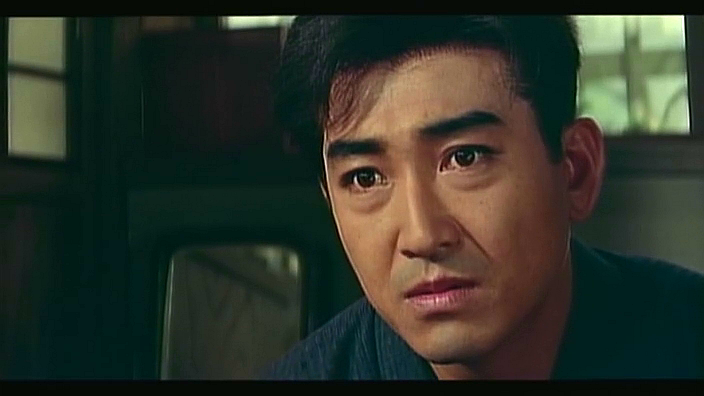
 

Koji Tsuruta


The film was based on a 1935 novel of the same name by Matsutaro Kawaguchi, who was the senior managing director at Daiei when it was made, so it’s a little surprising that a rival studio chose to adapt it. Kawaguchi actually won the first Naoki Prize for the book and went on to write many others, but as far as I’m aware, the only work of his to have been translated into English is Mistress Oriku – Tales from a Tokyo Teahouse. I’ve read a little of that and found it to be literature of a very lightweight and middlebrow variety, so was a little surprised that it had been selected for translation. 


So Yamamura


Deep River Melody the film is well-made by actor-turned-director So Yamamura, but it’s not as interesting as his earlier picture, The Crab Cannery Ship, which was based on a book by a communist author who fell foul of the authorities and was killed as a result. Perhaps in tribute, Yamamura gives himself a minor role here as a communist who also gets into trouble with the police. Incidentally, Japan’s relationship with communism is an interesting one – the Japanese Communist Party was founded in 1922, outlawed in 1925, then legalised by the occupation forces in 1945. In fact, it was almost encouraged by the Americans for a year or two as an antidote to feudalism before they did a U-turn and began discouraging it but ultimately decided not to ban it… 


Anyway, back to the film. Despite its rather hackneyed plot, it might have worked well with Ayako Wakao and Toshiro Mifune in the leads, but here we get Hibari Misora and Koji Tsuruta. Hibari was, of course, a huge singing star who mainly appeared in musicals, but even though the Japanese title contains the word for ‘song’, she doesn’t get one in this film and the material tends to expose her limitations as an actress. She had some ability in that department, but unfortunately she just did not have a very expressive face and that’s something that would have been very handy in this type of role. As for Tsuruta, well, he’s just not terribly interesting or charismatic here. 


Hibari with Isuzu Yamada


Weirdly, it turns out to be Isuzu Yamada who gets to sing a song here, which she does while accompanying herself on the shamisen. She also gives what’s easily the best performance in the film as Hibari’s widowed father’s forthright and not-to-be-messed-with mistress, who at one point actually attacks Hibari's dad for discouraging his daughter from marrying the one she loves. In my view, Yamada was the most versatile character actress in Japanese cinema and the shortcomings of the leads are even more obvious in contrast with her remarkable talents. If she’d had a larger role, I’d recommend watching the film for Yamada alone, but her screen time’s quite limited, so it’s probably not worth suffering through the misguided star pairing of Hibari and Tsuruta, which is to this film what that big lump of ice was to the Titanic. In terms of So Yamamura films, this one’s just… so-so (sorry!).

Friday, 21 February 2025

Oyafuko dori / 親不孝通り (1958)

Obscure Japanese Film #168

Hiroshi Kawaguchi and Yoko Katsuragi


Hiroshi Kawaguchi) is a cynical student who studies as little as possible, preferring to spend his time gambling, picking up women and getting drunk. He lives with his sister, Akie (Yoko Katsuragi), and is very protective of her, so, when he learns that she has had an abortion after becoming pregnant by Shuichi (Eiji Funakoshi), who refuses to marry her, he vows revenge. Katsuya discovers that Shuichi also has a sister, Kaneko (Hitomi Nozoe), and he decides to do the same to her…


Eiji Funakoshi and Hitomi Nozoe


This Daiei production tells a none-too-subtle story in which yet another woman falls in love with her rapist, which seemed to be a popular theme in Daiei films of this era. Unsurprisingly, it was written by a man – in fact, it was based on a story by Hiroshi Kawaguchi’s dad, Matsutaro Kawaguchi, who also happened to be executive director of Daiei. 


A little Hiroshi Kawaguchi goes a long way, in my opinion, and – unfortunately – there’s a lot of him to endure in this film. He can be good in comic roles on occasion, but his clumsy one-note performance here does nothing for the already unpromising material, while his future wife, Hitomi Nozoe, is saddled with a role in which she’s required to be naïve beyond belief. However, perhaps Kawaguchi could take comfort in the knowledge that his was not the worst performance in the film – that honour goes to the uncredited male ‘singer’ featured in a nightclub scene near the beginning, who appears to be trying to imitate American rock ‘n’ roll singers, but succeeds only in making a colossal arse of himself. 


The Japanese title translates as something like ‘Lack of Filial Piety Street’, which obviously doesn’t work in English, but is apparently an unofficial name used for certain streets in many Japanese cities where students congregate and behave badly. The film is sometimes listed as Disobedience, but I’m not sure that was ever an official English title and it doesn’t suit the movie very well. 


There might have been a good film to be made about a street frequented by students pursuing hedonism while they have the chance before having to buckle down to the salaryman life, but this ain’t it. A film about the absurdity of pursuing the tenet of an eye for an eye could also be a winner, but this ain’t that, either. It’s a film which wants to have its cake and eat it, and the contradiction inherent in a character who loves his sister and wants to protect her but will happily rape another woman to get revenge on somebody else is merely shrugged off. The incredibly flippant ending to the film delivers the coup de grace to one of director Yasuzo Masumura’s most dispensable works.

Thanks to A.K. 


Thursday, 26 December 2024

Asakusa no yoru / 浅草の夜 (‘Asakusa at Night’, 1954)

Obscure Japanese Film #156


Ayako Wakao and Machiko Kyo

Setsuko (Machiko Kyo) is a dancer at a theatre in Asakusa, where she’s been having a relationship with the in-house playwright, Yamaura (Koji Tsuruta), for the past three years. He’s a nice guy whose idealism is beginning to give way to disillusionment as he realises that the bosses will always prioritise putting bums on seats over art. Setsuko has a younger sister, Namie (Ayako Wakao), who has fallen in love with a young painter, Shisui (Jun Negami). 


Koji Tsuruta

Jun Negami


Setsuko is against the relationship and tries to force Namie into breaking it off, citing Shisui’s low social status as an adoptee as the reason. However, this seems to be merely an excuse because Shisui was adopted by Tsuzuki (Osamu Takizawa), a successful painter who is likely to make Shisui his heir. Things are further complicated when Komakichi (Hideo Takamatsu), the son of the yakuza boss who owns the theatre (Takashi Shimura), makes an unexpected offer of marriage to Namie…

Hideo Takamatsu


This Daiei production was based on a novel by Matsutaro Kawaguchi, who – perhaps not entirely coincidentally – was executive director of Daiei Studios. The novel had been published in serial form in Bungei Shunju magazine, but seems never to have made it into book form. Like the protagonists of this film, Kawaguchi grew up in Asakusa. He also went to school with director Kenji Mizoguchi, later writing or co-writing many of Mizoguchi’s films (as well as directing a few films of his own in the early 1930s), and was the father of Daiei star Hiroshi Kawaguchi.  He must have been quite a guy, and was well-respected as a writer, even having a collection published in English (Mistress Oriku – Tales from a Tokyo Teahouse). 

Jun Negami, Osamu Takizawa and Ayako Wakao


I was hoping for something a little grittier from this film, more along the lines of Yuzo Kawashima’s Suzaki Paradise: Red Light District (1956). Instead, what we get is a rather contrived melodrama with a plot hinging on a massively unlikely coincidence. The film was written and directed by Koji Shima, and occupies something of a middle ground among his films, being neither total hack work nor anything especially impressive artistically, although he throws in a few of his trademark symbolic shots (in this case including rolling pachinko balls and a broken sake bottle) and there's also a well-staged fight scene which takes place in heavy rain.

Machiko Kyo


Machiko Kyo fans will probably enjoy this, especially as she had worked as a revue dancer herself earlier in her career and gets to strut her stuff here. Ayako Wakao fans, however, are likely to find the film considerably less rewarding as she doesn’t have much of a role, although that shouldn't be too surprising as this was still early in her career and she wasn't yet a major star. 


The remainder of the cast are fine but unremarkable, with the exception of Takashi Shimura, who seems determined to steal each of his few scenes by any means necessary, and is variously seen limping, massaging his foot, smoking with a cigarette holder, using a lucky cat as an ashtray, and pruning his bonsai. It’s a masterclass in the actor’s guiding principle of there being ‘no small parts.’


Takashi Shimura

Thanks to A.K.

DVD at Amazon Japan (no English subtitles)