Showing posts with label Yasushi Akutagawa. Show all posts

Thursday, 27 November 2025

Waga ai / わが愛 (‘My Love’, 1960)

Obscure Japanese Film #232


Ineko Arima


Niizu (Shin Saburi) is a newspaper reporter who drops dead in the street after a night of heavy drinking. At the wake, his wife (Yatsuko Tan’ami) is surprised when a mysterious guest turns up to pay her respects. This is Kiyo (Ineko Arima), a young woman who has been Niizu’s mistress for the past three years while he was in the mountains working on a labour of love, a book entitled A History of the Chinese Salt Industry (sounds riveting!). 


Yatsuko Tan'ami


In flashback, we learn how Kiyo first met Niizu during the war when she was a teenager and was living with her aunt and a geisha named Hideya (Nobuko Otowa), who Niizu regularly slept with. One night, Niizu, Hideya and Kiyo were all sharing the same room when Niizu made love to Hideya while Kiyo kept her head turned away and covered her ears. When they were finished, Hideya went to use the bathroom and Niizu took the opportunity to say to Kiyo, ‘When you grow up, let’s have an affair.’ Instead of being creeped out by this, she fell in love with him and started keeping a scrapbook of his newspaper articles. When they met again a few years later, it was she who initiated their affair...


Arima


This Shochiku production involved many of the same talents that made the previously-reviewed film The Hunting Rifle (1961). Like that later picture, it was directed by Heinosuke Gosho, shot by Haruo Takeno, scripted by Toshio Yasumi based on a Yasushi Inoue story, scored by Yasushi Akutagawa and featured Shin Saburi and Nobuko Otowa. It’s safe to assume, then, that Waga ai was a commercial success as Shochiku would not have green-lit The Hunting Rifle otherwise. However, it suffers from several of the same fatal flaws as that later picture and I doubt it would be well-received by audiences today, which is perhaps why the only way to see it is via an old VHS transfer.


Shin Saburi

Nobel Prize nominee Yasushi Inoue was a very talented writer but, like many Japanese authors of the 20th-century, he was extremely prolific and divided his efforts between writing highbrow literary material and more commercial works to pay the rent, so that the quality of his work varied greatly. Without an English translation, I’m not sure how the 1952 story ‘Tsuya no kyaku’ (‘A Guest at the Wake’) which provided the basis for this film sits on that spectrum, but, for me anyway, the story is the fundamental problem here, consisting as it mostly does of  sentimental claptrap meets male wish-fulfilment. Indeed, it’s a complete mystery why Kiyo would fall in love with a craggy-faced, middle-aged, married drunk old enough to be her father and basically insist on becoming his uncomplaining slave; feminism must have been a completely alien concept to the people responsible for this film. Perhaps if Niizu had been played by someone more charismatic than Saburi, it might have helped a little, but probably not much – the picture is also sabotaged by the cloying clichés which make up Yasushi Akutagawa’s dreadful score.


Wednesday, 25 September 2024

A Hole of My Own Making / 自分の穴の中で / Jibun no ana no nakade (1955)

 Obscure Japanese Film #134

Rentaro Mikuni, Mie Kitahara and Jukichi Uno

Tamiko (Mie Kitahara) is a young woman living at home with her stepmother, Nobuko (Yumeji Tsukioka), and her bedridden brother, Junjiro (Nobuo Kaneko). Tamiko’s parents are both deceased and she’s approaching the usual age for marriage, so candidates are being discussed. Her father had wanted her to marry Komatsu (Jukichi Uno), an easygoing nice guy who works in a munitions factory, but she’s not attracted to him. Tamiko prefers the more aggressive and ambitious Ihara (Rentaro Mikuni), a medical doctor who spends most of his time experimenting on animals when he’s not womanising. However, she mistakenly believes that Nobuko wants him for herself, and this becomes a major source of friction between the two women. Meanwhile, Junjiro – who has never got over the fact that his wife left him – is becoming increasingly obsessed with investing in stocks and shares…

Yumeji Tsukioka


This Nikkatsu production was based on an untranslated 1955 novel of the same name by the left-wing writer Tatsuzo Ishikawa (1905-85), whose work was also to provide the basis for several Satsuo Yamamoto films, including The Human Wall (1959). Ishikawa had actually been imprisoned by the Japanese authorities for a few months in 1938 as a result of his novel Soldiers Alive, which criticised the Japanese presence in China; he subsequently avoided such topics until after the war. A Hole of My Own Making was adapted for the screen by Yasutaro Yagi, who had written a number of scripts for this film’s director, Tomu Uchida, back in the 1930s, before Uchida disappeared into Manchuria for a decade or so. The fact that Uchida chose to work with these two writers and that the resulting film shows so little regard for commercial considerations (with the possible exception of its casting) leaves little doubt that it was a personal passion project and by no means a routine studio assignment. 

Nobuo Kaneko


Like Uchida’s previous film, Twilight Saloon, it also seems to be something of an allegory for post-war Japan, perhaps most obviously in the character of Junjiro, a disillusioned and broken man pursuing financial wealth for its own sake from his sickbed. However, despite the rich symbolism that can be found throughout, I’ve seldom seen a film which leaves it so much up to the audience to decide how to feel about the characters, especially in the case of Tamiko and Nobuko. Who exactly are we supposed to be rooting for here? It’s so unclear that it’s almost disorienting in comparison to the majority of movies, and it’s difficult even to be certain about which character is referred to in the title – a hole of whose own making? Initially, I thought it must have been referring to Komatsu, who is introduced at the beginning of the film sleeping in a drainage tunnel (?), but by the end I thought it made more sense referring to Tamiko… Anyway, I personally enjoyed the film’s ambiguity, though I can imagine that some might feel exasperated and lose patience. 

Mie Kitahara


Even more unconventional is the harpsichord score by Yasushi Akutagawa (son of Rashomon writer Ryunosuke Akutagawa!), which at times sounds like it's being played by a demented chimp. Weirdly, I kind of liked this too, and you certainly can’t accuse anyone of going for the obvious here. Talking of music, Nobuko and Ihara attend a koto concert around half an hour in, and the blind musician we see performing is quite something. He is Michio Miyagi (1894-1956), one of the all-time greats of traditional Japanese music.*

Michio Miyagi


The actors are all well cast and the performances solid all round. Mikuni dissects a live frog at one point, and doesn’t appear to have faked it – unsurprising as he was known for taking realism to extremes. The point was presumably to underline the character’s lack of feeling, but I have to say that I thought it was unnecessary. 

Mikuni with another unfortunate co-star


To return to the film’s use of metaphors, a new sports centre is being built outside Tamiko’s family home, and construction noises are audible in every daytime scene set in that location – clearly a deliberate if unusual choice, and one that I think was intended to suggest that the old way of life is coming to an end. As in the recently-reviewed film A Rainbow at Every Turn (1956), military jets fly over in several scenes, including right at the end, implying an uncertain future not just for Tamiko and what’s left of her family, but for the Japanese people as a whole. But Uchida never represents his characters in this film as simple victims of change – many of them are unlikeable and are pursuing selfish goals, and in various ways they bring their misfortunes on themselves. Perhaps the title refers to more than one of the characters after all, and of course it could be taken to refer to the Japanese nation as a whole, so A Hole of Our Own Making might have been a better fit.

*Despite his blindness, Miyagi also composed the score for a 1935 version of Princess Kaguya photographed by special effects whiz Eiji Tsuburaya. A shortened version (33 minutes instead of the original 75) was rediscovered in the UK in 2015. An excerpt can be viewed on YouTube here

Thanks to A.K.

For more on A Hole of My Own Making, click here


Wednesday, 21 February 2024

Lake of Illusions / 幻の湖 / Maboroshi no mizuumi (1982)

Obscure Japanese Film #102

Reiko Nanjo

Shinobu Hashimoto (1918-2018) had one of the most impressive track records in screenwriting, including as it did not just many of Kurosawa’s best films, but also other cast-iron classics such as Hara Kiri (1962) and Sword of Doom (1966), together with a long list of other excellent pictures. In 1973, he formed his own production company, making two films in collaboration with Toho – Castle of Sand (1974) and Mount Hakkoda (1977) – both of which were big hits. These were followed by Village of Eight Gravestones (1977) for Shochiku, an even bigger hit, so when he and his production company asked Toho to co-produce Lake of Illusions, which he would write and direct, he was in an excellent position to get what he wanted and was given a free hand. As Hashimoto had also directed two previous features, they must have felt the risk to be minimal, and their optimism was such that the film was planned as Toho’s 50th anniversary celebration work. However, they probably failed to take into account that many of Hashimoto’s previous screenplays had been written in collaboration with others (which he himself always maintained was the best way) or under the firm guiding hand of top directors such as Yoshitaro Nomura, Masaki Kobayashi, Tadashi Imai, Kihachi Okamoto and others. Furthermore, Hashimoto was an eccentric, as anyone who reads his book Compound Cinematics – Akira Kurosawa and I can easily see. 

Daisuke Ryu


The genesis of Lake of Illusions is downright peculiar. As Castle of Sand had featured a lot of walking and Mount Hakkoda a lot of marching, he figured that it was time for a film with a lot of jogging. According to Japanese Wikipedia, Hashimoto also wanted to develop a story which included three elements – an image of a woman in traditional Japanese dress plunging a knife into a man; a statue of Kannon, the 11-faced Bodhisattva of mercy, located near Lake Biwa; and, randomly, computer technology. He spent two years working on the screenplay, but even he wasn’t convinced that he had successfully combined the three elements when the film went into production. 

Reiko Nanjo


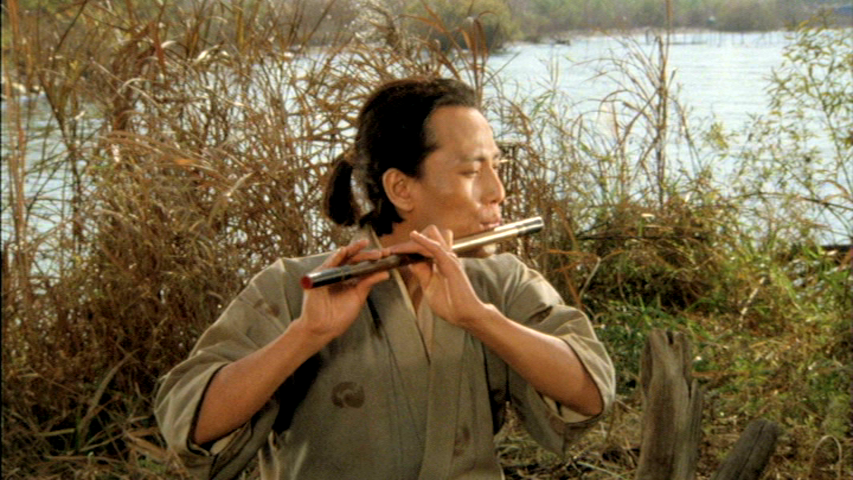
The central character is Michiko, a 22-year-old woman who works in a weird theme hotel where she has to dress in character as Oichi, a woman from the past who came to an unfortunate end (played by Keiko Takahashi in a flashback sequence). Michiko has no interest in history and is doing the job purely for the money and planning to leave as soon as she has reached her savings goal. Her main duties are actually providing baths and sex to wealthy businessmen, something she finds tolerable as long as she’s ‘Oichi’ and not Michiko. She adopts a stray dog, whom she dubs ‘Shiro’, and goes for long runs with him along the shores of Lake Biwa on her days off, meeting a mysterious flute player (Daisuke Ryu) along the way. When Shiro is found dead from a head wound, she becomes obsessed with tracking down the killer and getting revenge… 


Hashimoto held open auditions for the part of Michiko. Out of 1,627 applicants, a young model named Reiko Nanjo was chosen, seemingly for her good looks, athleticism and willingness to disrobe. Unfortunately, she had no real acting experience, and Hashimoto was asking too much of a novice to carry the weight of such a huge part in a major production. The film features endless scenes of Nanjo jogging – she reportedly ran 4,500 km while playing Michiko – as well as constant close-ups of her, usually wearing the same sullen expression. Nanjo deserves respect for her hard work but, in her hands, Michiko comes across as a bit of a brainless bimbo, which was presumably not the intention. Perhaps a more experienced director could have provided better guidance, but here she seems over-exposed and under-directed, and she received poor reviews and few offers of work once the film was released. However, Akira Kurosawa (perhaps taking pity on Nanjo) gave her a small part in Ran, and she subsequently enjoyed a decade of modest success as an actress in TV dramas before quitting the entertainment industry and vanishing from public life. 

Daisuke Ryu


On its release, the film was so badly received that Toho pulled it from cinemas two weeks after release and effectively buried it. Shinobu Hashimoto’s magic touch had deserted him and he suddenly found himself persona non grata with the film studios. It’s not difficult to see their point of view – Lake of Illusions has a terrible script consisting of several disparate elements clumsily cobbled together, even relying on two unlikely coincidences to patch up the deficiencies in its plot, like using sticking plaster to cover a wound when a transplant is called for. It also feels insanely long at over 2 hours and 40 minutes, while the ending, which is akin to being catapulted into a completely different movie, has to be seen to be believed. 

Keiko Takahashi


With no TV broadcasts or VHS release, Lake of Illusions was virtually impossible to see until its eventual DVD release in 2003. It had come to be regarded as a legendarily bad film, but since then it has acquired a small cult following and has its defenders. While it does offer some incidental pleasures along the way, such as a chance to see the scenery around Lake Biwa, and a subtle music score by Yasushi Akutagawa, in my opinion the film ultimately deserves its reputation as Hashimoto’s grand folly, and his own verdict as expressed in Compound Cinematics is equally damning. 


Sunday, 13 August 2023

The Hunting Rifle / 猟銃 / Ryoju (1961)

Obscure Japanese Film #73

Mariko Okada


Saiko (Fujiko Yamamoto), the wife of Kadota, a young doctor (Keiji Sada), receives an unexpected visit one day from Hamako (Nobuko Otowa), an emotionally unstable woman accompanied by a 5-year-old girl she claims to be Kadota’s daughter. Hamako dumps the girl, Shoko, on her, saying she is no longer able to raise her by herself and Shoko is Kadota’s responsibility. Shortly after leaving, Hamako commits suicide. Feeling sorry for Shoko, Saiko decides to raise her as her own, but cannot forgive her husband his infidelity and insists on a divorce. 


Fujiko Yamamoto

Sometime later, Saiko goes to visit her newly-married cousin, the 20-year-old Midori (Mariko Okada), and meets her much older, pottery-fancying husband, Misugi (Shin Saburi), for the first time. Misugi tricks Saiko into going for a walk alone with him, which leads to a long-running affair. Eight years passes, and Misugi and Saiko still have no idea that Midori has known they’ve been cheating on her almost from the beginning but has chosen to remain silent…


Keiji Sada

This Shochiku production is quite a free adaptation of Yasushi Inoue’s highbrow 60-page novella first published in 1949. The original story is introduced by a narrator who has been contacted out of the blue by a hunter (Misugi) after the latter realised that he must have been the inspiration for a man portrayed by the poet in one of his works. Misugi sends him a letter from each of the three women in his life, and it is these letters through which the rest of the story unfolds. Such a literary device was obviously not going to work for the cinema, so it was understandably dropped by screenwriter Toshio Yasumi, who had already collaborated on half a dozen other films with this film’s director, Heinosuke Gosho (and would go on to write a terrific screenplay for Shiro Toyoda’s Portrait of Hell). However, despite the fact that several scenes are replicated faithfully, much of the character motivation evident in the novella is not put across well here. 


Shin Saburi upstaged by a lamp

Indeed, The Hunting Rifle features perhaps the most implausible seduction scene in cinema history when Misugi, having known Saiko for what seems like five minutes, poses the question, ‘Being obsessed with Joseon white porcelain is alright, so why shouldn’t I be obsessed by you?’, which is apparently all it takes for her to melt into his arms. In the book, this is not really a ‘scene’ at all, and so is not an issue, especially as Saiko goes on to explain her motivation. Another clumsy moment occurs in the film when Misugi gives Shoko (now played by Haruko Wanibuchi) a book for her 16th birthday, explaining that the contents are all about love. This comes across as inappropriate and creepy here, but not so in the book, in which there is no explanation from Misugi. The filmmakers also neglect to make use of a memorable visual image that occurs in the original when Saiko visits a university and is disturbed by some snake specimens she sees preserved in jars. This leads Misugi to observe that ‘Everyone’s got a snake in him,’ a sentence which haunts Saiko, who comes to believe herself at the mercy of a persistent self-destructive urge which she visualises as a snake coiled in her belly. In the film, we don’t get the scene with the specimens, so the talk of snakes seems merely whimsical. Furthermore, the symbol of The Hunting Rifle itself goes for very little in the film, whereas in the story it is made quite clear that it represents man’s essential loneliness.


Nobuko Otowa

Another problem with Gosho’s film is the casting, especially that of Shin Saburi. In his hands, Misugi is not only physically unattractive but completely uncharismatic, making Saiko’s helpless attraction for him baffling. Fujiko Yamamoto is a fine actress, but does not seem at all the sort to stab her cousin in the back, and her somewhat mask-like features are perhaps not the best at expressing complex emotions. It’s the more expressive Mariko Okada who takes the acting honours here – when the story jumps forward by eight years, Midori has changed from a rather naïve, gauche young thing to a sophisticated woman with considerable poise, and Okada not only handles this transformation very well, but is great at revealing the hidden thoughts of her character with a subtle look. The other notable names in the cast – Nobuko Otowa and Keiji Sada – are featured surprisingly little considering their status, but do their usual good work. But the casting of Sada also works against the film – imagine a woman leaving Keiji Sada because he had an affair and then rushing off to have an affair of her own with Shin Saburi! 


I found this a real disappointment from director Heinosuke Gosho, whose films are generally good to excellent (I’d especially recommend An Inn at Osaka and An Innocent Witch). Although Inoue’s novella was unsuited to the screen in the first place, that certainly does not excuse all the poor choices here, which also include the truly awful string-laden music score complete with repeated harp glissando that heavily underlines every emotional moment. This is reminiscent of Hollywood at its corniest, and something I found especially grating as I watch Japanese films of this period partly to get away from all that. The culprit, Yasushi Akutagawa, has done good scores too, and I’ve noticed that the work of many Japanese film composers in particular seems to vary a great deal in quality, though I’m unsure why. Anyway, combined with the ham-fisted adaptation and ill-advised casting, the music makes The Hunting Rifle an almost total misfire for me, with only Mariko Okada hitting the target.


Sunday, 18 June 2023

Mount Hakkoda / 八甲田山 / Hakkado-san (1977)

Obscure Japanese Film #63


In the winter of 1901-02, a small squad and a larger regiment of soldiers try to find their way through the merciless Hakkoda mountains from opposite sides with the intention of meeting in the middle and establishing a new route to safeguard their supplies in the event of a Russian invasion. The two groups are led by Captain Tokushima (Ken Takakura) and Captain Kanda (Kinya Kitaoji); both men have the opportunity to decline the challenge but accept it against their better judgment due to fear of losing face. And so a tragedy is born out of the pride of men. 


Ken Takakura

I’m fascinated by tales of survival and love films shot in rugged locations, so I thought this would be right up my street, but I was disappointed for a number of reasons. Although the location photography is indeed impressive (the actors and crew were working in incredibly harsh conditions), Mount Hakkoda unfortunately has little else to recommend it and is far too long and drawn-out. It’s basically three hours of men being stupid, and no opportunity for overacting is missed - except by Ken Takakura, of course, who was incapable of such a thing. Kinya Kitaoji and Rentaro Mikuni also put in decent performances, but too many of the others unnecessarily shout every line of their dialogue in a ‘WHAT I’M SAYING IS REALLY IMPORTANT!’ kind of way. Perhaps this is overcompensation due to the utter lack of memorable characters in the film. Some scenes are also completely unconvincing; in one unintentionally funny sequence, a soldier goes mad, strips off all his clothes and promptly drops dead. We are told that the sweat on his body instantly froze when he stepped outside the shelter and into the freezing air, and that this is what killed him. Yeah, right. Another character supposedly bites off his own tongue to commit suicide, something which I also doubt is possible. Such nonsense might be more forgivable were it not for the fact that this is based on a true historical incident. But we are in movie-land here, which is also made clear when Kumiko Akiyoshi turns up as a beautiful young villager who guides the soldiers part of the way, putting them all to shame as she skips effortlessly through the snow while the men struggle and gasp for breath behind her. Other members of the all-star cast, such as Keiju Kobayashi and Tetsuro Tanba, are wasted in nothing roles. 


Kumiko Akiyoshi

Yasushi Akutagawa’s music score is unsubtle, sentimental and repetitive, which pretty much sums up the movie as well. Shinobu Hashimoto produced and wrote this (based on a novel by Jiro Nitta) and it was directed by Shiro Moritani, a former assistant of Akira Kurosawa. Talking of Kurosawa, if he had directed it, he would no doubt have improved the script, made the characters more colourful, insisted on a better music score and made the whole thing a far more profound and resonant study of man’s folly.


Sunday, 29 May 2022

Stepbrothers / 異母兄弟 / Ibo kyoudai (1957)

 Obscure Japanese film #23

Kido (Rentaro Mikuni) with his two eldest boys.

Covering a period of 25 years, Stepbrothers begins in 1921 as we see a military officer returning home on horseback. Upon being greeted by his servant, he dismounts and slaps the poor fellow so hard that he knocks him down. This introduction to Hantaro Kido provides an accurate first impression of a character who is to remain entirely unambiguous. Indeed, Kido proves to be not only an arrogant bully, but a humourless bore to boot. Who better to play him, then, than Rentaro Mikuni, an actor never afraid to be unsympathetic and who even seemed to revel in such roles.

Kinuyo Tanaka in a highly symbolic shot.

Kido has two nasty young sons who are chips off the old block and a terminally ill wife who has left him sexually frustrated. When a new maid arrives in the form of Rie (Kinuyo Tanaka), she’s barely begun work before he rapes her in the stable, and his wife passes away soon after. After learning that Rie is pregnant with his child, Kido initially plans to kick her out, but his superior officer hears about the pregnancy and asks him what he plans to do to avoid a scandal. Purely to impress the commander, he says he will marry Rie, and the unfortunate woman is doomed to a life of near-slavery as she has no other options. Another son, Tomohide, soon follows, and both her children are continually treated with contempt by their stepbrothers, although a scene in which one of the elder boys watches Rie laughing and having fun with her two young ones makes it clear that a degree of jealousy is involved. As the years pass, the Second World War begins and the focus of the narrative moves on to the teenage Tomohide (Katsuo Nakamura, who later played Hoichi the Earless in Kwaidan), the only boy in the family who has no wish to be a soldier. Tomohide falls in love with a maid, Haru (Hizuru Takachiho), but she is kicked out by Kido for singing and sold into prostitution (evidently, this was still happening in Japan as late as the 1940s).

Hizuru Takachiho and Katsuo Nakamura.

Like the young hero of the only other film I’ve seen directed by Miyoji Ieki, The Wayside Pebble (1964), Tomohide’s life is ruined as a result of living in an oppressive, semi-feudal, patriarchal society. The characters are as black and white as the images themselves, and perhaps it might have been preferable to make them a little more complex, but then again this may have diluted the strength of Ieki’s message that a society founded on such values is ultimately destructive for all involved.

Rentaro Mikuni

Kinuyo Tanaka is too old for her role in the early stages, but her casting makes more sense as the years pass. Her appearance remains the same, while Mikuni gradually transforms into a decrepit old git as he would also do in Satsuo Yamamoto’s Ballad of the Cart-Puller a couple of years later. The organ music by Kon Ichikawa favourite Yasushi Akutagawa has a very churchy feel and seems a strange choice, but then again Stepbrothers is certainly a solemn piece of work.

The film is based on a then recently-published novel of the same title by Torahiko Tamiya (1911-88), while the screenplay is co-written by Kenji Mizoguchi’s regular collaborator Yoshikata Yoda (who also wrote the screenplay for the aforementioned Ballad of the Cart-Puller) and the lesser-known Nobuyoshi Teruda. Stepbrothers shared the main prize at Czechoslovakia’s Karlovy Vary International Film Festival with Sergei Gerasimov’s epic And Quiet Flows the Don.