 |
| Hideko Takamine |
**The
first four paragraphs are mostly identical to those in my review of the 1959 version**
Junichiro Tanizaki’s
novel Sasameyuki is widely recognised
as a classic of Japanese literature. Translated into English as The Makioka Sisters in 1957 by Edward G
Seidensticker, it’s remained constantly in print ever since. The book was
originally published in serial form beginning in 1943, but this was soon halted
by the Japanese War Ministry – not because it criticised the government, but
because, according to them at the time, ‘The novel goes on and on detailing the
very thing we are most supposed to be on our guard against during this period
of wartime emergency: the soft, effeminate, and grossly individualistic lives
of women.’* I would have thought they should have been more worried about the
enemy, but in any case, Tanizaki was forced to wait until the war had ended to
resume publication, with the final instalment appearing in 1948.
 |
| Yukiko Todoroki |
The story itself takes
place between 1936 and 1941, ending around eight months before the attack on
Pearl Harbour, and it seems that Tanizaki’s intention was partly to provide a
record of a way of life he had seen rapidly vanishing before his eyes. The
Makioka sisters are four adult siblings whose parents are deceased. Once a
grand family, their fortunes are on the wane but they remain very well-to-do in
comparison with most Japanese and keep a number of servants. The eldest,
Tsuruko (played here by Ranko Hanai in what amounts to a minor role), lives
apart from the others with her husband and children in what is referred to as
the ‘main house.’ She is a peripheral character, but, as the senior surviving
member of the family, the other sisters must defer to her and her husband
before making any important decisions. Tsuruko later goes to live in Tokyo when
her husband has to relocate for his job, but her sisters remain in their
hometown of Osaka.
 |
| Hisako Yamane |
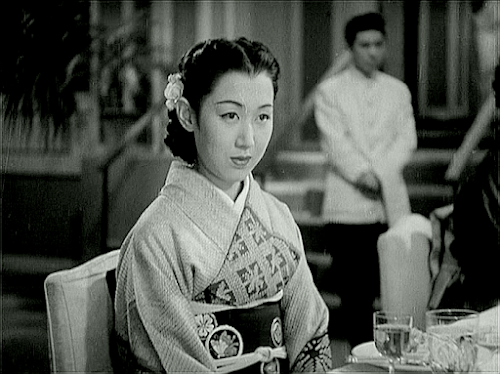
The other three sisters
live together. In order of age, they are Sachiko (Yukiko Todoroki, who went on
to play Tsuruko in the 1959 version), Yukiko (Hisako Yamane) and Taeko,
familiarly called ‘Koi-san’ (Hideko Takamine). Sachiko is married to Teinosuke
(Seizaburo Kawazu), with whom she has one child, Etsuko (Takako Yamazaki).
Although Sachiko is held responsible for her two younger sisters by the main
house, little of the drama revolves around her. Instead, much of it concerns
the attempts to find a husband for Yukiko, whose shy and sometimes stubborn
nature makes this difficult. Ever since her original fiancée was killed in an
accident, each marriage proposal has come to naught for one reason or another,
and Yukiko is already approaching 30 when the story begins. Complicating
matters further is the fact that Taeko must wait until Yukiko is married before
getting married herself in order not to humiliate Yukiko and leave her looking
like an old maid that nobody wants. Taeko is the closest thing to a rebel in
the family, generally doing as she likes and indulged by her older sisters, who
make allowances for her due to the fact that their parents died when she was so
young. She has a long-running on-and-off relationship with the wealthy Kei-bo (Haruo Tanaka).
 |
| Hideko Takamine |
The sisters are
likeable characters who live their lives trapped in a web of etiquette.
Overly-concerned with what others think, they are unable to make a move without
first ensuring that what they do will not offend anyone else or damage their
own social status, but there’s little in the way of arrogance about them.
Rather, they are simply behaving according to the rules by which they were
brought up and it doesn’t even occur to them to do otherwise. In the book,
Tanizaki paints a minutely-detailed picture of their lives, but never tells us
what to think about it. The future of the family is left open at the end, but
it’s impossible to be unaware of the dark cloud of war that awaits them just
over the horizon, and no doubt Tanizaki planned it that way.
 |
| Haruo Tanaka |
This first film version
of the novel was produced by Shintoho and is probably the most faithful of the
three overall. According to Japanese Wikipedia, it had ‘a budget of 38 million
yen, an unprecedented sum for a film at the time.’ The 1959 version updated the
story to what was then the present day, but this one retains the pre-war
setting of the book and, being around 35 minutes longer, is also able to fit a
little more in. Both the 1950s adaptations were scripted by Toshio Yasumi, who
in this one includes the dark spot on Yukiko’s face that comes and goes and is
supposedly a common affliction of unmarried women (something which was dropped
from the 1959 film).
 |
| Hisako Yamane |
The later version is probably the more technically (and visually) impressive of the two – here, although there is quite an impressive flood sequence, we
only hear about Koi-san’s rescue – but this one is well-done for its time and
much superior to the one other film I’ve seen by its director, Yutaka Abe (the
recently-reviewed 1956 film The
Confession). He was no flashy stylist; instead, he rightly lets the camera
be the actors’ friend here, using close-ups judiciously and tracking shots when
necessary. Another asset is the music by Kurosawa favourite Fumio Hayasaka,
which is certainly one of the less grating and more effective scores of its era.

Although technically an
ensemble piece, this is Hideko Takamine’s film all the way, partly because her
character goes through the most changes and she gets the lion’s share of the
screen time, but also because she’s so photogenic and charismatic that everyone
else seems to fade into the background when she’s in view. As Koi-san, she
rejects her family’s obsession with tradition and form, deciding that a man’s
actions are more important than his education or lineage – an ideology which
would have found favour with the occupying Americans whose approval was needed
for all films produced in Japan at the time. All in all, albeit not impressive
enough to qualify as a masterpiece, this is at least a fine version of a
literary classic, with a great star at its centre, and as such it deserves to
be restored and more widely seen.
Bonus trivia: Future
star Kyoko Kagawa appears briefly in one of her first roles as Itakura’s
sister.
Thanks to A.K.
 |
| Yamane and Takamine |


