Showing posts with label Hideko Takamine. Show all posts

Sunday, 8 March 2026

Asa no hamon / 朝の波紋 (‘Morning Ripples’, 1952)

Obscure Japanese Film #251

Hideko Takamine


Atsuko (Hideko Takamine) is a young woman living at home with her mother (Hisako Takihana) and nephew Kenichi (Katsumasa Okamoto), whose father was killed in the war and whose mother (Kuniko Miyake) works at a hotel in Hakone. Kenichi has become very attached to a stray dog he adopted but which his mother disapproves of due to its habit of stealing the neighbours’ shoes (the implication is that Kenichi feels rather like a stray dog himself). Atsuko works at a small trading company, where one of her ambitious male colleagues, Kaji (Eiji Okada), has developed a crush on her. One day she meets the less serious Inoda (Ryo Ikebe), who has befriended Kenichi and works for a larger trading company, and the two hit it off. However, Kaji’s jealousy, together with a dispute between the two rival companies over a client, threatens to destroy their burgeoning romance…


Ryo Ikebe

Kuniko Miyake


Distributed by Shintoho, this was the second production by director Heinosuke Gosho’s independent production company Studio 8. It was based on a novel of the same name by Jun Takami (1907-65), whose work also provided the basis for the previously-reviewed Love in the Mountains (1959), a similarly modest and sentimental love story about ordinary people.


Although this was far from star Hideo Takamine’s most interesting role, she and Ryo Ikebe make for an appealing pair as they search the post-war rubble of Asakusa in search of Kenichi after he runs away – Asakusa, most of which had been destroyed by bombs, was evidently not yet fully rebuilt in 1952, the final year of American occupation. Incidentally, Takamine speaks English in several scenes here as the company Atsuko works for does most of its business with foreigners. Her modern, independent personality and ability to do her job well is not always appreciated by her male colleagues, including Kaji. who are at times quite condescending towards her.


Eiji Okada


The film is full of quietly effective little moments, such as when Inoda takes a break on the stairwell with his colleague, looks down to see the cleaning woman on the floor below, then turns to look up at the sun shining through the window; although the influence of Western culture is apparent everywhere in the lives of these characters, such mundane details feel a long way from Hollywood.


Among the supporting cast, the best-known face is that of future Akira Kurosawa favourite Kyoko Kagawa, who appears here briefly as a nun.


The copy I watched was a low-res VHS transfer viewable on YouTube here, but I assume the Japanese DVD is better quality. English subtitles courtesy of Coralsundy can be found here.


If you enjoy this blog, feel free to Buy Me a Coffee!


Sunday, 2 November 2025

Hyoroku’s Dream Tale / 兵六夢物語 / Hyoroku yume monogatari (1943)

 Obscure Japanese Film #226

Ken'ichi Enomoto aka Enoken


Here’s a weird one! This Toho production was based on a story by Masanao Mori (1761-1803) with the slightly longer title of ‘Oishi Hyoroku yume monogatari’, though that was not a totally original work, but rather Mori's version of a folk tale. Of course, being made in Japan during the war years, the filmmakers had little choice but to introduce a propaganda element, so the film begins with a scene in the modern day in which young children with wooden swords are being taught to defend the motherland from attack by foreign soldiers. I guess somebody thought that was motivational at the time, but, from today’s perspective, it’s hard to see it as anything other than a sad indictment of a sick society (I suppose the other possible interpretation is that director Nobuo Aoyagi was subtly critiquing the militaristic government in a way they were too dumb to appreciate). 


Jumping back a couple of centuries, we’re introduced to Hyoroku (Ken’ichi Enomoto), a teenage samurai who lives with his mother and is practising for an upcoming kendo competition. With his small stature and prematurely-aged face, he cuts a ridiculous figure, but happens to be the grandson of a master swordsman and so feels obliged to try to act like one. Unfortunately, his efforts to impress not only embarrass himself, but bring shame to the others in his kendo group, who want to kick him out. 


Hideko Takamine


When Hyoroku’s mother asks him to deliver a letter to a monk five miles away, he discovers that he must first get past the various yokai (supernatural entities)* in the forest, and hopes to restore his honour by slaying them. However, these shape-shifting creatures – which include a fox who turns into a young girl (Hideko Takamine) – prove to be not so easy to defeat… 


For those unfamiliar with the story (probably everyone not Japanese), there’s little clue in the first half of the film that this comedy is going to turn into an out-and-out fantasy with a good number of special effects. In fact, it’s surprising that the film’s not a little better-known given that it features a number of yokai created by legendary effects whiz Eiji Tsuburaya, who went on to bring Godzilla to life in 1954. Although the 69-minute running time suggests a B-movie, budgets were low during the war years, and this film may well have been considered quite lavish at the time. Indeed, it’s also a musical and features an elaborate dance number at one point, as well as several popular stars of the era, even if only Ken’ichi Enomoto and Takamine are remembered at all today. 


Playing a curiously old-looking teenager, the comic actor Ken’ichi Enomoto, better-known as Enoken, was 38 at the time and one of the most well-known faces in Japanese entertainment. Outside of his home country, he’s only likely to be familiar to those who have seen The Men Who Tread on the Tiger’s Tail (1945), one of Akira Kurosawa’s early films. In Hyoroku’s Dream Tale, his unsmiling demeanour is sometimes reminiscent of Buster Keaton. 


Takamine again


The director, Nobuo Aoyagi, helmed over 80 films between 1940 and 1964, including the modest masterpiece World of Love (1943), also with Takamine, and over a dozen other Enoken vehicles. Despite its unfortunate message – which seems to be that even physical weaklings have a part to play in defeating the enemy – Hyoroku’s Dream Tale is often quite nicely shot and I somehow couldn’t bring myself to dislike it.


BONUS TRIVIA: The production manager was none other than Kon Ichikawa.

* For more on yokai, check out this interesting page. Thanks to Michel for the link. 

Watch on YouTube here (no English subtitles)

Monday, 11 August 2025

Flower-Picking Diary / 花つみ日記 / Hana-tsumi nikki (1939)

Hideko Takamine


 Mitsuru (Misako Shimizu) is a girl from Tokyo whose family have just moved to the Soemoncho district of Osaka. She’s in her early-mid teens and her mother is a Christian. When she begins attending her new school, she soon becomes best-friends with classmate Eiko (Hideko Takamine), who used to live in Tokyo herself when she was small. Her family have a business training maiko (apprentice geisha) to sing, dance and play instruments. When the two girls come up with a plan to make a gift together with which to surprise their kindly teacher (Kuniko Ashihara) on her birthday, a misunderstanding ensues and they fall out. Both girls are miserable as a result, and Eiko gets to the point where she can’t even face school anymore, so she drops out to become a maiko herself…


Misako Shimizu


Produced by Toho Eiga before they became known simply as Toho from 1943, Flower-Picking Diary was based on a story by Nobuko Yoshiya (1896-1973). Being both a Christian and a lesbian, she wrote from an unusual perspective for a Japanese author of the time, but her books were highly popular with female students – so much so, in fact, that there had already been around 30 movies based on her work. The main source of this particular picture is a story entitled ‘Tengoku to maiko’ (‘Heaven and maiko’) from her 1936 collection Chisana hanabana (Little Flowers), but it seems that some elements may have been borrowed from other stories by Yoshiya as the story of the film (as adapted by female screenwriter Noriko Suzuki) differs considerably. The main difference is that there is apparently no falling out between the two girls in the original – a fact I found quite surprising considering that this is absolutely central to the film. Indeed, the extent to which it should be interpreted as the story of a lesbian love is debatable  – there’s certainly nothing overt – but it’s certainly a film about friendship and the devastating feelings that can occur when two close friends fall out. It’s difficult to think of other examples of films dealing seriously with broken friendships, but this one is very moving once it gets going (there may be rather too much singing of sentimental songs in the earlier stages). 


The shadow of war looms large over the film, and the scenes of largely unquestioning and joyful celebration when Mitsuru’s brother gets called up have not dated well, but are revealing of their time. (Incidentally, Nobuko Yoshiya’s reputation suffered somewhat after the war as she was said to have toed the authoritarian government line a little more than necessary.) Ironically, though, it’s the war that gives some hope for the future of Eiko and Mitsuru’s friendship as Eiko decides to make a senninbari for Mitsuru’s brother, which involves her standing at the bridge on Shinsaibashi Street and asking passing women to sew a stitch to make up the 1000 needed for this type of amulet belt.


Hideko Takamine was 15 when she made this, but already an old pro who had made dozens of films since her film debut in 1929 at the age of 5. Her co-star, Misako Shimazu, was a very young-looking 20 years of age, and was featured in a few other films but disappeared from the screen after 1941. Takamine may well have related to her role more than usual here as, shortly before making the film, like Eiko, she had been forced to leave school and pursue a career she did not particularly care for (acting in movies was something she felt obliged to do as no less than nine family members were relying on her financially).

The sensitive direction is by Tamizo Ishida (1901-72), who made around 90 films between 1926 and 1947, but the only other one which is relatively easy to find in decent quality with English subtitles is Fallen Blossoms (1938).

BONUS TRIVIA: If the actor playing Eiko’s father looks familiar, that’s probably because it’s Eitaro Shindo, who went on to play the title role in Kenji Mizoguchi’s masterpiece Sansho Dayu (1954)

Some of the information above comes from a review on Amazon Japan by ‘Beautiful Summer.’

Thanks to A.K.

DVD at Amazon Japan


Wednesday, 23 July 2025

The Makioka Sisters / 細雪 / Sasameyuki (‘Light Snowfall’, 1950)


Hideko Takamine


**The first four paragraphs are mostly identical to those in my review of the 1959 version**

Junichiro Tanizaki’s novel Sasameyuki is widely recognised as a classic of Japanese literature. Translated into English as The Makioka Sisters in 1957 by Edward G Seidensticker, it’s remained constantly in print ever since. The book was originally published in serial form beginning in 1943, but this was soon halted by the Japanese War Ministry – not because it criticised the government, but because, according to them at the time, ‘The novel goes on and on detailing the very thing we are most supposed to be on our guard against during this period of wartime emergency: the soft, effeminate, and grossly individualistic lives of women.’* I would have thought they should have been more worried about the enemy, but in any case, Tanizaki was forced to wait until the war had ended to resume publication, with the final instalment appearing in 1948.


Yukiko Todoroki


The story itself takes place between 1936 and 1941, ending around eight months before the attack on Pearl Harbour, and it seems that Tanizaki’s intention was partly to provide a record of a way of life he had seen rapidly vanishing before his eyes. The Makioka sisters are four adult siblings whose parents are deceased. Once a grand family, their fortunes are on the wane but they remain very well-to-do in comparison with most Japanese and keep a number of servants. The eldest, Tsuruko (played here by Ranko Hanai in what amounts to a minor role), lives apart from the others with her husband and children in what is referred to as the ‘main house.’ She is a peripheral character, but, as the senior surviving member of the family, the other sisters must defer to her and her husband before making any important decisions. Tsuruko later goes to live in Tokyo when her husband has to relocate for his job, but her sisters remain in their hometown of Osaka.
 

Hisako Yamane

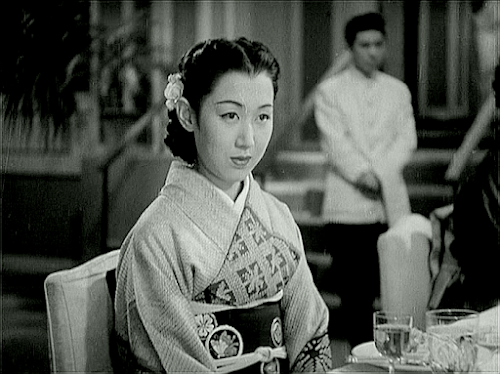
The other three sisters live together. In order of age, they are Sachiko (Yukiko Todoroki, who went on to play Tsuruko in the 1959 version), Yukiko (Hisako Yamane) and Taeko, familiarly called ‘Koi-san’ (Hideko Takamine). Sachiko is married to Teinosuke (Seizaburo Kawazu), with whom she has one child, Etsuko (Takako Yamazaki). Although Sachiko is held responsible for her two younger sisters by the main house, little of the drama revolves around her. Instead, much of it concerns the attempts to find a husband for Yukiko, whose shy and sometimes stubborn nature makes this difficult. Ever since her original fiancée was killed in an accident, each marriage proposal has come to naught for one reason or another, and Yukiko is already approaching 30 when the story begins. Complicating matters further is the fact that Taeko must wait until Yukiko is married before getting married herself in order not to humiliate Yukiko and leave her looking like an old maid that nobody wants. Taeko is the closest thing to a rebel in the family, generally doing as she likes and indulged by her older sisters, who make allowances for her due to the fact that their parents died when she was so young. She has a long-running on-and-off relationship with the wealthy Kei-bo (Haruo Tanaka). 


Hideko Takamine

The sisters are likeable characters who live their lives trapped in a web of etiquette. Overly-concerned with what others think, they are unable to make a move without first ensuring that what they do will not offend anyone else or damage their own social status, but there’s little in the way of arrogance about them. Rather, they are simply behaving according to the rules by which they were brought up and it doesn’t even occur to them to do otherwise. In the book, Tanizaki paints a minutely-detailed picture of their lives, but never tells us what to think about it. The future of the family is left open at the end, but it’s impossible to be unaware of the dark cloud of war that awaits them just over the horizon, and no doubt Tanizaki planned it that way.


Haruo Tanaka


This first film version of the novel was produced by Shintoho and is probably the most faithful of the three overall. According to Japanese Wikipedia, it had ‘a budget of 38 million yen, an unprecedented sum for a film at the time.’ The 1959 version updated the story to what was then the present day, but this one retains the pre-war setting of the book and, being around 35 minutes longer, is also able to fit a little more in. Both the 1950s adaptations were scripted by Toshio Yasumi, who in this one includes the dark spot on Yukiko’s face that comes and goes and is supposedly a common affliction of unmarried women (something which was dropped from the 1959 film). 


Hisako Yamane

The later version is probably the more technically (and visually) impressive of the two – here, although there is quite an impressive flood sequence, we only hear about Koi-san’s rescue – but this one is well-done for its time and much superior to the one other film I’ve seen by its director, Yutaka Abe (the recently-reviewed 1956 film The Confession). He was no flashy stylist; instead, he rightly lets the camera be the actors’ friend here, using close-ups judiciously and tracking shots when necessary. Another asset is the music by Kurosawa favourite Fumio Hayasaka, which is certainly one of the less grating and more effective scores of its era. 


Although technically an ensemble piece, this is Hideko Takamine’s film all the way, partly because her character goes through the most changes and she gets the lion’s share of the screen time, but also because she’s so photogenic and charismatic that everyone else seems to fade into the background when she’s in view. As Koi-san, she rejects her family’s obsession with tradition and form, deciding that a man’s actions are more important than his education or lineage – an ideology which would have found favour with the occupying Americans whose approval was needed for all films produced in Japan at the time. All in all, albeit not impressive enough to qualify as a masterpiece, this is at least a fine version of a literary classic, with a great star at its centre, and as such it deserves to be restored and more widely seen.

Bonus trivia: Future star Kyoko Kagawa appears briefly in one of her first roles as Itakura’s sister.

Thanks to A.K.

Yamane and Takamine


Monday, 27 January 2025

Kodomo no me / 子供の眼 / (‘Eyes of a Child’, 1955)

Obscure Japanese Film #162

Hideko Takamine

Hiroshi Akutagawa

Mieko Takamine

 
Minoru Oki

Yoshiro Kawazu, a former assistant to Keisuke Kinoshita who also often co-wrote screenplays with the writer of this film, Zenzo Matsuyama (who married Hideko Takamine the year this was made). Kawazu directed 24 films between 1955 and 1969, then went into TV when film work dried up before passing away at the early age of 46 in 1972 (I don’t know the cause). He won the 1956 Blue Ribbon Award for Best Newcomer for this film and Namida (‘Tears’), while the film itself shared the 1955 Golden Globe Award for Best Foreign Language Film with Dreyer’s Ordet (Denmark),  Michael Cacoyannis’ Stella (Greece), Laslo Benedek’s Sons, Mothers and a General (West Germany) and a Mexican film called Curvas Peligrosas (‘Dangerous Curves’) which has fallen into a profound obscurity. For some reason, this particular award was usually shared among entries from several countries at the time, but it’s still surprising that a modest little movie like Eyes of a Child would be submitted, let alone win. 

Koji Shitara


Sanyutei Kinba III