Showing posts with label Yusuke Watanabe. Show all posts

Sunday, 10 December 2023

Black Torrent/ 黒の奔流 / Kuro no honryu (1972)

Obscure Japanese Film #91

Tsutomu Yamazaki and Mariko Okada


Takeshi Yano (Tsutomu Yamazaki) is an ambitious but struggling lawyer whose office shakes every time a train goes past on the tracks outside. He’s in a casual relationship with his pragmatic assistant Yukiko (Kaoru Taniguchi) but hopes to marry Tomoko (Keiko Matsuzaka), the daughter of Masamichi Wakamiya (Tatsuo Matsumura), the head of a law firm. 

Kaoru Taniguchi

 
Keiko Matsuzaka

When the state needs someone to defend Fujie Kaizuka (Mariko Okada), a maid accused of murder, Yano agrees although the pay is negligible because he hopes that defeating tough prosecutor Kuraishi (Kei Sato) will be his chance to impress Tomoko’s father and turn his luck around. However, when he finds himself attracted to Fujie, things become complicated… 


Kei Sato

To reveal any more of the plot would spoil things as this is one of those crime dramas in which the twists are pretty much the raison d’etre. Based on a 1967 short story by Seicho Matsumoto entitled ‘Shuzoku domei’ (‘Tribal Alliance’), Black Torrent is a Shochiku production reminiscent of the films of director Yoshitaro Nomura, who frequently adapted Matsumoto’s work for the screen. The director of this film, Yusuke Watanabe (working together with co-writer Takeo Kunihiro), changed the details of the original story considerably and transformed the character of the defendant from a male to a female. This is probably a good thing as it created an interesting role for the great Mariko Okada, who turns in her usual highly convincing performance (and appears able to turn on the waterworks at the drop of a hat). 

Tsutomu Yamazaki


Her co-star, Tsutomu Yamazaki, is slightly less effective as he overacts a little at times and his expressions are sometimes unintentionally comical. I actually blame the director for this – Yamazaki (the kidnapper from Kurosawa's High and Low) is a very talented actor, but even the best actors need good guidance. However, in regard to other aspects, this is a well-directed film, and the cinematography by Masahiro Shinoda favourite Masao Kosugi is also a strong point. The music, on the other hand, is a detriment as it seems to be alternately emulating spy movies and spaghetti Westerns – even using a harmonica and Jew’s harp at times – none of which feels appropriate. Still, despite a few flaws, this is worth seeing for Mariko Okada and the enjoyably twisty plot. 

Mariko Okada


Intriguingly, the previously-reviewed Kao was also an adaptation of a Matsumoto story which transformed the central character from a male to a female played by Mariko Okada. Perhaps Okada felt some affinity for his work, as she also appeared in a number of TV versions of the author’s stories as well as a further feature film, Mushukunin-betsucho (1963).

For more on director Yusuke Watanabe, see my review of Wild Detective.
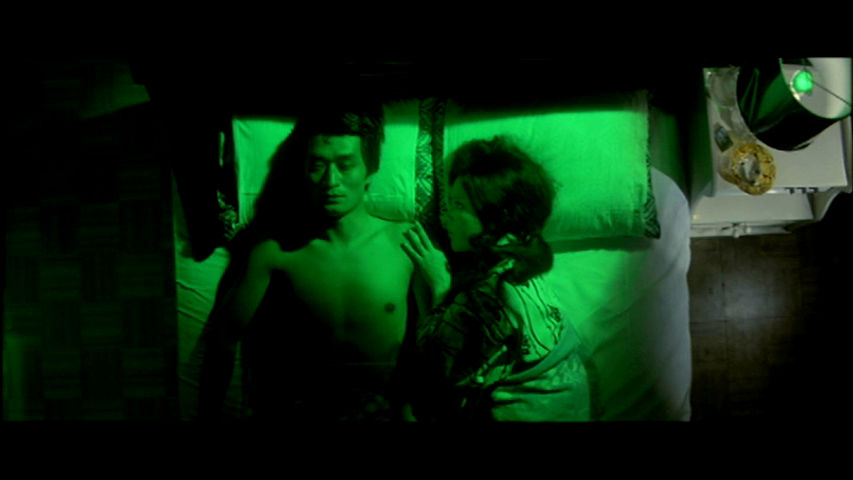
Tsutomu Yamazaki and Mariko Okada


Saturday, 13 May 2023

Wild Detective / Outlaw Cop / やさぐれ刑事 / Yasagure keiji (1976)

Obscure Japanese Film #58


Yoshio Harada
 

Based on a 1975 novel of the same name by Giichi Fujimoto (1933-2012), this Shochiku production stars an impressively-sideburned Yoshio Harada as Nishino, a police detective based in Hokkaido’s capital, Sapporo. When he learns that members of an Osaka-based yakuza gang, the Jumonji-gumi, are flying in to organise a drug-trafficking network with the local mob, he goes to the airport to check them out and discovers that their leader is none other than Sugitani (Etsushi Takahashi), a criminal he had arrested and sent to prison seven years earlier. Naturally, there’s no love lost between these two and Nishino also wants to prevent the gang establishing themselves on his turf, so he and his colleagues begin harassing them at every opportunity. Sugitani decides he’s not going to take this lying down, so he poses as a car salesman and seduces Nishino’s wife, Maho (Naoko Otani). This proves to be easy as Nishino is so wrapped up in his job that he pays her little attention. Sugitani even talks her into running away with him and, by the time she learns his true identity and motivation, they’re already on a boat speeding away from Hokkaido to Honshu and there’s no going back. When Nishino learns about this, he’s so incensed that he decks a colleague, quits the force and goes after Sugitano, tracking him first to Aomori, where he discovers that Maho has been forced into prostitution. Maho becomes her husband’s spy, feeding him information about Sugitano’s movements, but Nishino will have to pursue his enemy to the other end of the country before he finally catches up with him.

Naoko Otani
 

Yusuke Watanabe was a prolific director and screenwriter who directed 64 films and numerous television dramas between 1957 and his death in 1985 at the age of 58. He led a rather schizophrenic career, pioneering Toei’s early ventures into eroticism as a means to compete with TV with films like Two Bitches (1964), later making a series of movie vehicles for pop band The Drifters as well as comedies, dramas and seemingly just about everything else, including episodes of Monkey (1978-80). While little of Watanabe's work is accessible outside Japan, at least with subtitles, he has done a good job here on the whole and keeps things moving at a relentlessly fast pace. The film is also well-shot, mostly on location, by Keiji Maruyama, and features an effective music score by Hajime Kaburagi. 

Etsushi Takahashi
 

Watanabe’s film has one of the longest pre-credits sequences I’ve ever seen – it’s not until 18 minutes in, after Nishino quits the force, that the main title suddenly pops up on the screen. Wild Detective also features one of the most unsympathetic ‘heroes’ I can recall in a film – Nishino treats his nice wife like a doormat and, although the fact that she leaves him is entirely his own fault, the first thing he does when they are reunited is to slap her around. In fact, there’s really nothing he does in the whole film which elicits any sympathy, so if you’re looking for a film with someone to root for, look elsewhere! 


Although Ken Takakura is listed among the cast credits on IMDb, he’s not in it. However, it was nice to see Hideji Otaki appear briefly as a shadowy Mr Big, as he also did for director Kei Kumai in both A Chain of Islands (1965) and Wilful Murder (1981).


Hideji Otaki