Obscure Japanese Film #101
 |
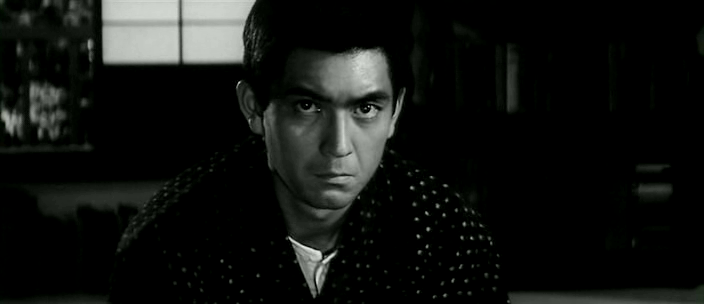
Yuzo Kayama
|
According to Stuart
Galbraith IV in his book The Emperor and
the Wolf, this remake of Kurosawa’s debut film (about an early exponent of
judo) and its sequel was motivated by the need to turn a quick profit after the
inordinately lengthy and expensive production of Red Beard. However, this may not have been the only reason, as Sanshiro Sugata Part Two (1945) not only
contained some badly dated anti-Western propaganda, but was actually considered
a lost film at the time this remake was produced.*
 |
Toshiro Mifune
|
In any case, Kurosawa
chose to co-produce the film, but not direct it, instead handing the reins over
to the 42-year-old Seiichiro Uchikawa, who had been an assistant to an
impressive range of directors, including Ozu, Kon Ichikawa, Hiroshi Shimizu and
Kenji Mizoguchi. He had found Mizoguchi extremely difficult and eventually been
fired by him after a dispute. Nevertheless, Uchikawa became a director himself
in 1953. By the time Sanshiro Sugata
went into production, he had already directed around 30 films – often also writing
the screenplays – and gradually built up a decent reputation without breaking
into the A-list. Most of these earlier films are inaccessible, the exceptions
being the two immediately preceding this one, namely Tange Sazen (1963) and Samurai
from Nowhere (1964). The latter of the two was especially well-received and
was likely the reason why Kurosawa chose him as director of this remake. Unfortunately
for Uchikawa, Sanshiro Sugata would
not be received as positively, at least by the critics, and seems to have
damaged his career as he did not direct another feature film until 4 years
later; when finally given another chance, he was reduced to making a vehicle
for the pop group known as The Tempters. In my opinion, that was unfair – while
the remake lacks the panache that Kurosawa himself would no doubt have brought to it,
in some ways it improves on the originals, benefitting from the use of
widescreen, staging at least some of the fight sequences more effectively, and employing
a stronger cast, and it’s certainly far more satisfying than Kihachi Okamoto’s1977 kiddie remake. Uchikawa was also somewhat straitjacketed by the obligation
to follow Kurosawa’s blueprint, as Kurosawa made only minor changes to his
originals and even had Uchikawa replicate the montage of the abandoned geta.
 |
Yunosuke Ito
|
 |
Bokuzen Hidari
|
 |
Tsutomu Yamazaki
|
Kurosawa further put
his stamp on the film by filling the cast with his favourite actors. Yuzo
Kayama (son of Ken Uehara) had just co-starred in Red Beard, and makes a good Sanshiro, being both convincing in the
fight scenes and likeable in general. Toshiro Mifune is the perfect actor to
play his mentor, Shogoro Yano, and it’s great to see him kicking ass at the
beginning, hurling multiple assailants into a canal. Also ideal casting is Bokuzen
Hidari as the comic priest who gives Sugata a hard time, while Yunosuke Ito and
Tsutomu Yamazaki make effective bad guys, and even Takashi Shimura pops up, although
his part is so brief it seems a mere token gesture. In the first film, Shimura
had played ju-jitsu master Hansuke Murai, the part played here by Daisuke Kato
(surprisingly convincing as a formidable martial artist!).
 |
Takashi Shimura
|
 |
Daisuke Ito and Eiji Okada
|
 |
Not Robert Shaw, but Eiji Okada
|
From outside the
Kurosawa stable, Eiji Okada is impressive in a dual role as two of the brothers
who are Sugata’s most dangerous opponents (as karate master Tesshin, he looks
remarkably like Robert Shaw). The female characters are played by less familiar
names – Yumiko Konoe is the love interest, while Chisako Hara** plays Yunosuke
Ito’s vengeful daughter. Konoe’s main career has been as a singer, while Hara was
the wife of director Akio Jissoji, and had a long career, but mainly played
supporting roles in movies. Both are fine, but Hara has the more interesting
role even though it’s much smaller than Konoe’s.
 |
Chisako Hara
|
 |
Yumiko Konoe
|
The high-contrast
cinematography looks good throughout, while Yojimbo
composer Masaru Sato provides a score which, ironically, seems to be imitating
Ennio Morricone’s music for Sergio Leone’s unacknowledged Yojimbo remake, A Fistful of
Dollars. The film’s main flaw is that it feels too long at two and a half
hours, but otherwise it’s hard to imagine it could have been much improved on by
a director other than Uchikawa – unless, of course, it were Kurosawa himself,
or perhaps Masaki Kobayashi. On the evidence of the film alone, it’s hard to
see why it should have been a career-killer for Uchikawa, although it’s
entirely possible there are additional unknown factors which account for the
sudden 4-year gap in his film career after this was released. Although this
film has been largely ignored by critics, its current of rating of 7.4 on IMDb
strongly suggests that most people who have seen it enjoyed it, and I would
certainly encourage anyone interested to check it out if you have the chance.
*A print was
subsequently discovered in Russia.
**Chisako Hara is listed as two separate people on IMDb.