Showing posts with label Shigeru Amachi. Show all posts

Tuesday, 12 March 2024

Shroud of Snow / 雪の喪章 / Yuki no mosho (1967)

Obscure Japanese Film #105

Ayako Wakao

The story begins in 1930 in Kanazawa, a city located on the west coast of Japan’s main island and known for its production of gold leaf and heavy snowfall in winter. Taeko (Ayako Wakao) has just married into the Sayama family, who have a successful gold leaf business. Soon after the wedding, her husband, Kunio (Toyota Fukuda), hires a new maid, Sei (Tamao Nakamura), apparently in an act of charity as she’s an orphan and a distant relation of the family. Sei is of a meek disposition, so Taeko is profoundly shocked when she catches Kunio in flagrante with her. Kunio’s mother (Mitsuko Yoshikawa) apologises to Taeko on behalf of her son, but explains pragmatically that it’s better than him spending his money in the red light district. However, Taeko finds herself unable to forgive Kunio so, when one of her husband’s employees, Guntaro (Shigeru Amachi), confesses his love to her, she seems ready to run off to Osaka with him and start a new life. 

Toyota Fukuda


When Kunio discovers their plans, Guntaro ends up leaving without her, and Taeko seems to have little choice but to stay with her husband and try to make it work. While resigning herself to her fate, she cannot help having vindictive thoughts, and when a series of tragedies occur – always during a heavy snowfall – she wonders if she has willed them into existence. As the years pass, the family’s fortunes take a dive, the war begins and events lead to an unexpected reunion of sorts with Guntaro…  

Tamao Nakamura

 
Shigeru Amachi

Revolving around the intertwined destinies of the four main characters, Shroud of Snow is not so much the story of a love triangle, but a love square. Despite a number of dramatic events, it’s a strange, enigmatic film in content as the real drama happens inside Taeko’s head. With no voiceover, the film relies heavily on the acting talents of Ayako Wakao; fortunately, she’s adept at expressing the inner thoughts and feelings of her characters, and gives her usual immaculate performance. Nevertheless, I’d love to be able to read the original novel in order to understand the film a little better, but unfortunately it’s never been translated and appears to be out of print in Japan. 


The author, Mitsuko Mizuashi (1914-2003), was herself from Kanazawa, where her father ran a gold leaf business before going bankrupt, after which the family moved to Osaka. Yuki no mosho, published in 1962, was her best-known work and the only one to be filmed, although she was a well-regarded writer nominated for both the Akutagawa and Naoki prizes on several occasions. I suspect that the task of adapting her novel must have been challenging and may be why it uncharacteristically took Daiei five years to turn it into a film as well as the reason it has not been filmed since. 


The director, Kenji Misumi, is well known for his Zatoichi and Lone Wolf and Cub films. Although Shroud of Snow is far from a typical Misumi film, his direction is impressive while seldom calling attention to itself. He extracts good performances all round and pulls off some difficult shots wonderfully, such as when we see flakes of gold leaf swirling about in the smoke from a fire. Another plus is the score by Sei Ikeno, which is subtle and restrained yet makes the most of the film’s dramatic moments.

Note on the title: A more literal translation of the Japanese title would be something like ‘Snow Mourning Band’. 

Bonus trivia: The gold leaf which covers Kyoto’s famous Kinkaku-ji (the Temple of the Golden Pavilion) was made in Kanazawa. 


Tuesday, 31 October 2023

The Military Policeman and the Ghost / 憲兵と幽霊 / Kenpei to yurei (1958)

Obscure Japanese Film #84

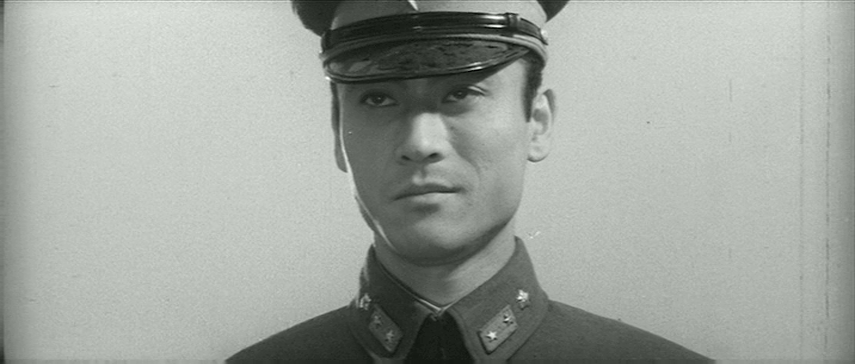
Shigeru Amachi

1941: Military policeman Lt Namishima (Shigeru Amachi) is extremely miffed when Akiko (Nahoko Kubo), the woman he fancies, marries Corporal Tazawa (Shoji Nakayama). Later, when a subordinate loses some classified documents, Namishima decides to take the old maxim of ‘all’s fair in love and war’ a little too literally and frame Tazawa in order to get his hands on his wife. Tazawa receives the death sentence as a traitor and is shot by firing squad, but not before he has placed a curse on Namishima, vowing to get revenge from beyond the grave. However, the dastardly lieutenant continues unabashed with his evil scheme – until Tazawa’s brother becomes an MP and begins investigating his brother’s death…

Shoji Nakayama and Nahoko Kubo


This Shintoho production was ordered by producer Mitsugu Okura, who assigned director Nobuo Nakagawa to come up with a new film to cash in on the (presumably modest) box office success of the previous year’s The Military Policeman and the Dismembered Beauty. Like that picture, this also features actors Shoji Nakayama and Shigeru Amachi, but here they play different characters and the story is unrelated. The earlier film had been directed by Kyotaro Namiki, who seemed not to be terribly at home in the horror genre, so the choice of Nakagawa – who had already enjoyed success with several such films – makes perfect sense. 

Shoji Nakayama contemplates the work of some over-enthusiastic gravediggers


Surprisingly, Japanese Wikipedia suggests that Nakagawa originally developed a straightforward thriller with screenwriter Yoshihiro Ishikawa and the supernatural element was added later at Okura’s insistence, and it does feel like something of an afterthought, most of the (fairly mild) spooky stuff being held back for the climax. In any case, Nakagawa’s film is much superior to the previous one. He and cinematographer Tadashi Nishimoto were able to make use of the new widescreen format and clearly went to considerable trouble in shooting scenes from unusual angles, making this an often visually arresting piece of work, even if they occasionally get a bit too carried away with tilting the camera this way and that. 

Shigeru Amachi


The film is unusual in featuring a villain as the main character, and it’s Shigeru Amachi in this role who gives the strongest performance, although he gets stiff competition from Yoko Mihara as the bad girl of the piece. It’s also fun to see Masayo Banri as a sexy nightclub dancer, but perhaps best of all is an absolutely priceless moment of (possibly unintentional) black comedy involving a corpse disposal.

Yoko Mihara

 
Masayo Banri


Saturday, 1 April 2023

The Military Policeman and the Dismembered Beauty /憲兵とバラバラ死美人 / Kenpei to barabara shibijin (1957)

Obscure Japanese Film #52

Shoji Nakayama


Set in Manchuria in 1937, The Military Policeman and the Dismembered Beauty opens with a Japanese soldier (whose face is concealed) having a secret liaison with a young Japanese woman (Akiko Mie). We then jump to a scene in which the (thankfully unseen) rotting torso of a pregnant woman is discovered in a well at a Japanese military barracks. The corpse has contaminated the army’s water; some rookies are forced to eat rice cooked in it by their seniors, but the latter also soon find themselves forced to eat the dodgy gohan, in their case by an indignant officer – karma in action! 

Just another day at the office for the Japanese Military Police


A military policeman, Tokusuke Kosaka (Shoji Nakayama), is sent from Tokyo to investigate the murder, but he meets with opposition from the local MPs. Despite having no evidence, they decide to pin the crime on the cook, Sergeant Tsuneyoshi (Shigeru Amachi), so they hang him upside down and try to whip a confession out of him. However, Kosaka begins to have visions of the dead woman which lead him to important clues and, eventually, the real murderer. 


I have a feeling I’ve just made this film sound more interesting than it actually it is – the story has potential, but the execution here is strictly routine and the cast unremarkable. The screenplay by Akira Sugimoto was based on a 1957 book by Keisuke Kosaka (1900-1972) entitled The Military Police Squirm: 68 Days of Headless Torso Investigation (Notautsu kenpei: Kubi nashi dōtai sōsa 68-nichi),  which appears to have been based on a true story. Kosaka, who had himself served as a military policeman in Manchuria and was the model for the character Kosaka in the film, has a pretty interesting bio – according to Japanese Wikipedia, he helped to save the life of the Prime Minister during the attempted military coup of 26 February 1936 and later received a death sentence as a war criminal due to his involvement in the execution of an American airman. However, he ultimately got away with serving a few years in prison before turning to writing after his release. One wonders how much we should trust such a person’s version of events – certainly, the film portrays Kosaka as the good guy and most of the other Japanese soldiers as brutes.   


More of a murder mystery than a horror film despite its title, The Military Policeman and the Dismembered Beauty, is a modest B-movie unlikely to get pulses racing these days. However, it was enough of a hit at the time that the same studio (Shintoho) produced The Military Policeman and the Ghost (Kenpei to yurei) from an original screenplay the following year, again starring Shoji Nakayama in a similar role. For his part, director Kyotaro Namiki does a competent if uninspired job – his earlier Hirate Miki (1951) was a more impressive piece of work.


Watched without subtitles.

DVD at Amazon Japan