Showing posts with label Kyotaro Namiki. Show all posts

Saturday, 1 April 2023

The Military Policeman and the Dismembered Beauty /憲兵とバラバラ死美人 / Kenpei to barabara shibijin (1957)

Obscure Japanese Film #52

Shoji Nakayama


Set in Manchuria in 1937, The Military Policeman and the Dismembered Beauty opens with a Japanese soldier (whose face is concealed) having a secret liaison with a young Japanese woman (Akiko Mie). We then jump to a scene in which the (thankfully unseen) rotting torso of a pregnant woman is discovered in a well at a Japanese military barracks. The corpse has contaminated the army’s water; some rookies are forced to eat rice cooked in it by their seniors, but the latter also soon find themselves forced to eat the dodgy gohan, in their case by an indignant officer – karma in action! 

Just another day at the office for the Japanese Military Police


A military policeman, Tokusuke Kosaka (Shoji Nakayama), is sent from Tokyo to investigate the murder, but he meets with opposition from the local MPs. Despite having no evidence, they decide to pin the crime on the cook, Sergeant Tsuneyoshi (Shigeru Amachi), so they hang him upside down and try to whip a confession out of him. However, Kosaka begins to have visions of the dead woman which lead him to important clues and, eventually, the real murderer. 


I have a feeling I’ve just made this film sound more interesting than it actually it is – the story has potential, but the execution here is strictly routine and the cast unremarkable. The screenplay by Akira Sugimoto was based on a 1957 book by Keisuke Kosaka (1900-1972) entitled The Military Police Squirm: 68 Days of Headless Torso Investigation (Notautsu kenpei: Kubi nashi dōtai sōsa 68-nichi),  which appears to have been based on a true story. Kosaka, who had himself served as a military policeman in Manchuria and was the model for the character Kosaka in the film, has a pretty interesting bio – according to Japanese Wikipedia, he helped to save the life of the Prime Minister during the attempted military coup of 26 February 1936 and later received a death sentence as a war criminal due to his involvement in the execution of an American airman. However, he ultimately got away with serving a few years in prison before turning to writing after his release. One wonders how much we should trust such a person’s version of events – certainly, the film portrays Kosaka as the good guy and most of the other Japanese soldiers as brutes.   


More of a murder mystery than a horror film despite its title, The Military Policeman and the Dismembered Beauty, is a modest B-movie unlikely to get pulses racing these days. However, it was enough of a hit at the time that the same studio (Shintoho) produced The Military Policeman and the Ghost (Kenpei to yurei) from an original screenplay the following year, again starring Shoji Nakayama in a similar role. For his part, director Kyotaro Namiki does a competent if uninspired job – his earlier Hirate Miki (1951) was a more impressive piece of work.


Watched without subtitles.

DVD at Amazon Japan


Saturday, 4 March 2023

Hirate Miki / 平手造酒 (1951)

Obscure Japanese Film #49

Ranko Hanai


Hirate Miki (c.1814-1844) was a swordsman who became a bodyguard for a yakuza boss and died in a fight with a rival gang. There were numerous films about him throughout the 1920s and ‘30s, but these abruptly ceased at the time that Japan entered WW2, presumably because Miki was killed at a young age and his story would have been seen as defeatist. His first reappearance in a movie after the war was as a supporting character in Shintoho’s Tenpo suiko-den: Otone no yogiri (1950), in which he had also been played by So Yamamura, the star of this film. 

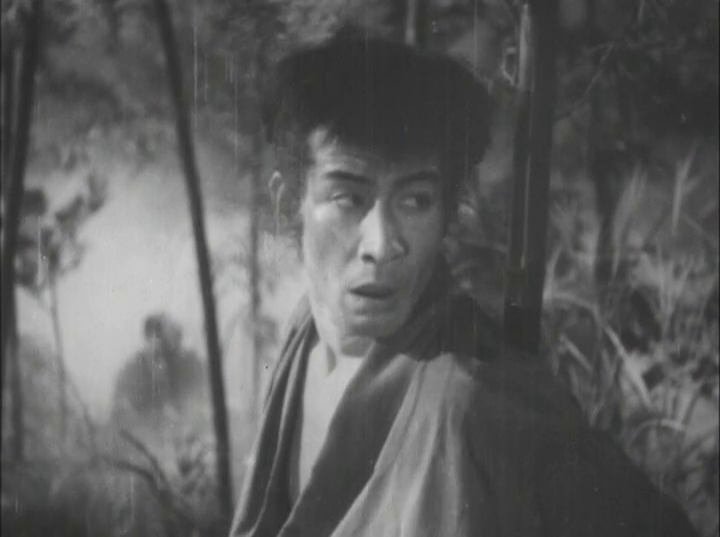
So Yamamura


Hirate Miki is reminiscent of Kurosawa’s Sanshiro Sugata (1943) in that the heroes of both are martial arts experts who undergo a spiritual crisis which causes them to stray from the path of righteousness before they finally redeem themselves. Aside from the choice of martial art and the lighter ending of Kurosawa’s film, the main point of difference between the two works is that Miki, as played by Yamamura, is an unlikeable and charmless character; ‘He must have quit smiling in the womb!’, one character aptly comments. Yamamura seems an odd choice as he was already 41 when this was made and is clearly too old for the role. 


Miki starts out as an idealistic young man whose skill sees him move quickly up the ranks. However, he is frustrated in his romantic ambitions and becomes bitter about the importance of money and status. One night, he gets drunk, trashes a restaurant and loses a lucrative new position as a result. Admonished by the head of his dojo, he nevertheless continues to be insufferable, frequently beating the crap out of his poor students with his bamboo practise sword.  Eventually, he runs off with a geisha, Masuji (Ranko Hanai from Kurosawa's Sanshiro Sugata). She is another disappointed idealist, having worked hard for years to become a top shamisen player only to find that her male clients have little interest in that particular skill. Meanwhile, Miki falls ill with tuberculosis and ends up working for a yakuza boss. There’s a splendidly ironic moment when Miki begins coughing up blood after slaying a bunch of rival gang members; his friend, standing amid the corpses, finally decides the moment has come to shout for a doctor.


The narrative of the film is rather choppy to say the least – hardly surprising as the version I saw ran 64 minutes, and it seems there was originally a longer 107-minute version. With 43 minutes missing, it’s not really possible to judge this film fairly in my opinion, but what remains is certainly worth a look for the fine cinematography (by Kikuzo Kawasaki) and a number of nice touches, such as the paper crane made by Masuji which finally softens the heart of old misery-guts Miki. 


Further Kurosawa connections include a cameo by eccentric geriatric-specialist Bokuzen Hidari as a priest and the fact that this was the second script by the great screenwriter Shinobu Hashimoto to be filmed (Rashomon being the first). Director Kyotaro Namiki does fine work here but is remembered, if at all, for a couple of horror films he made towards the end of his career, The Military Policeman and the Dismembered Beauty (1957) and Vampire Bride (1960).