Showing posts with label Yoko Mihara. Show all posts

Friday, 21 August 2026

Convicted Woman / 女犯破戒 / Nyohan hakai (1966)

Obscure Japanese Film #275

Yoko Mihara and Takahiro Tamura


Ushinosuke (Takahiro Tamura) is a Kyoto actor who elopes with a young woman, O-Ume (Mayumi Ogawa), in a small boat. She decides they must die together and attacks him with a knife; the boat capsizes in the struggle and only Ushinosuke survives. Seven years later, in repentance, he has become a monk at Enmei-in Temple in Edo under the new name of Dogyo, but his faith is continually tested by lustful young women like Okura (Reiko Ohara), who apparently find his pompous piety and shaven pate irresistible.


Mayumi Ogawa


One day, Ryuzen (Nobuo Kaneko), who knows about Dogyo’s past, comes to the monastery to train as a monk, but appears to have some form of blackmail in mind. Meanwhile, the elderly head priest is dying but tries to seduce Dogyo on his deathbed. A shocked Dogyo runs off and lets himself be seduced by Okura instead while Ryuzen is finishing off the old priest. For some reason, Dogyo then decides to become the wickedest priest that ever lived...


Nobuo Kaneko with TT


This monksploitation meller from Toei was part of the studio’s drive to lure dwindling audiences back into the cinema with the promise of more erotic content, although said content remains mostly rather tame at this early stage. The fact that it was made in black and white and the star is Takahiro Tamura (who had seldom carried a picture before this one) seems indicative of a low budget, as does the silly script by B-movie hack Kikuma Shimoiizaka. Director Eiichi Kudo of 13 Assassins (1963) fame pulls off a few memorable moments, but the unconvincing characters and over-the-top performances soon prove tiresome, making the film quite a let-down after a strong opening sequence.


Reiko Ohara and TT


A note on the title:

Although Convicted Woman appears to have been an official English title, it doesn’t fit the content; the Japanese title can be translated as ‘Female Transgression’ or ‘Women Breaking the Commandments’, either of which make more sense in light of the story.


Thanks to A.K.


If you’d like to support this blog, you can Buy Me a Coffee.


Tuesday, 31 October 2023

The Military Policeman and the Ghost / 憲兵と幽霊 / Kenpei to yurei (1958)

Obscure Japanese Film #84

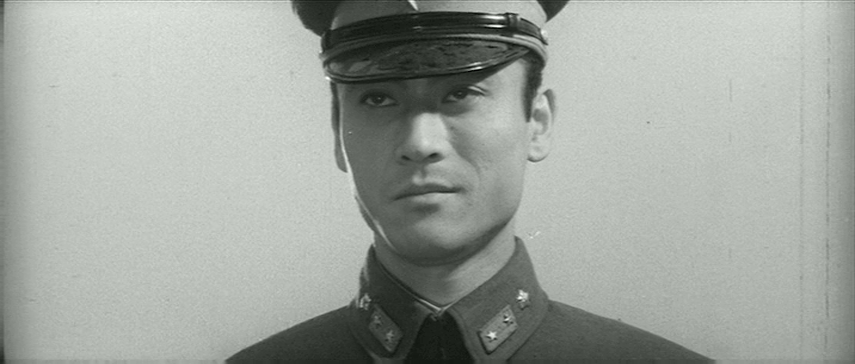
Shigeru Amachi

1941: Military policeman Lt Namishima (Shigeru Amachi) is extremely miffed when Akiko (Nahoko Kubo), the woman he fancies, marries Corporal Tazawa (Shoji Nakayama). Later, when a subordinate loses some classified documents, Namishima decides to take the old maxim of ‘all’s fair in love and war’ a little too literally and frame Tazawa in order to get his hands on his wife. Tazawa receives the death sentence as a traitor and is shot by firing squad, but not before he has placed a curse on Namishima, vowing to get revenge from beyond the grave. However, the dastardly lieutenant continues unabashed with his evil scheme – until Tazawa’s brother becomes an MP and begins investigating his brother’s death…

Shoji Nakayama and Nahoko Kubo


This Shintoho production was ordered by producer Mitsugu Okura, who assigned director Nobuo Nakagawa to come up with a new film to cash in on the (presumably modest) box office success of the previous year’s The Military Policeman and the Dismembered Beauty. Like that picture, this also features actors Shoji Nakayama and Shigeru Amachi, but here they play different characters and the story is unrelated. The earlier film had been directed by Kyotaro Namiki, who seemed not to be terribly at home in the horror genre, so the choice of Nakagawa – who had already enjoyed success with several such films – makes perfect sense. 

Shoji Nakayama contemplates the work of some over-enthusiastic gravediggers


Surprisingly, Japanese Wikipedia suggests that Nakagawa originally developed a straightforward thriller with screenwriter Yoshihiro Ishikawa and the supernatural element was added later at Okura’s insistence, and it does feel like something of an afterthought, most of the (fairly mild) spooky stuff being held back for the climax. In any case, Nakagawa’s film is much superior to the previous one. He and cinematographer Tadashi Nishimoto were able to make use of the new widescreen format and clearly went to considerable trouble in shooting scenes from unusual angles, making this an often visually arresting piece of work, even if they occasionally get a bit too carried away with tilting the camera this way and that. 

Shigeru Amachi


The film is unusual in featuring a villain as the main character, and it’s Shigeru Amachi in this role who gives the strongest performance, although he gets stiff competition from Yoko Mihara as the bad girl of the piece. It’s also fun to see Masayo Banri as a sexy nightclub dancer, but perhaps best of all is an absolutely priceless moment of (possibly unintentional) black comedy involving a corpse disposal.

Yoko Mihara

 
Masayo Banri