Showing posts with label Nobuo Nakagawa. Show all posts

Tuesday, 1 September 2026

O-Den jigoku / お伝地獄 (‘O-Den Hell’, 1960)

Obscure Japanese Film #277

Eiji Funakoshi and Machiko Kyo


The early Meiji era (1870s). O-Den (Machiko Kyo) and Naminosuke (Eiji Funakoshi) are young villagers recently married. Naminosuke is suffering from a mysterious illness, but they lack the money to pay for proper medical care. Then Daihachi (Taiji Tonoyama), a man who had wanted to marry O-Den, turns up and gives her the necessary money, but then reveals there’s a catch – she has to sleep with him for it. The two argue on a bridge with rotten railings and Daihichi rather conveniently falls to his doom below.


Taiji Tonoyama


The couple hotfoot it to Tokyo, where Naminosuke is treated by a dashing young doctor, Sugimoto (Keizo Kawasaki), who dresses in the newly-fashionable Western style. He gives Naminosuke a medicine which proves very effective in stopping the pain, but he becomes reliant on it and it’s not long before O-Den is sleeping with the doctor in order to get repeat prescriptions – and so begins her fall into immorality...


Keizo Kawasaki


This Daiei production was based on a novel of the same name from 1935 by Kanji Kunieda (1892-1956), who had previously provided the source material for Tamizo Ishida’s Kenka tobi (1939) and Mizoguchi’s Utamaro and His Five Women (1946) among others, but appears to have remained untranslated in English. His novel was itself based on the story of O-Den (or Oden) Takahashi, who was convicted of murder and beheaded in 1879 at the age of 31. Kodansha’s Japan: An Illustrated Encyclopedia contains the following entry on Takahashi:


Murderess, the most notorious dokufu (wicked woman) of the modern era. Accused of several sex-related murders, Oden was the first woman to be executed by beheading after the Edo period (1600-1868). Born in what is now Gumma Prefecture, she was known from girlhood for her beauty and promiscuity. Her life of crime began after her husband contracted leprosy. When the disease proved incurable, Oden allegedly poisoned her husband and embarked on a career of prostitution, larceny and homicide. Arrested in 1876 for slitting the throat of a used-clothing merchant at an inn in Asakusa, she was convicted and ultimately executed. It was the most sensational crime story of the day, and lurid accounts of Oden’s escapades filled the newspapers. The popular author Kanagaki Robun wrote a spicy novel based on her life, Takahashi Oden yasha monogatari (1879, Tale of Takahashi Oden, the She-Devil), which Kawatake Mokuami adapted as a kabuki play.


I can’t vouch for the accuracy of all of the information in the above entry, but it’s certainly clear that O-Den’s life began to be fictionalised in the very year of her death, and few of her chroniclers seem to have worried much about the actual facts since. Surprisingly, this film version features no throat-slitting, no arrest of O-Den and no execution. It’s also worth noting that, although it’s widely believed that she was the last woman to be executed by beheading in Japan, that’s simply not the case – there were at least a further 22 women put to death in this way in the two years following O-Den’s execution.


O-Den had already been the subject of at least half a dozen previous films, including silent pictures now lost, as well as Nobuo Nakagawa’s Dokufu Takahashi Oden (1958), usually known in English as A Wicked Woman, and a 1935 version of Kunieda’s novel directed by Tamizo Ishida. I doubt that Ishida’s film has survived, but the theme song sung by Kiyozo Shinbashi (who appeared in Sadao Yamanaka’s 1935 film The Million Ryo Pot) has, and you can listen to it on YouTube here. Incidentally, the role of O-Den in Ishida’s film was played by Sumiko Suzuki, who had also played her in a 1929 film. Suzuki (1904-85) is largely forgotten today, but may be known to some as the star of The Ghost Cat and the Shamisen (1938) and she apparently cornered the market in ‘ghost cat’ roles.


This film is so unlike Nakagawa’s version of O-Den’s story from only two years previously that it would be easy to miss the fact that they were inspired by the same real-life person. Director Keigo Kimura, who also wrote the screenplay, avoids the obvious exploitation elements of the story and focuses instead on charting the moral downfall of a woman who begins as a model wife trying her best to help her suffering husband. Having been the one to turn Machiko Kyo into a star in his 1949 film A Fool’s Love and worked with her frequently since, he was perhaps also concerned with providing her with a juicy role, which he certainly did. It’s a very sympathetic portrayal of O-Den which views her largely as a victim of circumstance – or fate – and her journey into cynicism is played perfectly by Kyo. In fact, performances are top-notch all round, with Eiji Funakoshi being especially believable in a difficult role as a man frequently almost out of his mind with pain.


Kimura pays considerable attention to period detail, and we see how the then-recent opening up of Japan has introduced various novel experiences to its people, from the eating of beef to having a photograph taken. In terms of style, he uses mainly long- and medium-shots throughout, with few close-ups and slightly longer takes than usual, allowing plenty of freedom to his actors, something which is especially apparent in Kyo and Funakoshi’s final, dramatic scene together. Kimura also seldom cuts to his main characters when transitioning between scenes, opting instead to focus briefly on random people going about their business: a crouching rickshaw driver tapping his pipe on the wheel of his vehicle, a young child fascinated by a sparkler, an old man enjoying a bottle of beer at a festival. As someone who’s always disliked the received wisdom that everything should be there to move the plot along, I heartily approve of these beautiful moments, and it’s these more than anything that, for me, make this an exceptionally fine film.


A note on the title:

The ‘O’ in O-Den’s name is an honorific prefix seldom used today, while the ‘Den’ (伝) can mean ‘legend’ in English, and the film is sometimes listed as ‘The Legendary Hell’, which makes little sense and, as far as I’m aware, was never an official release title. It does seem odd to use to use ‘O-Den Hell’ as a title without the character の, which would indicate that the English should be ‘O-Den’s Hell’ or ‘The Hell of O-Den’; my guess is that O-Den Hell is a sort of nickname, but I haven’t been able to confirm this.


Thanks to A.K.


DVD at Amazon Japan (no English subtitles)


If you’d like to support this blog, you can Buy Me a Coffee


Monday, 2 June 2025

Hachi hyakuman goku ni idomu otoko / 八百万石に挑む男 (‘The Man Who Made an 8 Million koku Challenge’, 1961)

Obscure Japanese Film #191


Utaemon Ichikawa and Katsuo Nakamura


1729. Ten’ichibo (Katsuo Nakamura, brother of Kinnosuke Nakamura) is a young man who drifts from town to town gambling and drinking. He carries an antique dagger and letter explaining that the knife is an heirloom given to him as he is the illegitimate son of the eighth shogun, Yoshimune Tokugawa (Shin Tokudaiji), but nobody believes him and Ten’ichibo himself is uncertain of the truth. However, both the letter and the weapon look authentic and when the story comes to the attention of once-powerful samurai vassal Iganosuke (Utaemon Ichikawa), he cares little whether it’s true or not, but sees an opportunity to take over the shogunate by claiming Ten’ichibo as the rightful heir. It’s a high stakes gamble which could cost Ten’ichibo and Iganosuke their lives if they fail, but win them 8 million koku if they succeed (koku being a unit of measurement of rice, which was how wealth was calculated at the time). The shogun’s advisor, Matsudaira (So Yamamura), is also unconcerned about the truth of Ten’ichibo’s parentage, but wants to discredit him anyway to retain the power of the current regime… 


So Yamamura


Inspired by a real historical event and based on an original screenplay by regular Kurosawa collaborator Shinobu Hashimoto, this Toei production was directed by Nobuo Nakagawa, best remembered today for horror movies such as The Ghost of Yotsuya (1959), though the genre accounted for only eight out of his nearly 100 films. Many of his pictures tended to be quite low budget, but this one looks comparatively expensive, boasting elaborate costumes and impressive sets. Typically for a Hashimoto script, it’s full of cruel ironies and highlights the hypocrisy of the feudal system. 


Utaemon Ichikawa


Most (if not all) of the cast had theatre backgrounds, and the acting is rather stagey, with many of the actors projecting their voices as if worried about not being heard in the back row.   Given the formal context of most of the dialogues, the stiffness of some cast members is perhaps inevitable, but I’m not sure there’s much excuse for Utaemon Ichikawa, who – with his demoniacal laugh – is such an old ham he’d make Tod Slaughter blush. It’s also a very male-dominated movie, and the one female character (played by Hiroko Sakuramachi) has very little to do except be a victim. Fans of chanbara (sword-fighting films) should be warned that there is very little action (with the climax even taking place off screen), but, on a more positive note, the battle of wills between the two sides is tense enough to hold the interest for the most part, and there’s a fine score by Chumei Watanabe. 


Hiroko Sakuramachi


The story of the Ten’ichibo jiken, or ‘incident’ (as it is often referred to in Japan), has been filmed many times – there were numerous silent versions (now lost) as well as various TV versions made subsequent to this film. However, the most notable other feature film version is Daisuke Ito’s Suronin makaritoru (1947), the first period drama made after the war, starring Tsumasaburo Bando as Iganosuke and Akihiko Katayama as Ten’ichibo, which is available on DVD (without English subtitles) here. The real Ten’ichibo was arrested, charged with being an imposter, sentenced to death and executed.  

Thanks to A.K.


Tuesday, 31 October 2023

The Military Policeman and the Ghost / 憲兵と幽霊 / Kenpei to yurei (1958)

Obscure Japanese Film #84

Shigeru Amachi

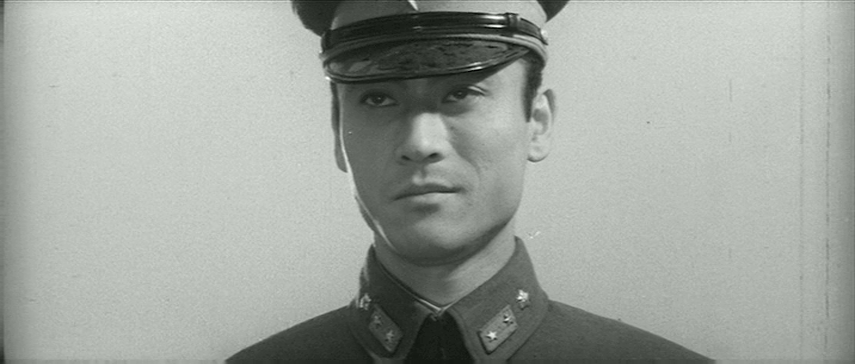
1941: Military policeman Lt Namishima (Shigeru Amachi) is extremely miffed when Akiko (Nahoko Kubo), the woman he fancies, marries Corporal Tazawa (Shoji Nakayama). Later, when a subordinate loses some classified documents, Namishima decides to take the old maxim of ‘all’s fair in love and war’ a little too literally and frame Tazawa in order to get his hands on his wife. Tazawa receives the death sentence as a traitor and is shot by firing squad, but not before he has placed a curse on Namishima, vowing to get revenge from beyond the grave. However, the dastardly lieutenant continues unabashed with his evil scheme – until Tazawa’s brother becomes an MP and begins investigating his brother’s death…

Shoji Nakayama and Nahoko Kubo


This Shintoho production was ordered by producer Mitsugu Okura, who assigned director Nobuo Nakagawa to come up with a new film to cash in on the (presumably modest) box office success of the previous year’s The Military Policeman and the Dismembered Beauty. Like that picture, this also features actors Shoji Nakayama and Shigeru Amachi, but here they play different characters and the story is unrelated. The earlier film had been directed by Kyotaro Namiki, who seemed not to be terribly at home in the horror genre, so the choice of Nakagawa – who had already enjoyed success with several such films – makes perfect sense. 

Shoji Nakayama contemplates the work of some over-enthusiastic gravediggers


Surprisingly, Japanese Wikipedia suggests that Nakagawa originally developed a straightforward thriller with screenwriter Yoshihiro Ishikawa and the supernatural element was added later at Okura’s insistence, and it does feel like something of an afterthought, most of the (fairly mild) spooky stuff being held back for the climax. In any case, Nakagawa’s film is much superior to the previous one. He and cinematographer Tadashi Nishimoto were able to make use of the new widescreen format and clearly went to considerable trouble in shooting scenes from unusual angles, making this an often visually arresting piece of work, even if they occasionally get a bit too carried away with tilting the camera this way and that. 

Shigeru Amachi


The film is unusual in featuring a villain as the main character, and it’s Shigeru Amachi in this role who gives the strongest performance, although he gets stiff competition from Yoko Mihara as the bad girl of the piece. It’s also fun to see Masayo Banri as a sexy nightclub dancer, but perhaps best of all is an absolutely priceless moment of (possibly unintentional) black comedy involving a corpse disposal.

Yoko Mihara

 
Masayo Banri


Saturday, 18 December 2021

Chutaro of Banba /番場の忠太郎/ Banba no Chutaro (1955)

Obscure Japanese Film #8 

Isuzu Yamada and Tomisaburo Wakayama

Based on a play by Shin Hasegawa entitled Mabuta no haha (which translates rather awkwardly as ‘Mother of the Eyelids’), Chutaro of Banba stars Tomisaburo ‘Lone Wolf’ Wakayama in one of his first film appearances as the title character. Having already been a famous kabuki actor before quitting the theatre in 1953 to concentrate on judo (becoming a black-belt in the process), Wakayama’s cinema career saw him go straight into starring roles in action pictures.

Chutaro of Banba has an autobiographical element as original author Hasegawa had himself been separated from his mother at an early age and the hero of his story is a matatabi (wandering yakuza) searching for his long-lost mother. Along the way, Chutaro gets into fights with less honourable yakuza, picks up a couple of waifs and strays, makes a few friends and falls in love. The opening fight scene may seem a little tame as, pre-dating Yojimbo by several years,  it’s too early for spurting blood, hacked-off limbs and even the sound of clashing swords, but Wakayama moves pretty fast for a chubby guy and is even better in a later fight scene when he fends off multiple opponents with a water dipper. 


The film boasts a strong supporting cast, three of whom have Kurosawa connections. Chutaro’s friend Hanji is played by Koji Mitsui, who appeared in seven Kurosawa films from Scandal to Dodes’ka-den, most notably as the gambler in The Lower Depths, where he got to deliver the memorable last line, ‘Idiot…you ruined the song.’ He rarely played a leading role, but specialised in acerbic character parts in which his wonderfully rasping voice and expressive facial features made an indelible impression. The English Wikipedia page for Mitsui is surprisingly detailed and well worth a read.


Koji Mitsui

Hanji’s sister, who supplies the love interest in the film, is played by Yoko Katsuragi, who was Takashi Shimura’s sick daughter in Kurosawa’s Scandal and also popped up in the Kurosawa-scripted The Portrait (1948), directed by Keisuke Kinoshita, although she has a better part in Kinoshita’s A Broken Drum (1949) as an aspiring actress playing Hamlet. 

Yoko Katsuragi
 

Most notably, however, Isuzu Yamada appears as Chutaro’s mother. Yamada was one of the greats and appeared in three films for Kurosawa, always in villainous roles - most memorably as the Lady Macbeth equivalent in Throne of Blood. In her youth she had been a beauty, often playing romantic leads, and she had in fact appeared in the first version of Mabuta no haha in 1931 – not as the mother, but as Otose, the half-sister Chutaro never knew he had (played in the 1955 version by Sanae Mitsuoka). 


Isuzu Yamada

The 1931 film was a silent directed by Hiroshi Inagaki and starring Tomu Uchida favourite Chiezo Kataoka (Bloody Spear at Mount Fuji / Swords in the Moonlight / Killing in Yoshiwara). Kataoka repeated the role for a 1936 version, while a third appeared in 1938 starring Kazuo Hasegawa (Gate of Hell / An Actor’s Revenge), making the 1955 film the fourth but not the last: in 1962, Tai Kato directed a remake with Kinnosuke Nakamura.

This 1955 Shintoho version is directed by Nobuo Nakagawa, remembered mostly for his horror films and sometimes referred to as ‘the Roger Corman of Japan.’ His best-known film nowadays seems to be Jigoku (Hell, 1960) – a shame, as I personally thought that was easily the worst of the five Nakagawa films I’ve seen. Much better were The Ghost of Yotsuya and a couple of female-focused films noir, Death Row Woman and A Wicked Woman. 

Hisaya Morishige, Tomisaburo Wakayama and Yoko Katsuragi


Chutaro of Banba has a lot going for it – the strong cast, which also includes an enjoyable guest star appearance by Hisaya Morishige as a surprisingly genial law enforcement official; Kagai Okaido’s dynamic camerawork and excellent sense of composition, and a pretty decent music score by Yasuji Kiyose. The story may be sentimental but there are quirks enough to keep things interesting all the way to the finale, when we are treated to one of those unnecessarily  sad endings that Japanese audiences seem to crave (see my earlier review of The Saga of Tanegashima for more thoughts on this phenomenon).

The film can be bought in a good quality print with excellent subtitles (by Merlin David) here: https://samuraidvd.com/chutaro-of-banba/