Showing posts with label Kaoru Yachigusa. Show all posts

Monday, 30 March 2026

Settlement of love / 愛情の決算 / Aijo no kessan (1956)

Obscure Japanese Film #255

Shin Saburi


Narasaki (Shin Saburi) has married Katsuko (Setsuko Hara), the widow of a soldier who got killed fighting alongside Narasaki in the Philippines and who left her with a son, Hiroshi. However, it was a marriage of convenience and there’s been little intimacy between the two – her husband is suffering from PTSD and suppressing his emotions, so he often comes across as a bit of a cold fish. One of Narasaki’s friends is Ohira (Toshiro Mifune), a less damaged veteran who finds himself attracted to Katsuko. Emotionally starved as she is, she finds herself falling for him despite her moral qualms...


Setsuko Hara


This Toho production was based on a story entitled Kono ju-nen (‘These 10 Years’) by Hidemi Kon (1903-84), who had himself been stationed in the Philippines during the war. It was adapted by Toshiro Ide, a notable screenwriter who worked for many of Japan’s top directors, but is perhaps best-known for his frequent collaborations with Mikio Naruse, whose films this one somewhat resembles. On this occasion, however, the director is none other than star actor Shin Saburi, whom I’ve often criticised in previous reviews for being wooden. After seeing this film, he’s definitely gone up in my estimation as, not only does he give a better performance than usual – indeed, there are times you could almost swear that he’s alive – but he also does a highly creditable job of direction. This was actually the 11th of 14 films he directed, though I’ve yet to see any of the others.


Toshiro Mifune


Saburi also gets excellent performances out of the rest of the cast, although considering that – apart from Setsuko Hara and Toshiro Mifune – this also includes Keiju Kobayashi, Murasaki Fujima and Kaoru Yachigusa, they may not have needed too much help. Mifune might seem an unlikely romantic lead but, reunited with Hara after their successful pairing in Tokyo Sweetheart (1952), he again shows that he was quite capable of giving a good performance in a non-aggressive role. However, top-billed Hara is the real star of the show here and for her part she demonstrates a wide range of subtle expressions that her work for Ozu rarely allowed her.


Setsuko Hara


Aside from being a strong love story for grown-ups which offers no fairy-tale endings or easy solutions, the film is also an insightful portrait of post-war Japanese life, the story taking place in flashbacks over a period of 10 years from the end of the war until what was then the present day. We witness the lives of the various characters change greatly during this period, especially in economic terms – immediately after the war, they’re all living hand-to-mouth, but some prove able to adapt to new circumstances very successfully and become quite wealthy within just a few years, while others (like Narasaki) are, to their detriment, unable to let go of the past and seem bewildered by the sudden dramatic social changes. Meanwhile, the Americans are a constant background presence throughout – jeeps rumble through the streets and military jets fly over, startling everyone with their sudden noise. Such sights are common in films of the period, and this one in particular shows that the war and its aftermath continued to affect the lives of everyone in the country in all sorts of subtle ways.

A pleasant surprise, then, and a film well-worth seeking out.


If you enjoy this blog, feel free to Buy Me a Coffee!


Tuesday, 1 July 2025

Snow Country / 雪国 / Yukiguni (1965)

Obscure Japanese Film #198


Shima Iwashita


Isao Kimura


Mariko Kaga


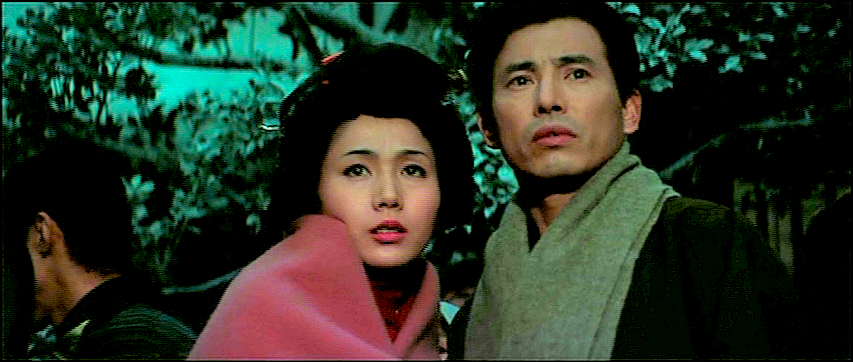
fourth of five films with star Shima Iwashita, and it’s fans of Iwashita who are likely to find this film most rewarding.

Unfortunately, the colour photography did not look its best on the rather low-res copy I watched. 


DVD at Amazon Japan (no English subtitles)

Monday, 23 October 2023

Pu-san / プーサン/ Mr Pu (1953)

Obscure Japanese Film #83

Yunosuke Ito with cabbage


During the war, Japanese filmmakers were severely restricted by the authorities in their country, who would not allow any content that could be perceived as being critical of the military or having a pacifist message. After the war, the country’s filmmakers remained restricted, though the nature of the censorship changed – the occupying Americans banned anything they felt promoted feudalism, while encouraging material with a pro-democracy message, such as the previously reviewed A Descendant of Urashima Taro. The occupation ended in 1952, and it’s no coincidence that Kon Ichikawa’s Pu-san appeared the following year when the film industry was finally free of political restrictions for the first time in over a decade. 

Ito with Daisuke Kato


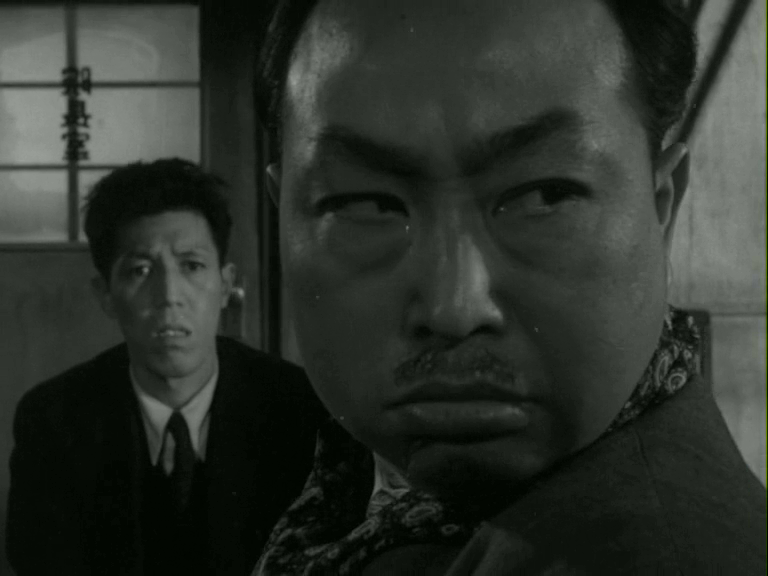
In Pu-san, Ichikawa gleefully indulges in a vulgarity that would have been frowned upon in previous years, while also emphasizing the fact that idealism has little value in a world where people are struggling simply to get enough to eat and keep a roof over their heads. This situation enables employers to exploit workers like Noro (Yunosuke Ito), a downtrodden 39-year-old maths teacher whose boss (Daisuke Kato) gives him a stark choice: teach extra night classes with no additional pay, or leave. Noro is a classic ‘loser’ whose unassuming manner attracts bad luck – this crisis happens shortly after he has been knocked down by a truck in Ginza and injured his hand. A widower and war veteran, he lodges with a couple in their 50s and is in love with their 24-year-old daughter, Kanko (Fubuki Koshiji), but his feelings are not reciprocated, as he learns only too well after overhearing a conversation between Kanko and her mother through the paper-thin wall of his room. Meanwhile, Noro’s students are flirting with communism and his old friends are reduced to selling items on the black market… 

Fubiki Koshiji, Daisuke Kato and Yoko Sugi


Such a scenario may not seem an obvious choice for comedy, but that’s exactly what this Toho production is – and a determinedly eccentric and anarchic one to boot. Based on a comic strip by Taizo Yokoyama (who makes a cameo appearance as a policeman), it’s unclear (at least to me) why Pu-san is referred to as Noro throughout the film. In any case, Ichikawa seems to be raising two fingers to the establishment here, and it’s probably the earliest Japanese film I’ve seen to have that ‘new wave’ vibe familiar from later pictures such as Shohei Imamura’s Pigs and Battleships (1959). It’s not at all funny but certainly ironic that the only way Noro can survive in the end is by taking a highly dubious job packing machine gun bullets. 

Eiko Miyoshi, Kamatari Fujiwara and Fubiki Koshiji


Long-faced character actor Yunosuke Ito has not always played such meek and mild types, but proves to be a good choice in what was a rare leading role for him. However, I felt that Fubuki Koshiji (better known as a singer) stole the show here with her superb comic performance as the stubborn Kanko (a character originating in a separate comic strip by the same artist) – her facial expressions are often priceless. 

Kaoru Yachigusa


Also notable in a remarkable ensemble cast featuring a number of Kurosawa regulars are Keiju Kobayashi as a young policeman, a very young-looking Kaoru Yachigusa as a nurse, Isao Yamagata as a friend of Noro’s fallen on hard times, Eiko Miyoshi as Noro’s opportunistic landlady, Kamatari Fujiwara as her more understanding husband, Yoko Sugi as Kanko’s best friend and, of course, the great Daisuke Kato as Noro’s nasty boss – the kind of guy who smiles and tells you it’s all for your own good while casually cutting your throat. 

Daisuke Kato


Ably abetted by Kurosawa cameraman Asakazu Nakai, Ichikawa shows considerable invention throughout, often using extreme close-ups and unusual framing but, overall, I’d say that Pu-san is more in the nature of a fascinating oddity than a complete success – the first few scenes flit confusingly from one seemingly random group of characters to another and it remains all over the place until the end. In fact, I doubt I’ve seen another film with as many extraneous characters – a narrower focus would surely have been preferable. 

Composer Toshiro Mayuzumi in a rare screen appearance with Fubiki Koshiji