Obscure Japanese Film #198

 |
| Shima Iwashita |
Yasunari Kawabata’s novel Snow Country began to appear in fragmented chapters in 1935, but was not published in its final form until 1948. Set in the mid-1930s at a hot spring resort somewhere in the mountains in the west of Japan’s main island, Honshu, it concerns Shimamura, a writer who rather absurdly writes about Western dancing despite never having witnessed a performance. A married man and father with a certain amount of independent wealth, he’s an idler who travels to the resort alone and meets Komako, a young woman whose company the innkeeper arranges as all of the town’s geisha are already booked for a big party. The two are quickly attracted to one another – Komako falls for him a little too hard, although Shimamura is more reserved and has no intention of leaving his wife. Still, after returning home from his trip, he finds himself unable to forget Komako and returns to see her on two further occasions, by which time she has become a full-fledged geisha. Shimamura also becomes interested in Yoko, a young woman with whom Komako has an uneasy relationship due to their mutual connection to Yukio, a young man dying of tuberculosis who had been Komako’s childhood friend, possibly fiancée, and is now being cared for by Yoko…
 |
| Isao Kimura |
Snow Country was first filmed in 1957 by director Shiro Toyoda for Toho with Keiko Kishi as Komako, Ryo Ikebe as Shimamura and Kaoru Yachigusa as Yoko. This Shochiku version directed by Hideo Oba a mere eight years later is by no means a carbon copy. Most obviously, whereas the earlier film was shot in academy ratio black and white and ran 143 minutes, this film is in colour and widescreen and (mercifully) runs 21 minutes shorter. Oba’s reputation is considerably less distinguished than Toyoda’s – probably rightly so – but in some respects his film does manage to improve on the previous one.

As played by Keiko Kishi, Komako came across as childish, over-emotional and actually quite annoying, her mood changing by the minute, whereas Shima Iwashita somehow manages to avoid the pitfalls of playing Kawabata’s heroine, making her appeal for Shimamura much more understandable (although why she should be drawn to him so much is less clear). The music is also an improvement – there was way too much of it in Toyoda’s film, and the quality was also poor, but Naozumi Yamamoto’s superior score is used more sparingly and effectively even if it is occasionally on the syrupy side.
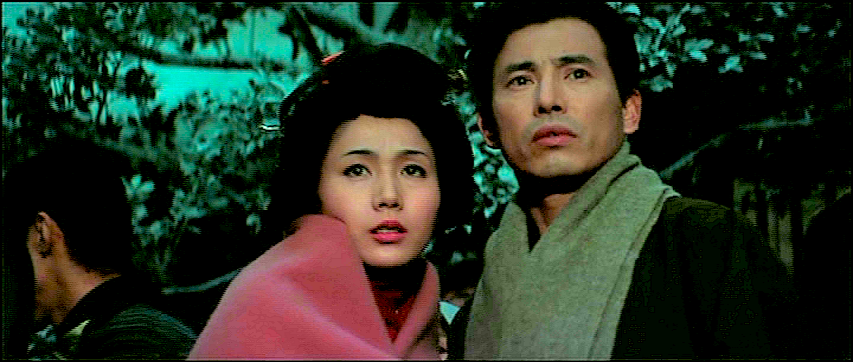
On the other hand, as Shimamura, Isao Kimura (a respected actor but not a big star), lacks Ryo Ikebe’s charisma and makes little impression, while Toyoda’s snowscapes were more visually arresting even without the benefit of colour and widescreen. The underwritten character of Yoko is a thankless role in both films, but I felt that Kaoru Yachigusa managed it better than Mariko Kaga does here. Incidentally, Chieko Naniwa – who played the head maid in the earlier picture – somehow managed to get herself cast again here, this time playing the blind masseur.
 |
| Mariko Kaga |
Like the novel, Toyoda began his film with Shimamura’s second visit before flashing back to the first, while Oba has opted for a chronological timeline and also added a little narration from Shimamura which works well. Toyoda had found it more convenient to make Shimamura a painter, while Oba retains the character’s occupation as described by Kawabata, but adds a scene with Shimamura’s wife (played by Kaneko Iwasaki), who is only spoken about in both the book and the first film. One aspect that both films have in common is to resolve some of the ambiguity of the novel, in which it’s never really clear whether Shimamura and Komako sleep together or whether Yoko survives the climactic fire – both filmmakers strongly imply that the relationship is consummated and clarify the fate of Yoko. The two films both have their strengths and weaknesses and it will be a matter of personal opinion which one is preferred, but in my view Kawabata’s famous work is not terribly well-suited to film adaptation.

In regard to Hideo Oba, a director best-known for his What’s Your Name? trilogy (1953-54), but still obscure to most, I suspect that his previously-reviewed film The Invisible Wall (1958) was a random assignment that did not especially interest him, whereas this was a project he at least put his heart into even if it’s no masterpiece. Like the other four films I’ve seen by him, it’s well made but not particularly inspired, original or individual. It was his sixtieth film out of the 64 he would direct and his final screenplay credit out of 14, as well as his fourth of five films with star Shima Iwashita, and it’s fans of Iwashita who are likely to find this film most rewarding.
Unfortunately, the colour photography did not look its best on the rather low-res copy I watched.

DVD at Amazon Japan (no English subtitles)


