Obscure Japanese Film #224
.png) |
| Keiko Tsushima |
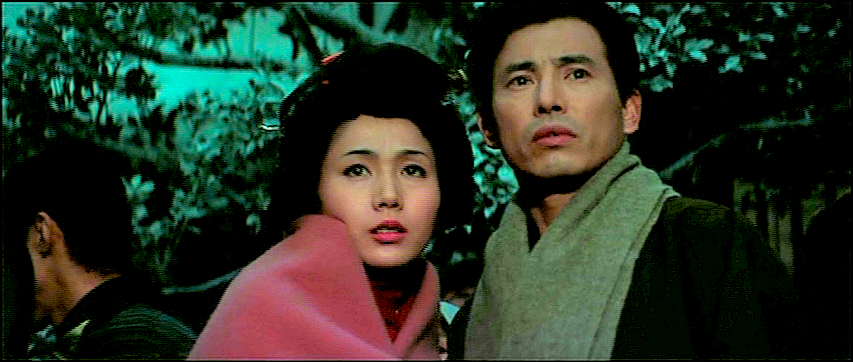
1932. Intending to kill herself in a beautiful place, high school girl Yukiko (Keiko Tsushima) travels to Lake Towada in northern Honshu, but her plans are foiled by Kyosuke (Jukichi Uno), an older artist who happened to be contemplating suicide in the same spot. Kyosuke is disabled as a result of contracting polio at the age of 30 and is miserable because his wife has left him and run off with his apprentice.
.png) |
| Jukichi Uno |
As Yukiko tells her story to Kyosuke, we learn in flashback that she is an orphan brought up by her cold-hearted aunt (Sachiko Murase), who considers Yukiko’s mother to have been a slut as she had Yukiko out of wedlock and who thinks that Yukiko will go the same way. Yukiko’s best friend, Tatsuko (Chieko Seki), has already dropped out of school and become a dancer at the Casino Follies in Asakusa, run by dapper gangster Aoto (Eitaro Ozawa), who has already broken up Tatsuko’s relationship with her fiancé Miyoshi (Isao Kimura).
.png) |
| Chieko Seki |
Yukiko finds herself in the awkward position of becoming an intermediary between Tatsuko and Miyoshi, but the result is that she falls out with Tatsuko and becomes close to Miyoshi, who gets in a fight with Aoto, stabs him in self-defence and is forced to flee. Yukiko is then expelled from school for having been friends with Miyoshi, who is now wanted by the police.
.png)
Isao Kimura
Back in the present, Yukiko and Kyosuke become close companions. Four years pass, and it’s now 1936. When the attempted coup of February 26 occurs, they head south to escape the chaos, and she suggests going to Innoshima island. Her hidden motive is that she knows this is where Miyoshi fled to and is hoping to see him again. She finds him in a remote fishing village where he has now become engaged to fisherman’s daughter Tome (Hitomi Nozoe)…
.png) |
| Hitomi Nozoe |
This independent production by by Chuo Eiga (who made the previously-reviewed Sisters the same year) was based on a popular radio serial of the time by the prolific Kazuo Kikuta (male, 1908-73), who also provided the source material for Kurosawa’s The Silent Duel (1949), Hideo Oba’s What’s Your Name? (trilogy 1953-54) and wrote the play version of Fumiko Hayashi’s autobiographical Horo-ki filmed by Mikio Naruse in 1962 (the film is known in English as A Wanderer’s Notebook).
.png) |
| Sachiko Murase |
It’s difficult to see what director Tadashi Imai saw in this corny and sentimental misery fest – certainly, it’s quite a dull watch and there’s little of interest in it in terms of direction, although he does do an excellent job of recreating the Asakusa of 1932. This neighbourhood was largely destroyed in bombing raids during the war, but the Casino Follies was a real venue located, oddly enough, above an aquarium, and the mock-up constructed for this film looks identical.*
.png)
Keiko Tsushima
Matters are not helped by the miscasting of
the 29-year-old Keiko Tsushima, who’s entirely unconvincing as a
high school teenager and immediately looks more comfortable as soon
as her character’s finally grown up a bit and shed the sailor suit
uniform. The organ music featured prominently on the soundtrack is
another poor choice.
.png) |
| Eitaro Ozawa and Chieko Seki |
The only people to come out of this film well are Sachiko Murase (later the elderly heroine of Kurosawa’s 1991 film Rhapsody in August), whose performance suggests a thin line between puritanism and sadism, and Eitaro Ozawa as the foppish, narcissistic bully Aoto. Ozawa seems to have got into his role a bit too much, in fact, as I swear he’s hitting poor Isao Kimura for real during their big confrontation scene.
*Go to this link if you’d like to compare the two.
Watched with dodgy subtitles.