Showing posts with label Isao Yamagata. Show all posts

Thursday, 6 November 2025

A Picture of Madame Yuki / 雪夫人繪圖 / Yuki Fujin ezu (1968)

Obscure Japanese Film #227


1949. Teenage orphan Hamako (Sumiko Hasegawa) arrives at a grand residence at Shinobazu Pond in Ueno, Tokyo, to serve as maid to the aristocratic Madame Yuki (Yoshiko Sakuma), whose father, a former viscount, has just died. Various relatives and opportunistic acquaintances flock to the scene like vultures hoping to secure a piece of the carcass for themselves. Among them are Yuki’s husband, Naoyuki (Isao Yamagata), who spends most of his time in Kyoto with his mistress, Ayako (Yuko Hama). However, it turns out that Yuki’s father has left nothing but debts, so the house is sold and the family’s other home in snowy Nagano is turned into an inn. Meanwhile, Yuki has been having an affair with Kikunaka (Tetsuro Tanba), a married writer, but even though she detests her own husband, he retains a mysterious sexual hold over her from which she seems unable to break free...


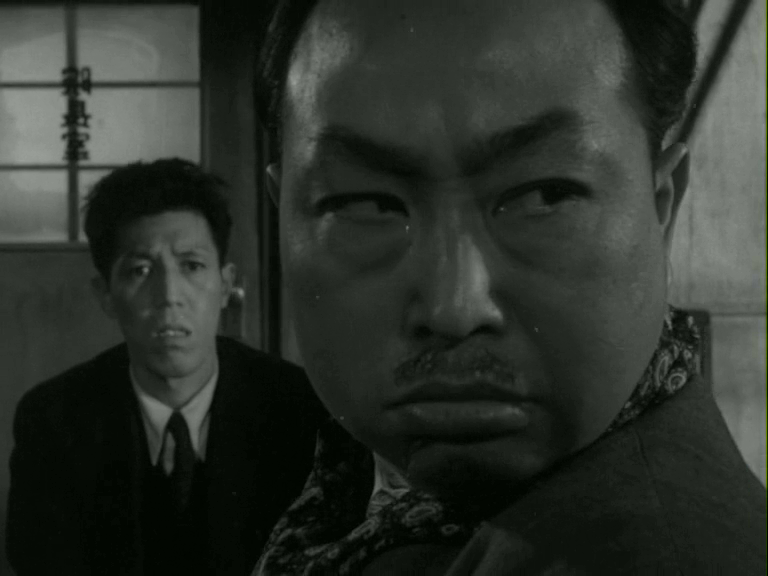
Isao Yamagata


Although the official English title of this film chooses ‘Picture’ over ‘Portrait’, it is, of course, based on the same novel as the better-known Kenji Mizoguchi film of 1950. The novel, by Seiichi Funahashi* (1904-76), first appeared in serial form between 1948-1950 and remains untranslated into English. To be frank, I can’t stand the story in either film version. One reason is the portrayal of unquestioning devotion, even idolatry, of a servant for her mistress, which seems to give tacit approval to the class system. Although Hamako becomes disillusioned with her mistress and Funahashi may have been trying to make a broader point about the disillusionment of the younger generation in the post-war years regarding the ruling class, the problem is that Yuki is presented as someone to be pitied and, if not deserving of the elevated status she enjoyed, it’s only because of her lack of courage. Indeed, while her self-pitying, acquiescent victimhood is irritating, she’s still painted as a tragic heroine. It also doesn’t help that the bad behaviour of the villains of the piece – the cruel husband and his predictably cheap and vulgar mistress – is so blatant that it’s never convincing.


At heart, the story is an old-fashioned melodrama, and, while the writer-director of this version, Masashige Narusawa – who had been a screenwriter for Mizoguchi on four of the latter’s final films – has for the most part clearly tried to downplay this as much as possible, still it is what it is. He certainly made a very different film to his mentor’s and was, reportedly, more faithful to the original novel. However, well-photographed though it is, it lacks the often inspired camera placement and composition found in the original, and so is not really an improvement overall, only in certain aspects. Transferring the bulk of the story to a snowy location (yuki means snow in Japanese) was a good idea, but it’s those crane shots with the rolling mist by the lake at the end of Mizoguchi’s film that linger in my mind.


Tetsuro Tanba


Compared to the wimpy character portrayed by Ken Uehara in 1950, Tetsuro Tanba is a much more commanding, masculine presence, yet none of the performances in either film are especially notable, perhaps because Funahashi – who also wrote the source novel for The Story of a Blind Woman – failed to put much life into them in the first place. Still, it’s a shame that this proved to be the final film directed by Narusawa as he clearly had talent, even if it’s less evident here than in his previous two pictures.


Produced by Toei, who had been pushing Yoshiko Sakuma as a star of literary erotica since their 1963 film of Tsutomu Mizukami’s Gobancho Yugiri-ro (aka A House in the Quarter), this version was shelved and not released until it was bought by Nikkatsu in 1975.


*Sometimes listed as Funabashi, but I think that’s incorrect.

Thanks to Coralsundy for the subtitles, which can be found here.

Thanks to A.K.


Thursday, 17 July 2025

Daikon to ninjin / 大根と人参 / (‘Radishes and Carrots’, 1965)


Chishu Ryu


Yamaki (Chishu Ryu) is a typical middle-aged salaryman who has worked his way up into a comfortable senior management position. He’s been married to Nobuyo (Nobuko Otowa) for 28 years, has four adult daughters and is a creature of habit who rarely deviates from his daily routine. As his younger brother and subordinate co-worker Kosuki (Hiroyuki Nagato) says, he’s ‘as ordinary as radishes and carrots’. 


Hiroyuki Nagato and Nobuko Otowa

However, problems begin to pile up – a friend (Kinzo Shin) has cancer but hasn’t been told, Kosuki has embezzled money from the company and is expecting Yamaki to bail him out, and he’s been getting into increasingly aggressive arguments with his best friend, Suzuka (Isao Yamagata), to whose son his youngest daughter (Mariko Kaga) is sngaged. 


Isao Yamagata

Mariko Kaga


One day, his family are shocked when he fails to return from work. Unbeknownst to them, he’s gone off to Osaka, where he becomes involved with a cheerful call girl (Miyuki Kuwano) and her eccentric pimp (Daisuke Kato), who also has a Chinese medicine business he wants Yamaki to come in on with him…


Miyuki Kuwano

 
Daisuke Kato

This Shochiku comedy features an all-star cast which also includes Ineko Arima, Mariko Okada and Yoko Tsukasa as Yamaki’s other three daughters as well as Ryo Ikebe and Shima Iwashita, although some of these big names (especially Ikebe) are given precious little to do. At the beginning of the film, we’re presented with statistics informing us that over 80, 000 people go missing per year in Japan – a phenomenon which seems an odd topic for comedy. The film originated from an idea by Yasujiro Ozu, no less, who took his inspiration from a short story by Ryunosuke Akutagawa entitled ‘Yamagamo’, which centres around a quarrel between two old friends, and worked up a treatment with his regular collaborator Kogo Noda which remained unfinished. It seems likely that the theme of a man who goes missing was added later by credited screenwriters Yoshio Shirasaka and Minoru Shibuya, the latter of whom directed the film (his penultimate feature). 


Nobuko Otowa and Mariko Okada

 
Shima Iwashita

Although this is actually the first film I’ve seen by Shibuya, he was known for somewhat cynical comedies and it’s clear that Daikon to ninjin  is far closer to his usual style than it is to Ozu’s. In fact, one of the pleasures of the film is seeing its unlikely lead, Chishu Ryu, send up all those ‘perfect father’ roles he played for Ozu over the years. There’s also some surprisingly frank sexual dialogue that would not have been found in an Ozu picture. While Yamaki’s disappearance is not really given sufficient motivation, and the film does seem a rather messy, cobbled-together affair, it remains quite entertaining and likeable, and certainly worth a watch for anyone with an affection for the Japanese actors of the era.

Thanks to A.K. 


Monday, 23 October 2023

Pu-san / プーサン/ Mr Pu (1953)

Obscure Japanese Film #83

Yunosuke Ito with cabbage


During the war, Japanese filmmakers were severely restricted by the authorities in their country, who would not allow any content that could be perceived as being critical of the military or having a pacifist message. After the war, the country’s filmmakers remained restricted, though the nature of the censorship changed – the occupying Americans banned anything they felt promoted feudalism, while encouraging material with a pro-democracy message, such as the previously reviewed A Descendant of Urashima Taro. The occupation ended in 1952, and it’s no coincidence that Kon Ichikawa’s Pu-san appeared the following year when the film industry was finally free of political restrictions for the first time in over a decade. 

Ito with Daisuke Kato


In Pu-san, Ichikawa gleefully indulges in a vulgarity that would have been frowned upon in previous years, while also emphasizing the fact that idealism has little value in a world where people are struggling simply to get enough to eat and keep a roof over their heads. This situation enables employers to exploit workers like Noro (Yunosuke Ito), a downtrodden 39-year-old maths teacher whose boss (Daisuke Kato) gives him a stark choice: teach extra night classes with no additional pay, or leave. Noro is a classic ‘loser’ whose unassuming manner attracts bad luck – this crisis happens shortly after he has been knocked down by a truck in Ginza and injured his hand. A widower and war veteran, he lodges with a couple in their 50s and is in love with their 24-year-old daughter, Kanko (Fubuki Koshiji), but his feelings are not reciprocated, as he learns only too well after overhearing a conversation between Kanko and her mother through the paper-thin wall of his room. Meanwhile, Noro’s students are flirting with communism and his old friends are reduced to selling items on the black market… 

Fubiki Koshiji, Daisuke Kato and Yoko Sugi


Such a scenario may not seem an obvious choice for comedy, but that’s exactly what this Toho production is – and a determinedly eccentric and anarchic one to boot. Based on a comic strip by Taizo Yokoyama (who makes a cameo appearance as a policeman), it’s unclear (at least to me) why Pu-san is referred to as Noro throughout the film. In any case, Ichikawa seems to be raising two fingers to the establishment here, and it’s probably the earliest Japanese film I’ve seen to have that ‘new wave’ vibe familiar from later pictures such as Shohei Imamura’s Pigs and Battleships (1959). It’s not at all funny but certainly ironic that the only way Noro can survive in the end is by taking a highly dubious job packing machine gun bullets. 

Eiko Miyoshi, Kamatari Fujiwara and Fubiki Koshiji


Long-faced character actor Yunosuke Ito has not always played such meek and mild types, but proves to be a good choice in what was a rare leading role for him. However, I felt that Fubuki Koshiji (better known as a singer) stole the show here with her superb comic performance as the stubborn Kanko (a character originating in a separate comic strip by the same artist) – her facial expressions are often priceless. 

Kaoru Yachigusa


Also notable in a remarkable ensemble cast featuring a number of Kurosawa regulars are Keiju Kobayashi as a young policeman, a very young-looking Kaoru Yachigusa as a nurse, Isao Yamagata as a friend of Noro’s fallen on hard times, Eiko Miyoshi as Noro’s opportunistic landlady, Kamatari Fujiwara as her more understanding husband, Yoko Sugi as Kanko’s best friend and, of course, the great Daisuke Kato as Noro’s nasty boss – the kind of guy who smiles and tells you it’s all for your own good while casually cutting your throat. 

Daisuke Kato


Ably abetted by Kurosawa cameraman Asakazu Nakai, Ichikawa shows considerable invention throughout, often using extreme close-ups and unusual framing but, overall, I’d say that Pu-san is more in the nature of a fascinating oddity than a complete success – the first few scenes flit confusingly from one seemingly random group of characters to another and it remains all over the place until the end. In fact, I doubt I’ve seen another film with as many extraneous characters – a narrower focus would surely have been preferable. 

Composer Toshiro Mayuzumi in a rare screen appearance with Fubiki Koshiji


Wednesday, 28 September 2022

Feisty Edo Girl Nakanori-San / べらんめえ中乗りさん / Hibari minyo no tabi beranmee Nakanori-san (1961)

Obscure Japanese Film #37

Hibari Misora

Only after watching this and doing a little research did I discover that Feisty Edo Girl Nakanori-San is the third in the series of five (I think) ‘Beranmee’ films. The first of these appeared in 1959 and is best-known in English as The Prickly-Mouthed Geisha (‘prickly-mouthed’ being a fair translation of the Japanese ‘beranmee’), while the final entry was released in 1963 under the title Beranmee geisha to detchi shachou (‘The Prickly-Mouthed Geisha and the Apprentice President’). However, it seems to matter little that I missed the first two as all are separate stories.


The film is a vehicle for Hibari Misora, one of Japan’s most popular stars of all time, but who remains little-known abroad. Born in 1937 as Kazue Kato, she became a star in late childhood, when she was given the stage name ‘Hibari’, meaning ‘lark’ (as in the songbird) due to her natural singing talent. As an actress, her abilities were a little more limited, but this did not prevent her becoming a major movie star. The film in question was made at the height of her popularity, when she was churning out almost one film a month for Toei Studios. 

Isao Yamagata
 

In Feisty Edo Girl Nakanori-San, Hibari stars as the daughter of a lumber company owner played by Isao Yamagata, probably best-known as Machiko Kyo’s kindly husband in Gate of Hell (1953), but later known for more villainous roles. Here, he is once more on the side of the angels and is also the best actor in the film. Hibari falls in love with the son of a rival company owner, a plot device harking back to Romeo and Juliet, which this movie explicitly references. The son is played by a gangly Ken Takakura, who stands a foot taller than Hibari and looks decidedly uncomfortable here before he had settled into the yakuza niche to which he was better suited. There are few surprises, although things become quite violent for such a piece of fluff, and basing it around the lumber industry certainly seems a novel choice.  Otherwise, it’s business as usual, with the irrepressible Hibari bursting into song on several occasions – though I’m not sure I would call this a musical as there are no big Hollywood-style production numbers.  Nevertheless, the film has its charms and anyone looking for light entertainment could do a lot worse. 

Hibari with Ken Takakura
 

Director Masamitsu Igayama, a former assistant to Tomu Uchida, left the movie business shortly after this film and worked in television until his retirement in 1982. He passed away in 2001 at the ripe old age of 96.