Obscure Japanese Film #104
 |
Ayako Wakao
|
Umeki (Keisuke Sonoi)
is a car salesman who gives a lift to two women whose car has broken down. He’s
immediately attracted by the beauty and well-dressed sophistication of one of his
passengers, Miyuki (Ayako Wakao), with whom he soon becomes obsessed, even
though she’s clearly out of his league. After Umeki questions a hotel clerk
about her, he is approached by Hamada (Eiji Funakoshi), who invites him for a
drink and confides that he is pursuing the same woman. The two men agree to
remain friendly rivals and exchange information about Miyuki, who is extremely
reticent about her private life. It turns out that she lives with her
half-brother, Hidemichi (Takahiro Tamura), who harbours an incestuous desire
for her. Umeki decides to install his current girlfriend, Setsuko (Kyoko
Enami), in their household as a spy by getting her to work as a maid there. It
becomes apparent that there are other men in Miyuki’s life as well, and the
feelings of obsession and jealousy she inspires in the various men competing
for her attentions soon leads to murder…

Based on an
untranslated novel by Seicho Matsumoto, this Daiei production reunited star
Ayako Wakao with director Sokichi Tomimoto, with whom she had recently made Frolic of the Beasts. He does a decent
but unremarkable job, while Wakao is terrific as usual, especially in a scene
in which she learns about a murder and you can really see the wheels turning in
her head as she processes the information. It's a masterclass in reactive acting.
 |
Keisuke Sonoi
|
As the male lead, the
little-known Keisuke Sonoi is competent but lacking in star quality, while
Takahiro Tamura is a little over-the-top at times as the jealous and possessive brother. Eiji Funakoshi, on the other
hand, hits the right note as a man who has completely given himself over to his
obsession, while behind the horn-rimmed glasses of Miyuki’s fashion-designer
friend lurks Rieko Sumi, aka Natsuko from Natsuko’s
Adventure in Hokkaido (see previous review).
 |
Eiji Funakoshi
|
As
Umeki's girlfriend, Kyoko Enami gives a strong performance in an
underwritten role - she was soon to become a major star after Ayako
Wakao hurt herself when she slipped in her bathroom and had to withdraw
from the title role of Onna no toba (Lady Gambler), leaving Enami to
step in and score a big hit which sparked a series of 17 films.
 |
Kyoko Enami
|
As one would expect
from a Matsumoto story, there is a good twist at the end but, unfortunately,
there is also some very lazy writing – we get zero explanation of exactly how
Umeki manages to get Setsuko a job as Miyuki’s maid, for instance. It also
seems as if we’re supposed to take Umeki’s behaviour – which we would call
stalking today – as perfectly normal, and the ease with which people provide
him with sensitive personal information about Miyuki is entirely unrealistic. Having
read a couple of books by Seicho Matsumoto (in translation), I wouldn’t be at
all surprised if these weaknesses are present in the original, especially as
screenwriter Kazuo Funahashi, who also adapted Mishima’s Frolic of the Beasts and Tsutomu Mizukami’s Temple of Wild Geese, tended to be faithful to his literary
sources as far as possible. It’s perhaps also worth noting that Daiei seemed
to have a policy of restricting the running times of their films to around 90
minutes, which would have made any extra exposition challenging.
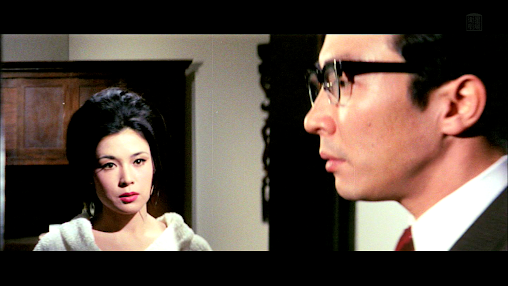
Featuring what sounds
like a musical saw, Sei Ikeno’s music is too often eccentric and distracting,
although it does become highly effective at the end when events reach their
climax. Overall, the film holds the interest fairly well despite its
unconvincing set-up, and it makes a pretty good vehicle for the great talent of
Ayako Wakao, who also changes hairstyles and clothes numerous times throughout.
The Japanese title can
be translated as either ‘Forest without Flowers and Fruits’ or ‘Forest without
Substance’; in my opinion, the latter reading makes more sense. In either case,
it’s a metaphor, so any tree fans out there may be disappointed to learn of the
absence of an actual forest.
Bonus trivia: In 1975, actor Keisuke Sonoi was sentenced to ten years in
prison for tax evasion.


