Showing posts with label Terumi Niki. Show all posts

Saturday, 12 April 2025

Wandering Shore / 流離の岸 / Ryuri no kishi (1956)

Obscure Japanese Film #180

Terumi Niki

 
Sachiko Murase

Chiho (Terumi Niki) is a young child left alone in the country to be raised by her grandmother , Uta (Sachiko Murase), because her mother, Hagiyo (Nobuko Otowa), has left her father and is getting remarried. Chiho is a sensitive but also somewhat wilful and proud child who misses her mother but doesn’t like to admit it. Uta sends Chiho to take food to her neighbour, Okichi (Sachiko Soma), whom Uta has known since childhood. Uta is now a penniless old lady living in a shack; according to Uta, she has ended up this way because she was frivolous in her relationships with men and spent her life doing what she wanted without regard for the consequences. 

Mie Kitahara and Nobuko Otowa


After a year, Chiho goes to live with her mother and stepfather, Takakura (Nobuo Kaneko), who has a son of his own, but Chiho’s status is lower and she feels it. Ten years pass, and Chiho (now played by Mie Kitahara) is a high school student living with her uncle (Taiji Tonoyama) and his wife (Yoshiko Tsubouchi). When Chiho wakes up one day with a strange pain in her finger, she goes to see her friend’s father, a doctor, but he’s out, so the doctor’s son, a newly graduated medical student, Ryukichi (Rentaro Mikuni), attends to her instead. An instant mutual attraction soon leads to marriage plans, but Ryukichi has not been entirely honest with her about his past…

Rentaro Mikuni

 
Mie Kitahara

Released four months after Love is Lost (see review below), this is another Nikkatsu production written and directed by Kaneto Shindo and featuring some of the same cast, with Nobuko Otowa taking a supporting role here and Taiji Tonoyama and Jun Hamamura popping up as expected. Again, the screenplay was not an original – in this case it’s an adaptation of a novel first published in 1953 by Yoko Ota (1906-63),* whose childhood seems to have been similar to that of Chiho’s. 


The film is a little less successful than Love is Lost – although it also features the work of composer Akira Ifukube and cinematographer Takeo Ito, their contributions here are less memorable. For his part, Shindo was perhaps a little too faithful to the novel as the story feels more complicated than it needed to be. However, while Terumi Niki (from the previous year’s Policeman’s Diary) growing up to be Mie Kitahara is a stretch, the attraction between Chiho and Ryukichi is convincing. The film is also quite powerful in putting across its message, which I would summarise as a cautionary one about the irreparable damage that can be caused to a relationship when one party deceives the other – especially when that other is a sensitive soul like Chiho, whose fractured childhood has left her more emotionally vulnerable than most.


*Ota was a Hiroshima survivor and her 1948 novel City of Corpses on this theme is available in English translation in Hiroshima: Three Witnesses (Princeton University Press, 1990). She also has a short story in the collection Fire from the Ashes: Short Stories about Hiroshima and Nagasaki (Readers International, 1985).

Thanks to A.K. 

Amazon Japan (no English subtitles)

Tuesday, 3 May 2022

Policeman's Diary / 警察日記 / Keisatsu nikki (1955)

Obscure Japanese Film #20

Rentaro Mikuni and Kaneko Iwasaki


Rentaro Mikuni, star of my previous post’s film, appears here on the other side of the law, but in a smaller role, as this Nikkatsu production is an ensemble piece featuring a cast of well-known actors, each of whom has limited screen time. Here, Mikuni is a naïve country policeman who falls for a young woman (Kaneko Iwasaki) he rescues from the clutches of a people trafficker played by Haruko Sugimura. 

Haruko Sugimura

Masao Mishima


Masao Mishima plays Mikuni’s boss, while Taiji Tonoyama and Hisaya Morishige appear as his colleagues. In this world, a long way from the yakuza and seedy bars of Tokyo, the cops are all good-natured types who prefer to help people rather than lock them up. However, life remains far from ideal, and we see many signs of economic hardship and lives shattered by the war. The strand which receives the most attention focuses on Police Sergeant Yoshii (Morishige); lumbered with a young girl and her baby brother who have been abandoned on a train by their mother, he finds a temporary home for the baby and takes the girl into his own house as he already has five kids and figures one more will make no difference.


Taiji Tonoyama, Hisaya Morishige, Terumi Niki and Joe Shishido

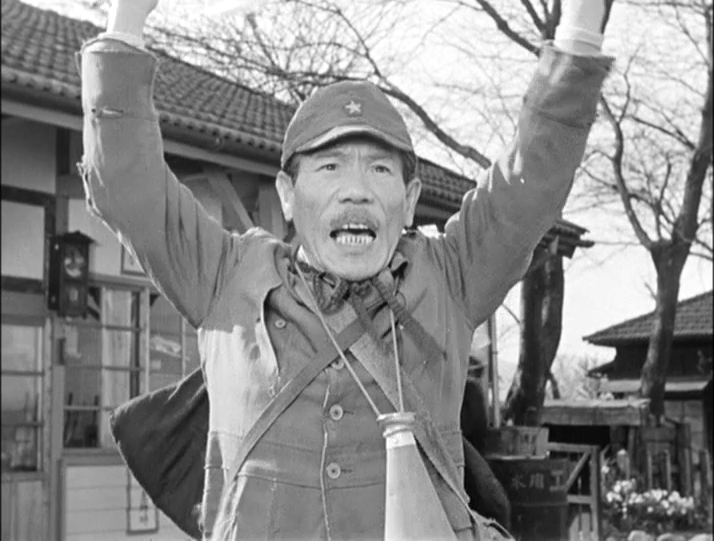
A number of familiar faces pop up in Policeman’s Diary, many of whom will be recognisable from the films of Kurosawa...

Noriko Sengoku

Bokuzen Hidari (centre)


Miki Odagiri and Yunosuke Ito (centre)

Eijiro Tono


Terumi Niki

Noriko Sengoku portrays a woman abandoned by her husband who resorts to shoplifting in order to feed her children. Bokuzen Hidari plays a poor farmer, while Yunosuke Ito is an equally poor cart-puller who has been dumped by his fiancé but finds he is loved by barmaid Miki Odagiri (the cheerful young colleague of Takashi Shimura in Ikiru). Eijiro Tono, the tavern-keeper in Yojimbo, here plays a primary school teacher who lost his mind when his children were killed during the war, which he believes is still in progress. The little girl taken in by Sergeant Yoshii is played by Terumi Niki, making her official film debut at the tender age of 6, although she had appeared briefly in Seven Samurai at the age of 3. She continued acting throughout her childhood, adolescence and adulthood, appearing most memorably as the traumatised young patient who repeatedly refuses the medicine offered by Toshiro Mifune in Redbeard.  Another notable actor making a debut here is Joe Shishido, who appears as a young policeman but is not immediately recognisable as this was prior to his bizarre cheek-expansion surgery.

Based on an untranslated 1952 novel by Einosuke Ito and adapted by Mikio Naruse’s regular collaborator, Toshiro Ide, Policeman’s Diary is well-directed by Seiji Hisamatsu (1912-1990), a prolific filmmaker who seems to be entirely unknown in the West. He directed his first film in 1934 for Shinko Kinema, with whom he remained until the war, during which Shinko was swallowed up in a merger, becoming part of Daiei.  Hisamatsu then worked at Daiei before going freelance in 1954, when he was mainly employed by Nikkatsu, Toho and Tokyo Eiga. Like many Japanese directors, he ended his career in television after film work dried up in the late ‘60s. His filmography is full of quality dramas featuring the top actors of the day, so why this is the only film accessible outside Japan of the 101 that he directed remains a mystery. Given that his 1954 picture Onna no koyomi (Women’s Calendar) was screened in competition at Cannes, he won the Japanese Art Award in 1956 and his 1961 film Chi no hate ni ikiru mono (aka The Angry Sea) was nominated for Best Film at the Mar del Plata Film Festival in Argentina, Hisamatsu was clearly no hack.

Despite all the Kurosawa regulars among the cast, Policeman’s Diary is more reminiscent of the films of Keisuke Kinoshita, partly due to its setting in a rural community. I found it to be a charming, bittersweet comic drama from a more innocent age, and it was clearly popular as Nikkatsu produced a sequel the following year.