Tuesday, 31 October 2023

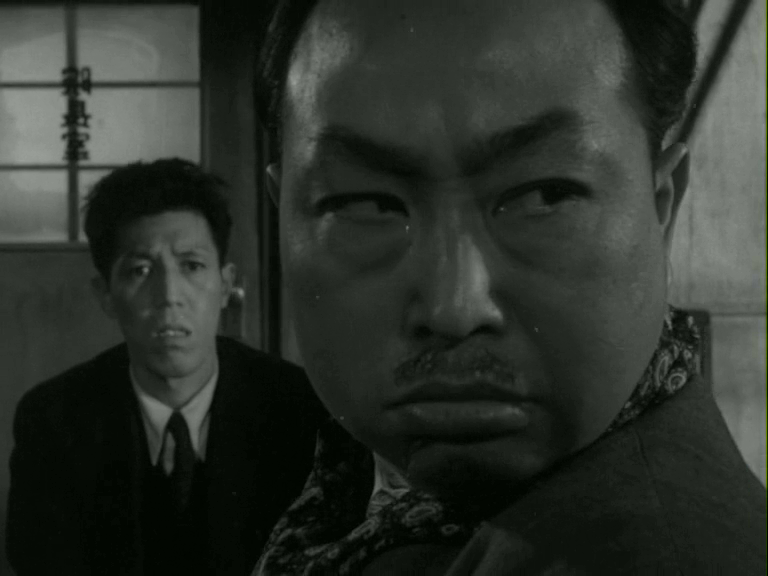
The Military Policeman and the Ghost / 憲兵と幽霊 / Kenpei to yurei (1958)

Obscure Japanese Film #84
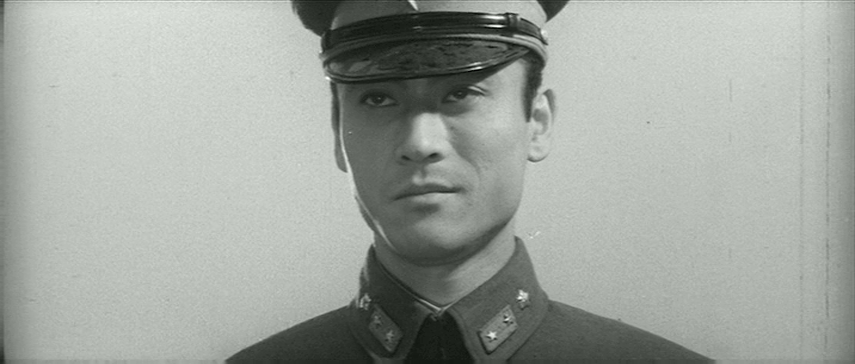
Shigeru Amachi

1941: Military policeman Lt Namishima (Shigeru Amachi) is extremely miffed when Akiko (Nahoko Kubo), the woman he fancies, marries Corporal Tazawa (Shoji Nakayama). Later, when a subordinate loses some classified documents, Namishima decides to take the old maxim of ‘all’s fair in love and war’ a little too literally and frame Tazawa in order to get his hands on his wife. Tazawa receives the death sentence as a traitor and is shot by firing squad, but not before he has placed a curse on Namishima, vowing to get revenge from beyond the grave. However, the dastardly lieutenant continues unabashed with his evil scheme – until Tazawa’s brother becomes an MP and begins investigating his brother’s death…

Shoji Nakayama and Nahoko Kubo


This Shintoho production was ordered by producer Mitsugu Okura, who assigned director Nobuo Nakagawa to come up with a new film to cash in on the (presumably modest) box office success of the previous year’s The Military Policeman and the Dismembered Beauty. Like that picture, this also features actors Shoji Nakayama and Shigeru Amachi, but here they play different characters and the story is unrelated. The earlier film had been directed by Kyotaro Namiki, who seemed not to be terribly at home in the horror genre, so the choice of Nakagawa – who had already enjoyed success with several such films – makes perfect sense. 

Shoji Nakayama contemplates the work of some over-enthusiastic gravediggers


Surprisingly, Japanese Wikipedia suggests that Nakagawa originally developed a straightforward thriller with screenwriter Yoshihiro Ishikawa and the supernatural element was added later at Okura’s insistence, and it does feel like something of an afterthought, most of the (fairly mild) spooky stuff being held back for the climax. In any case, Nakagawa’s film is much superior to the previous one. He and cinematographer Tadashi Nishimoto were able to make use of the new widescreen format and clearly went to considerable trouble in shooting scenes from unusual angles, making this an often visually arresting piece of work, even if they occasionally get a bit too carried away with tilting the camera this way and that. 

Shigeru Amachi


The film is unusual in featuring a villain as the main character, and it’s Shigeru Amachi in this role who gives the strongest performance, although he gets stiff competition from Yoko Mihara as the bad girl of the piece. It’s also fun to see Masayo Banri as a sexy nightclub dancer, but perhaps best of all is an absolutely priceless moment of (possibly unintentional) black comedy involving a corpse disposal.

Yoko Mihara

 
Masayo Banri


Monday, 23 October 2023

Pu-san / プーサン/ Mr Pu (1953)

Obscure Japanese Film #83

Yunosuke Ito with cabbage


During the war, Japanese filmmakers were severely restricted by the authorities in their country, who would not allow any content that could be perceived as being critical of the military or having a pacifist message. After the war, the country’s filmmakers remained restricted, though the nature of the censorship changed – the occupying Americans banned anything they felt promoted feudalism, while encouraging material with a pro-democracy message, such as the previously reviewed A Descendant of Urashima Taro. The occupation ended in 1952, and it’s no coincidence that Kon Ichikawa’s Pu-san appeared the following year when the film industry was finally free of political restrictions for the first time in over a decade. 

Ito with Daisuke Kato


In Pu-san, Ichikawa gleefully indulges in a vulgarity that would have been frowned upon in previous years, while also emphasizing the fact that idealism has little value in a world where people are struggling simply to get enough to eat and keep a roof over their heads. This situation enables employers to exploit workers like Noro (Yunosuke Ito), a downtrodden 39-year-old maths teacher whose boss (Daisuke Kato) gives him a stark choice: teach extra night classes with no additional pay, or leave. Noro is a classic ‘loser’ whose unassuming manner attracts bad luck – this crisis happens shortly after he has been knocked down by a truck in Ginza and injured his hand. A widower and war veteran, he lodges with a couple in their 50s and is in love with their 24-year-old daughter, Kanko (Fubuki Koshiji), but his feelings are not reciprocated, as he learns only too well after overhearing a conversation between Kanko and her mother through the paper-thin wall of his room. Meanwhile, Noro’s students are flirting with communism and his old friends are reduced to selling items on the black market… 

Fubiki Koshiji, Daisuke Kato and Yoko Sugi


Such a scenario may not seem an obvious choice for comedy, but that’s exactly what this Toho production is – and a determinedly eccentric and anarchic one to boot. Based on a comic strip by Taizo Yokoyama (who makes a cameo appearance as a policeman), it’s unclear (at least to me) why Pu-san is referred to as Noro throughout the film. In any case, Ichikawa seems to be raising two fingers to the establishment here, and it’s probably the earliest Japanese film I’ve seen to have that ‘new wave’ vibe familiar from later pictures such as Shohei Imamura’s Pigs and Battleships (1959). It’s not at all funny but certainly ironic that the only way Noro can survive in the end is by taking a highly dubious job packing machine gun bullets. 

Eiko Miyoshi, Kamatari Fujiwara and Fubiki Koshiji


Long-faced character actor Yunosuke Ito has not always played such meek and mild types, but proves to be a good choice in what was a rare leading role for him. However, I felt that Fubuki Koshiji (better known as a singer) stole the show here with her superb comic performance as the stubborn Kanko (a character originating in a separate comic strip by the same artist) – her facial expressions are often priceless. 

Kaoru Yachigusa


Also notable in a remarkable ensemble cast featuring a number of Kurosawa regulars are Keiju Kobayashi as a young policeman, a very young-looking Kaoru Yachigusa as a nurse, Isao Yamagata as a friend of Noro’s fallen on hard times, Eiko Miyoshi as Noro’s opportunistic landlady, Kamatari Fujiwara as her more understanding husband, Yoko Sugi as Kanko’s best friend and, of course, the great Daisuke Kato as Noro’s nasty boss – the kind of guy who smiles and tells you it’s all for your own good while casually cutting your throat. 

Daisuke Kato


Ably abetted by Kurosawa cameraman Asakazu Nakai, Ichikawa shows considerable invention throughout, often using extreme close-ups and unusual framing but, overall, I’d say that Pu-san is more in the nature of a fascinating oddity than a complete success – the first few scenes flit confusingly from one seemingly random group of characters to another and it remains all over the place until the end. In fact, I doubt I’ve seen another film with as many extraneous characters – a narrower focus would surely have been preferable. 

Composer Toshiro Mayuzumi in a rare screen appearance with Fubiki Koshiji


Wednesday, 18 October 2023

A Descendant of Urashima Taro / 浦島太郎の後裔 / Urashima Taro no koei (1946)

Obscure Japanese Film #82

Hideko Takamine

Taro Urashima is the mythical hero of a Japanese folk tale who rode on the back of a turtle which took him to an underwater palace where he stayed for what he thought was a few days before returning home to find that centuries had passed. The hero of this Toho production, Goro Urashima (Susumu Fujita, the star of Kurosawa’s Sanshiro Sagata films), is a former soldier newly returned to Japan after being stranded for 18 months on a south seas island. Sporting an impressive beard, he yearns for peace and democracy now that the war is over. When he is interviewed on the radio about his experiences, he tells of how the island natives would sometimes gather and let out a haunting, mournful cry which moved him deeply. He demonstrates the sound over the airwaves, after which it resonates with Japan’s workers, who begin imitating it. 

Susumu Fujita
 

Meanwhile, young reporter Akiko (Hideko Takamine) – accused of having ‘pretty face, empty head’ by her boss (Haruko Sugimura) – spots an opportunity and tracks down Urashima for an interview. Hoping to milk the story for as long as possible, she suggests that he perform his cry from the roof of the Diet building for several days, and she runs a series of articles in which she claims that he is a descendant of Taro Urashima. Goro’s wail becomes a rallying call and the workers build him up into their champion. But soon he is being unwittingly used by a fake democratic group called the Japanese Happiness Party, who actually intend to exploit the workers mercilessly once they get into power…


With its obvious pro-democracy, beware-false-prophets message, this is the sort of film that the occupying Americans strongly encouraged after the war. In fact, the story owes much to the Frank Capra movies Mr Smith Goes to Washington (1939) and Meet John Doe (1941), but here it’s all a bit po-faced. This type of material was clearly not director Mikio Naruse’s forte and it remains a real anomaly among his films – he did not repeat the error and only collaborated with screenwriter Yasutaro Yagi on one further occasion for the more enjoyable comedy Conduct Report of Professor Ishinaka (1950).


Apart from Hideko Takamine, it’s hard to find much to like about this film – Fujita seems uncomfortable in his role, while the music score is quite poor, perhaps explaining why it would be the final of just three screen credits for composer Toshio Yamada. Worse still, Goro’s cry sounds like a bad Tarzan impression and, unfortunately, it soon becomes grating and is repeated ad infinitum. 


Friday, 13 October 2023

Hi no tori / 火の鳥 / Phoenix (1956)


Obscure Japanese Film #81

Yumeji Tsukioka and Tatsuya Nakadai


This Nikkatsu production stars Yumeji Tsukioka as Emi, a half-Japanese, half-British actress who belongs to a Shingeki theatre company (i.e. one specialising in performing Japanese translations of dramas by playwrights such as Shakespeare and Chekhov). The film opens with Emi learning that her British father has passed away suddenly. Despite being shocked and saddened, she manages to pull herself together and deliver a good performance in the evening. After the show, she’s approached by two men, a producer (Toru Abe) and director (Nobuo Kaneko) who work in the film industry and want to give her a screen test, but first she must seek permission from Tajima (Shin Date), the director of the theatre company with whom she is having an affair. On her way home, she meets her ex, Sugiyama (Tatsuya Mihashi), who disapproves of her career and wants to get back together, but she brushes him off. They have a bitter argument, after which she is escorted home by Toku (Shiro Osaka), a lighting technician at the theatre who has a crush on her, although she regards him only as a friend. At home, she is visited by Tajima, who gives his approval for her screen test the following day. 

Tsukioka with Shin Date


At the studio, she encounters a young actor, Keiichi (Tatsuya Nakadai), and feels a strong attraction to him which seems to be mutual. Later, at a birthday party for one of the studio’s stars (real-life star Mie Kitahara), she dances with Keiichi. This is noticed by the producer and director, who decide they make a good couple and cast them together in a film entitled Phoenix. Emi and Keiichi soon find themselves a hot topic in the gossip columns, but when the studio holds the first test screening of Phoenix, Keiichi is mysteriously absent. It turns out that he has been arrested for his part in a demonstration against the presence of American military bases in Japan. As Emi becomes more involved with Keiichi, she begins skipping rehearsals at her theatre company and her relationship with Tajima becomes increasingly tense. To add to her troubles, she discovers that Keiichi has been two-timing her with a young actress, Kazuko (Sanae Nakahara), who belongs to the same student theatre group as himself. 


I couldn’t help finding the content of this film rather inconsequential and I wasn’t sure how I was supposed to feel about Emi or why I should particularly care. She is certainly not an entirely sympathetic character – she shirks her responsibility to the theatre and treats her older sister (Hisano Yamaoka) like a servant. But of course, it could be argued that this makes her more believable and interesting than the straightforwardly ‘good’ heroines typical at the time. 

A first edition copy of the original novel.


The film was based on a bestseller of the same name first published in 1953 and written by Sei Ito, a writer popular at the time, so that’s one reason for the film’s existence. The other is to provide a vehicle for Yumeji Tsukioka, a talented actress most likely to be familiar to viewers in the West from her roles in Hiroshima (1953) and The Eternal Breasts (1955). Tsukioka was Nikkatsu’s top female star at the time. The following year, she married the director of this picture, Umetsugu Inoue, a prolific filmmaker seemingly able to turn a deft hand to almost any given genre. He was also known as Umeji, making the couple Umeji and Yumeji. 


Today, Hi not tori is most likely to be of interest for providing Tatsuya Nakadai with his first substantial film role (it was Yumeji Tsukioka herself who suggested him for the part). Inoue gives him a fantastic entrance around 26 minutes in when Emi notices a casually confident Keiichi strolling past below her with his shirt off and looking up at her admiringly. In fact, it looks as if Nikkatsu’s intention was to introduce the 23-year-old Nakadai as a new sex symbol. However, in some of his later scenes, he’s a trifle awkward and his inexperience shows – perhaps that’s why it would be a few more films down the line before he made his true breakthrough with Black River (1957). Of course, Tsukioka and Nakadai are both playing characters rather like themselves, although it was actually Nakadai who had the Shingeki background. 


Hi no tori provides an interesting behind-the-scenes glimpse of the real Nikkatsu studios, and it’s probably those with a particular affection for Japanese films of this vintage who will appreciate this one the most, not to mention enjoy the uncredited cameos by Mie Kitahara, Frankie Sakai, Masumi Okada, Hiroyuki Nagato, Izumi Ashikawa and Rentaro Mikuni. 


NB. Nakadai later appeared in a 1978 film with the same title directed by Kon Ichikawa which has nothing whatever to do with this one. 

Watched without subtitles.


Saturday, 30 September 2023

Onna no kunsho /女の勲章 (‘A Woman’s Medal’, 1961)

Obscure Japanese Film #80

Machiko Kyo
 

This Daiei production is based on a novel by Toyoko Yamasaki (1924-2013), an author of best-selling novels which often dealt with scheming, corruption and scandal in various industries and were based on interviews with insiders. Many of these were turned into successful films, such as The Great White Tower (the medical industry), A Splendid Family (the banking industry) and Barren Zone (the aviation industry). She became the subject of scandal herself for a while when she faced several accusations of plagiarism, but ultimately these failed to do any serious damage to her career. However, Yamasaki was more popular with readers than critics, most of whom saw little of literary merit in her work. Onna no kunsho, published the year of the film’s release, was the first example of what became the familiar Yamasaki formula and is set in the world of the fashion industry. 


Jiro Tamiya

Machiko Kyo stars as Shikiko, a talented fashion designer in Osaka* who forms an alliance with an ambitious business manager, Ginshiro (Jiro Tamiya). Unfortunately, behind the fake concern for her welfare, Ginshiro is an unscrupulous character who seeks only to exploit her for his own ends. After seducing Shikiko, he talks her into signing off on a lot of dodgy deals, then proceeds to work his way through her senior designers, Rinko (Ayako Wakao), Katsumi (Junko Kano) and Tomie (Tamao Nakamura), seducing each in turn and using them to expand the company and consolidate his own position. 


Ayako Wakao

Junko Kano and Tamao Nakamura


Although Tamiya later played a similarly ruthless character in the 1966 film of Yamasaki’s The Great White Tower – which became his signature role – Ginshiro is an unusual part for him in that he talks a lot and is not at all moody, being almost entirely unfazed by whatever difficult situation may occur. Tamiya handles this well and holds his own among a cast dominated by formidable female stars. Most of the female characters here turn out to be just as duplicitous as Ginshiro, and when somebody finally shows some moral backbone, it’s in the unlikely form of a journalist (the excellent Eiji Funakoshi). Journalists are seldom depicted as the most ethical of people, so the fact that Yamasaki was a former journalist herself might not be entirely coincidental. 


Eiji Funakoshi

Kaneto Shindo’s screenplay results in a very talky film with largely unsympathetic characters I found it difficult to care about very much, making it a stark contrast to the last film I reviewed here, A Night to Remember, also starring Ayako Wakao and Jiro Tamiya and directed by Kozaburo Yoshimura. I had the distinct impression that Yoshimura was less invested in this film as the direction is competent but seldom notable. However, Onna no kunsho does have a highly effective ending and was presumably successful at the box office as it has been remade for television three times since.  


*Shikiko is said to have been based on real-life Osakan fashion designer Yasuko Ueda (1906-96). 


Wednesday, 27 September 2023

A Night to Remember / その夜は忘れない / Sono yoru wa wasurenai (1962)

Obscure Japanese Film #79

Jiro Tamiya and Ayako Wakao


This Daiei production stars Jiro Tamiya as Kyosuke, a Tokyo journalist who is also something of a playboy. He’s sent on assignment to Hiroshima to cover the memorial ceremony for the 17th anniversary of the dropping of the bomb. He begins by visiting the museum, where he’s disturbed by the grisly artefacts on display and seems to hear the voices of the dead whispering to him. He also interviews some A-bomb survivors; one, a young woman with a disfigured face, is disconcertingly cheerful and has long accepted her condition, but Kyosuke nevertheless feels uncomfortable in her presence and has trouble looking her in the face. In fact, he’s so affected by what he sees and hears that, when a carefree young Japanese couple speed past him on a motorbike, he finds himself glaring at them resentfully.


Hoping to take his mind off the bomb, Kyosuke meets up with an old friend, Kikuta (Keizo Kawasaki), who takes him to a bar, where he is introduced to the manageress, Akiko (Ayako Wakao). Kyosuke and Akiko are attracted to each other, but she seems uncommonly keen to avoid the topic of the bomb…


Kozaburo Yoshimura (1911-2000) was a highly respected director of serious dramas and literary adaptations (his 1951 version of The Tale of Genji is especially good). Here, he’s working from an original screenplay by Yoko Mizuki, Kosei Shirai and Tokuhei Wakao (no relation to Ayako as far as I’m aware). One of the film’s strengths is that it’s mostly shot on location, and veteran cinematographer Joji Ohara makes it look great. The fact that Yoshimura used several real-life A-bomb survivors in the cast also lends authenticity. 


What really carries the film, however, is the performances of the two leads. In my view, among male Japanese film stars of the ‘60s, Jiro Tamiya was one of the best actors, and he puts across the conflicted feelings of Kyosuke very well here. Ayako Wakao has less screen time despite being top-billed, and first appears 24 minutes in; of course, when she finally arrives, she delivers her usual flawless performance. 


The film, on the other hand, does have its flaws – Ikuma Dan’s music is often intrusive and unsubtle, while the story relies far too much on coincidence (Kyosuke has chance meetings with people that he knows on no less than three occasions!). However, the sensitive acting of Tamiya and Wakao makes this a genuinely moving experience.